Home > Producer Profiles > Loire Profiles > Chateau de la Roulerie

Chateau de la Roulerie

There are very few vinous stories in the Loire that originate in Bordeaux. Some touch on that region of course; it is easy to forget, as an example, that ultra-natural winemaker Marc Angeli dallied at La Tour Blanche before moving to take up residence at La Ferme de la Sansonnière in Thouarcé. It is perhaps not so easy to overlook Philippe Alliet's love affair with the vines and wines of Aquitaine; his frequent visits to the region provide an obvious source of inspiration for him, clearly apparent when tasting his wines. Accepting these notable cases, there are few stories that truly begin in Bordeaux, fewer still that are rooted there for a century before the Loire comes into play. And those stories that straddle the two regions, with domaines situated in both, must be very rare. But the Germain family, currently in charge of two leading Loire domaines, certainly do begin their story in Bordeaux. And what is more, not only were they Bordeaux vignerons for many decades before they branched out in the Loire, they still have a firm foothold in Bordeaux today.

The Germain Family

The Germain progenitor appears to be Vincent Saincrit, the blood line running through to the modern day Germains through the women of the family, hence the change in name. Originally a rural miller living not too far from Bordeaux, it was Saincrit who moved into viticulture and wine, and through his activities and those of his descendents the family's portfolio of properties grew. Even today, although the latest generations have now settled in the Loire Valley, they continue to exploit five estates located around the old Blaye and Bourg appellations, now collectively known as the Côtes de Bordeaux of course.

Chateau de la RoulerieIt was Vincent's great-great-grandson Thierry Germain who made the move away from the Gironde and up to the Loire, taking possession of Domaine des Roches Neuves in Saumur in 1991. Shortly afterwards he was followed by his father, Vincent's great grandson, Bernard Germain. Although in Bernard's case it might be more appropriate to say he came up to the Layon, as of all the estates that he purchased Bernard Germain was perhaps best known for his tenure of Chateau de Fesles, which lies very close to Thouarcé overlooking the Layon as it courses down towards the Loire. He acquired this fine property from pastry chef Gaston Lenôtre, in what seems for all the world like a bulk deal which also saw him take possession of Chateau de Varennes in Savennières as well as Chateau de la Guimonière and Chateau de la Roulerie, both domaines firmly within the Anjou-Layon appellations. Although Bernard's possession of Fesles was relatively short-lived in the grand scheme of things, presumed financial difficulties resulting in its sale to the négociant group Grands Chais de France in 2008, the rest of the family seem to be having more success at their respective domaines. Whilst Thierry remains firmly ensconced at Roches Neuves very near to Saumur, Bernard's other son Philippe (above, at the foot of La Roulerie's terraced vineyards) and his family seem to be settling in very nicely at Chateau de la Roulerie.

Chateau de la Roulerie

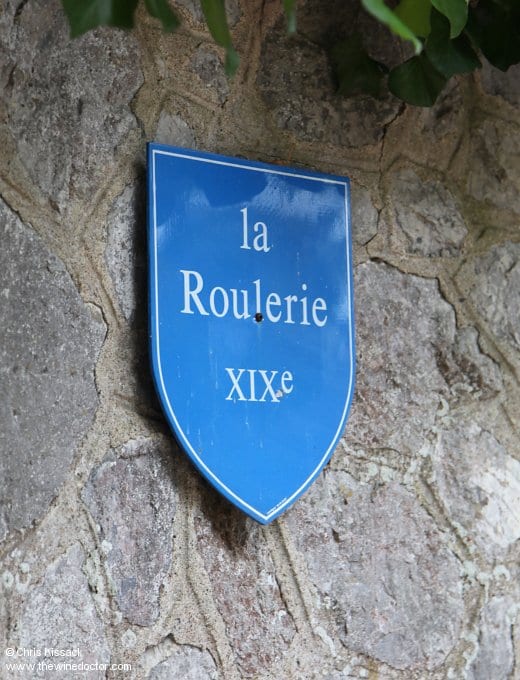
Chateau de la RoulerieTaking a walk around Chateau de la Roulerie, through the buildings and up to the vineyards, I soon began to sense that this was an ancient domaine. Roulerie feels old. It is not just the terraced vineyards (shown here on the left), the existence of which are remarkable enough in the Loire Valley, but which also call to mind the ancient terraces of the Douro, adding to the suggestion that the domaine is of a good age. It is more what lies around the domaine. Perhaps I should not be surprised at this sensation; after all, the origins of the estate can be traced as far back as 1070. The trees here are tall and knotty and have clearly seen many years, and the ground was strewn with damp, fallen, windblown leaves. Alongside the property a little brook bubbled gently along, carrying away these dark little tokens of decay. It seemed to me as though I had walked momentarily into a Medieval landscape in La France Profonde, and although the domaine is in fact located just on the outskirts of St-Aubin de Luigné, I felt as though I was in an isolated wilderness. I suspect the biting cold of early February may have enhanced that feeling! But the moment and the associated sensation soon pass, for around the front of the property we see the frontage of the rather functional-looking chateau, all brick and stone, and a few gently manicured shrubs. And inside the approach is certainly not Medieval, rather it is modern, dynamic and forward thrusting. For that is the nature of La Roulerie's 21st-century patron, Philippe Germain.

Philippe has been living at Chateau de la Roulerie since 2001, but it is only more recently that he has stamped his authority on the domaine. Indeed until recently all the wine was made at Fesles with Bernard overseeing the operation, and with the help of brother Thierry. In 2004 Philippe took full control, and with him firmly in place operations moved to Roulerie in 2008. Remarkably, this was the return of winemaking to the domaine after a 20 year hiatus, wine having last been made here only before the property was sold by previous owner Jadeau to the chef Lenôtre. Under Philippe's direction the style of wine is set to change somewhat; indeed, from what I witnessed during my visit to the domaine in early 2010, change is already well underway, both in vineyard and cave.

Vineyards

Chateau de la RoulerieWine begins in the vineyard, and so does Philippe's programme of developments at La Roulerie. There has been a dramatic expansion, Philippe having purchased part of the nearby Domaine de la Grande Brosse. He has acquired 8.5 hectares of the domaine, and will be renting the remaining 9.5 hectares en fermage (in which Philippe will tend the vines and bring the wine to market, paying the owner of the land a fixed rent per annum over a long contract, usually ten years or longer), and so the Roulerie domaine now amounts to 42 hectares in total. The new vineyards include Gamay and Grolleau and will facilitate the production of a greater volume of rosé, not the domaine's greatest wine but one which is of a certain commercial importance to Philippe (right, in the cave). They also come with some useful buildings.

These new vineyards add to some notable sites, the most remarkable of which is undoubtedly Les Terrasses. Directly adjacent to the property, running alongside that bubbling brook from northwest to southeast, before turning the corner and running to the northeast, these vines are rooted along wide terraces and yield some of the highest-quality fruit to be found at La Roulerie. These vines are the obvious source for the first of three cuvées of Chenin Blanc made here, Les Terrasses, the next two cuvées being La Grande Brosse and the Roulerie domaine wine. Altogether these three wines are sourced from 19 different plots around the domaine, vineyards which are currently in conversion to organic methods which Philippe says has improved the quality of the vegetation considerably. It is too soon to tell regarding fruit quality, it seems. As indicated above, however, there are also plots of Gamay and Grolleau, very suitable for rosé as well as Cabernet Franc for red, and some of the Chenin is used for the production of Coteaux du Layon.

Vinification & Wines

Philippe Germain doesn't believe in high alcohol for Chenin Blanc, thinking 12.5-13% works best. Manual harvest, picking in tries, facilitates the management of ripeness and alcohol in the various wines, as well as allowing for some fruit to be directed into sweeter Layon cuvées rather than dry Anjou. Until recently there have been up to 40 aliquots of Chenin Blanc for the white Anjou and Layon wines in good vintages, perhaps as few as 27 in less bountiful vintages. The wines are - until recently at least - fermented en barrique, the barrels generally 2-4 years old, before élevage over 9 months for Les Terrasses, shorter for the domaine wine, with bâtonnage, before bottling. Philippe is moving away from barriques, however, and increasingly Roulerie whites will be fermented in stainless steel or large wooden vats, without malolactic fermentation which he does not favour. This reflects Philippe's philosophy, stating that he "doesn't use oak for the oak"; he is not looking to mark the wine with the aromas or flavours of wood, as he believes top quality Chenin Blanc simply doesn't need or benefit from the treatment. With this in mind in 2010 he will complete the move from 400-litre oak barrels to larger vessels. As to those who insist in using barriques for Chenin Blanc, Philippe says they are making "a big mistake". His belief in this is firmly held and unwavering, it seems.

Chateau de la RoulerieAs for red there is only one cuvée brought to market, that being a 100% Cabernet Franc Anjou Rouge, although Philippe does have another cuvée which he assembles for a big-buying private client. The wine is fermented in stainless steel, regulated to 30-33ºC with up to a two-week maceration. After 3-4 months resting on the lees the wine is bottled and then released to the market six months later. Being pure Cabernet Franc it naturally has a pure and lifted, rather perfumed style which is pretty and appealing, although when tasting samples of the 2009, from cuve, including press wines, I was more impressed by the silkiness of the tannins and the depth of fruit, both appropriate reflections of the vintage I think.

Finally, after the dry whites and red, naturally our attention should turn to the sweet wines, in the case of La Roulerie a straight Coteaux du Layon as well as a Chaume. Here is where Philippe's winemaking hand is most evident, the wines clearly being fashioned into a lighter and more citric style than many other cuvées from these appellations. The difference is notable at the Chaume level, where it is only natural for us to look for greater depth and complexity, but even with the entry-level Coteaux du Layon the wine is plainly forging its own path away from that followed by most within the appellation. This is largely managed, I believe, by harvest time and selection, as Philippe aims for a style not over-ripe, fresh, not over-burdened with sugar and not short of acidity. I must confess it is not a style that suits my palate, although others looking for a lighter but still sweet cuvée to match with certain foods may find what they want here. To my palate, the true strengths of Chateau de la Roulerie here are the white cuvées, especially Les Terrasses, although the 2009 reds I tasted from vat also showed some promise. It will be fascinating to see how the domaine develops now that Philippe is firmly in control. (18/5/10)

Contact details:
Address: 49190 St-Aubin de Luigné
Telephone: +33 (0) 2 41 68 94 00
Fax: +33 (0) 2 41 69 94 01
Internet: www.vgas.com

Chateau de la Roulerie - Tasting Notes

Click to locate stockists.

2009

The notes below are on representative barrel samples tasted at the 2010 Salon des Vins de Loire. I have scored them using a range as appropriate. Further down the page are tasting notes from numerous blending components tasted at the domaine.

Chateau de la Roulerie Anjou 2009: This barrel sample has a pale hue, with the aromas of yellow-green fruit. Attractively textured, with a minerally-papery young Chenin character tinged with yellow plum. There is some nice substance here, although it has a very clean style, and sits towards the leaner end of the spectrum. 14-15+/20 (February 2010)

Chateau de la Roulerie Anjou Les Terrasses 2009: This is a cask sample taken from old oak, which is due to be bottled July 2010. A fresh and lean style on the nose. Nicely composed on the palate, linear and vivacious with a fine-boned acid structure. But there is a lot of substance underneath it all, as well as a mineral seam. It offers some greater promise on the finish, where it opens out into a vibrant fruit-rich style. Very good potential here I think. 15.5-16.5+/20 (February 2010)

Chateau de la Roulerie Coteaux du Layon 2009: The Roulerie style in the sweeter cuvées tends towards the light and fresh and this wine certainly shows that. Still a little cloudy but a very good colour, with notes of honey and beeswax on the nose, together with a lighter, floral lift. Light citrus fruit flavours on the palate add to an overall feel which is light, fresh and forward. 15.5-16.5+/20 (February 2010)

Chateau de la Roulerie Chaume 2009: On the nose this wine, which was bottled in November 2009 after 1 year in oak, is less expressive than the Coteaux du Layon. The palate shows some finely presented fresh acidity, alongside a light and sweet texture. Floral, fruit-rich, still very primary in character, rather light in terms of substance. Attractive. 15.5-16.5+/20 (February 2010)

Chateau de la Roulerie Anjou Cabernet Franc 2009: This is a special limited bottling run of just 6000 bottles for a private customer; the Anjou Cabernet Franc you find on the shelves will be the one below. This is fermented in cement vat only, and has chalky red fruits on the nose, nicely perfumed, although with a slightly warm and sweet character. A midweight to light fruit style, grippy with rather terse acidity, this is certainly a very fresh style in keeping with Philippe Germain's philosophies. 13.5-14.5+/20 (February 2010)

Chateau de la Roulerie Anjou Cabernet Franc 2009: To be bottled in June 2010. Warm fruit on the nose here, a touch smoky. Dark fruits, sweet and textured, with good grip. Lots of structure and acidity here, a supple character underpinned by some sooty tannins. I find this much more appealing than the first private customer's cuvée. 14.5-15.5+/20 (February 2010)

The following notes relate to a fascinating tasting of wines from different plots which will eventually be blended into the three established white cuvées. Although I have made comments as these are not to be marketed as individual wines I have refrained from scoring, and I have not linked through to Wine-Searcher.

Chateau de la Roulerie Anjou La Petite Roulerie 2009: From this plot, the largest section of the Roulerie vineyard which lies opposite the chateau, comes Chenin Blanc picked on October 3rd then put into five-year-old barrels on October 4th for fermentation en barrique. Honeyed oak on the nose, an expressive and rich style. The same character on the palate, fine and crisp, no malolactic here. Full, vibrant, with white stone fruit. Great structure. No score (see above). (February 2010)

Chateau de la Roulerie Anjou Clos de L'Elu 2009: This is a 0.6-hectare plot of Chenin Blanc (there is some Cabernet Franc here too) once used for Coteau du Layon but Philippe Germain has been channelling the fruit into the dry Anjou wines for several years. The quality is always high - this isn't used for the domaine wine. Residual sugar less than 4 g/l. On the nose this is more floral, honeyed and gritty, fresh and vibrant with citrus fruits, grapefruit and lemon. Overall the palate is more vibrant that that of La Petite Roulerie with good acids, giving a style more full and punchy rather than fat, and a lovely sappy finish. No score (see above). (February 2010)

Chateau de la Roulerie Anjou Les Terrasses Barrel #1 2009: Les Terrasses is the most significant site here, a large terraced vineyard (hence the name) with a number of different aspects. This sample was picked from the main part of the vineyard (southwest-facing), with a yield of 22 hl/ha. The nose has lovely beeswax and honeysuckle character, together quite delightful, and there is also a hint of sulphur still which should subside given time. The palate is fine, supple, defined, floral and bright, with excellent structure. A favourite of Philippe Germain and I am can see why. Lovely wine. No score (see above). (February 2010)

Chateau de la Roulerie Anjou Les Terrasses Barrel #2 2009: This was picked from a cooler, lower part of the vineyard (which turns to run more northwards at the eastern end), one day after barrel #1. A very powerful and direct nose here, citrus and honeysuckle, fresh and intense. Great direction and wonderful acidity here, a deeply structured wine but fresh with acidity and flower petal aromas. Lovely finish. No score (see above). (February 2010)

Chateau de la Roulerie Anjou Les Terrasses Barrel #3 2009: This was picked the same day and barrel #2. This is also vibrant on the nose but has a more creamy feel to it. And on the palate there is a lot more flesh, giving a rich and creamy feel, although backed up by fabulous acidity. It only has 5 g/l of residual sugar, so this isn't simply a sugar effect. A very stylish wine which has a great combination of fleshy substance and stony backbone. Fine. No score (see above). (February 2010)

And some red components:

Chateau de la Roulerie Anjou Cabernet Franc 2009: From a lieu-dit named Les Mérances with schistous-carboniferous soils. A glossy wine, with fine and dense fruit here, rich and meaty and quite delicious. Pure, deep, clean, tannic but ripe. Fresh, with a great storm of pure black fruits. This has lovely potential. We could see some very fine reds from this vintage if this is typical. No score (see above). (February 2010)

Chateau de la Roulerie Anjou Vin de Presse 2009: The press wine, mostly Cabernet Franc but incorporating 20% Cabernet Sauvignon. An amazing colour here, dense black, with concentrated fruit on the nose even though it was rather reticent, unsurprising in freezing cold of the cellar. On the palate it is powerful, with lovely clean fruit, naturally very rich in extract, but also very creamy and accessible. The soft and velvety quality of the tannins is exceptional - I have had finished wines harder than this! This must be an exceptional vintage. No score (see above). (February 2010)

And some nascent aliquots of Coteaux du Layon:

Chateau de la Roulerie Coteaux du Layon Barrel #1 2009: This wine started off with 16% potential, ending up with 12.5% alcohol and somewhere between 52 and 55 g/l residual sugar. The nose is quite beautiful, reminiscent of white flowers, pure and vibrant and bright. On the palate it has a very fresh style, bright and full of acid, elegant rather than rich in terms of substance and flavour or indeed botrytis. Attractive but stylistically idiosyncratic within the appellation I feel. No score (see above). (February 2010)

Chateau de la Roulerie Coteaux du Layon Barrel #2 2009: This is a sample of the première trie, picked with a natural potential of 19%. Honey and pear on the nose here, delightful aromas very typical of young Chenin Blanc. The palate certainly blows barrel #1 out of the water, a richer style with more sugar and yet also more vibrant, with a beautiful purity, fresh with the scents of sweetpeas and a lovely, sappy finish. No score (see above). (February 2010)

Chateau de la Roulerie Chaume 2009: This is another première trie sample brought in at 21% natural potential, the first of three pickings, the total yield being somewhere between 30-35 hl/ha. Picked in the first week of October. The nose is vibrant with pure fruit. Fleshy on the palate, a great style, fresh with lovely ripe citrus fruits. Good richness here cut through by fine acidity. Delicious potential. No score (see above). (February 2010)

2005

Chateau de la Roulerie Coteaux du Layon Chaume 2005: A pale but yellow-golden wine. The nose is all candied fruits, especially sweet and dried pineapple, canned pears and sweet syrup. The palate is fresh, light and delicate, undeniably sweet, nicely balanced although simple in terms of flavour, and not in possession of the greatest depth or substance you will find in this appellation. There are notes of pear, apple-mint and a hint of white pepper, though, which certainly provide some interest. This makes for good and unfussy drinking, and is very good value. From my 2008 Loire wine tasting notes. 16/20 (July 2008)

2003

Chateau de la Roulerie Chaume Premier Cru des Coteaux du Layon 2003: This has a nose of gentle honey, with a lightly mineral edge. It is certainly fresh and lifted, on the palate it shows a harmonious style with a certain creaminess at the core. Not a rich style though, despite that characteristic, even in this hot vintage. There are some appealing notes of quartz, beeswax and minerals in the finish which I like, as well as a little length. Good. 16+/20 (February 2010)

1996

Chateau de la Roulerie Coteaux du Layon Chaume 1996: A moderately rich, at best, golden hue. But certainly an attractive nose, with its intermingling notes of crushed rocks, citrus fruit and lime leaves. A nice style on the palate, too, which has a rounded, gently creamy texture, perhaps lacking a little in impact to be truly great, but certainly holding its own. Full, slightly, bitter, smoky character provides a little grip, although there is fair acidity too, albeit a little subtle in style. Long and rather sharp finish. Nicely balanced overall, but lacks the concentration and thrust of flavour I would expect of what is, after the Quarts, the Layon's greatest appellation. From a 1996 vintage ten years on tasting. 16.5+/20 (December 2006)