Home > Producer Profiles > Bordeaux Profiles > Chateau Meyney
Chateau Meyney
The history of Chateau Meyney dates back to at least the 17th Century (although it is almost certainly much older), and was originally the site of a convent entitled the Prieuré des Couleys, occasionally also referred to as the Couvent des Feuillants. Indeed, this ecclesiastical origin still has some influence today, as a number of writers still refer to the estate as Prieuré de Meyney. Traces of the early buildings, from the time this was a religious settlement, still exist at the estate today. With the Revolution in the ensuing century, in which the church lost out just as much as the nobility, the estate was seized as a bien national and thus entered private ownership. There was not much in the way of active viticulture, although the site undoubtedly had potential. This was recognised by Désiré Cordier, who purchased the estate in 1917.

For much of the 20th Century the estate was part of the Cordier portfolio, quietly turning out good value wines, many of which were of remarkably high quality. No doubt this was in part due to the skill of Georges Pauli, better known for his sterling work at Gruaud-Larose, another Cordier property, who from 1978 oversaw the activity in the chai at Meyney. This was very much an insider's estate, not a great or well known name, yet the wines were actively sought out by those in the know, and I recall the 1989 was a classic example of what the vineyards here were capable of. As such the estate eventually came under the umbrella of Cordier-Mestrezat when the two négociants amalgamated. Here it formed part of a small portfolio of top estates also including Grand-Puy-Ducasse and Rayne-Vigneau. Over the years there have been many interested parties, most recently including the Vignerons de Val d'Orbieu, a leading Languedoc co-operative, who held a significant share in the business. In 2004 the Mediterranean investors sold out, and Cordier-Mestrezat saw some fresh and seemingly much needed investment from the French bank Crédit Agricole. This famous French financial institution acquired more than 400 hectares of vineyards, including Meyney, in exchange for 95 million Euros, leaving Cordier-Mestrezat one of the few debt-free businesses in Bordeaux. Today Meyney is thus under the ownership of Crédit Agricole Grands Crus, alongside Ducasse, Rayne-Vigneau and a handful of Cru Bourgeois estates also acquired by the French bank.
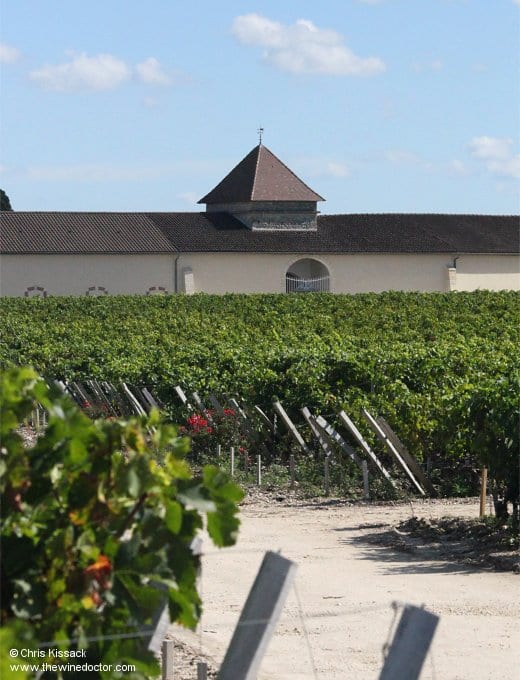
The Meyney vineyard is in a single plot, covering an impressive 51 hectares
of the St-Estèphe
appellation, adjoining those of near neighbours Montrose and
Phélan-Ségur. It enjoys an
attractive position on gravel ridges overlooking the Gironde, beneath which is a
mix of iron-rich blue clay and sand, over calcareous bedrock from a depth of
about two metres. It is planted with 56% Cabernet Sauvignon, 26% Merlot, 9%
Petit Verdot and 9% Cabernet Franc, although there has been a replanting scheme
ongoing in recent years, replacing the oldest vines, aimed at reducing the
percentage of Cabernet Franc. They have an average age of about 35 years
although this may fall a little with the ongoing planting, with a density of up
to 7500 vines/ha. Once intensively fertilised, this is no longer the case, the
soil left unnourished and merely ploughed each quarter to aerate it,
although some lesser sections are interplanted with grass and are thus left
untouched. The estate is moving towards a system of minimum intervention
viticulture. The fruit is harvested by hand, with a selection in the vineyard,
followed by a sorting table at entry to the chai, then destemmed before a
cold maceration for up to six days, at a temperature of around 10ºC.
The fermentation is in glass-lined cement vats with temperature control, rising
to 32ºC, using cultured yeasts, with pumping
over to submerge the cap. Subsequently the wine will go into oak, although there
are also stainless steel vats to hand for storage and blending as required. The
oak is 70-90% new each vintage for the grand vin, Chateau Meyney
(24000 cases per annum) and 10% new oak for the second wine, Prieur de Meyney
(6000 cases per annum). The wine undergoes malolactic fermentation in barrel, is
racked every three months, and after fourteen will be fined and then bottled.
Over the years the wines of Chateau Meyney have given me (and many others) much pleasure, with vintages such as the aforementioned 1989 firmly rooted in many a tasting memory. But Meyney is no one-hit wonder, and although the wines have been criticised in recent years for not matching earlier successes, they remain very good and at the right price should still be considered. The 2003 in particular has, despite its rather low acidity, a lovely freshness and appeal which is atypical for the vintage, and is very welcome. (15/5/07)
Contact details:
Address: 33180 St-Estèphe
Telephone: +33 (0) 5 56 95 53 00
Fax +33 (0) 5 56 95 53 01
Chateau Meyney - Tasting Notes
Chateau Meyney (St Estèphe) 2005: A very unusual nose here today, with a sensation
of stretched-out beef stock and some dirty gravel, rather withdrawn overall, and
just closed down at the moment? Quite some substance and structure on the
palate, cleaner fruit here, very hard in terms of substance and style though.
Nevertheless it has appeal, more than the nose would suggest; everything is in
good balance, with firm tannins and crisp acidity underneath the hard and
polished structure. If the aromatic profile develops in a favourable fashion
this could be very good indeed. From a
2005 Bordeaux tasting
at four years of age. 17+?/20 (November 2009)
![]()
Chateau Meyney (St Estèphe) 2004: A dense, interesting nose, with rich fruit, with lots of blueberry, bramble and
blackberry character, backed up by polished oak. Soft and broad, a rounded
palate, with spicy tannins at the core. Lots of structure here in fact, but it
is ripe, with nice acidity, and a bright and fresh character to the fruit. A
touch raw though, and a short finish. Good. From a
2004 Bordeaux tasting
at four years of age. 15.5+/20 (November 2008)
![]()
Chateau Meyney (St Estèphe) 2004: A deep colour, rather dark and
concentrated. Dark, nutty fruits on the nose. Rather glossy, obvious structure,
lots of appealing texture too but does seem a touch hot too. Slightly attenuated
perhaps. There is a pile of grip. It seems somewhat over-worked. It has promise
though. 15-16+/20 (February 2007)
![]()
Chateau Meyney (St Estèphe) 2003: A deep, rich colour. On the nose this wine offers a fine array of perfume, with a melange of cassis, graphite, smoke
and coffee, this is a very expressive and attractive bouquet. The palate follows
through, with a remarkable well-knit backbone of tannins, rather than the huge and
obtrusive wall experienced with many wines of 2003. They have a lovely ripe, velvety
feel. The wine has a fine,
plump, presence, with rather low acidity, but with good but with grip and backbone.
This gives lots of pleasure now, but is not really for the long haul as it
doesn't possess the structure which I would like to see in a wine destined for the cellar, but it is lovely now and
should remain so over the next few years I think. For label images and more see my
Wine of the Week write-up. 17/20 (January 2007)
![]()
Chateau Meyney (St Estèphe) 2002: Quite a stylish nose here, a little
woody, although with appealing deep fruit. Nicely textured, well rounded, but
with some grip beneath. Good weight and presence of fruit through, nicely
structured. Attractive cherry and black fruit character, altogether really
rather good for the vintage. 16.5+/20 (February 2007)
![]()
Chateau Meyney (St Estèphe) 1989: Quite a dark, mahogany-red colour in
the glass for this wine, and so plainly more mature - in appearance at least -
than the Chasse-Spleen. The nose is rather muted at first, without the early
bright perfume of the preceding wine, but it soon gets going with a fine,
mature, meaty nose, very much a robustly ageing claret. This is nuanced with
elements of tea leaves, sweet decay, undergrowth and a soft, green, vegetal
note. It might not sound very appealing, but the aromas are really quite
captivating. The palate is where it has the edge though, as although it might
not have the delicate finesse of some other wines it has a nicely polished,
ample texture, soft and gently plump from start to finish. It shows perhaps a
little less drily than my previous bottle. There is a more rustic side to the
finish, where there is a little wave of stout tannin which rolls out on the
palate, with a little peppery spice too, but this is certainly nothing to
complain about. Very good wine. From a
1989 vintage twenty years on tasting. 17.5/20 (November 2009)
![]()
Chateau Meyney (St Estèphe) 1989: The cork is long and of high quality, with red staining
reaching up the side, in finger-like streaks, less than halfway. On inspection
it has a very mature, claretty, deep oxblood hue when poured into the
decanter, and there is very little sediment left. The nose is quite classic, with
aromas of iron and rust, tea leaves and charred beef, with a high-toned
liquorice note at the edge. Fresh, with good bright acidity, sappy texture and
moderate weight, this is a delight on the palate also. It still shows a seam of
tannin, and a very dry composition, and overall this works very well together;
it has a pleasing, old school composition that I like very much. Approachable
now, although it has the substance to go a little further in the cellar yet,
that is for sure. Lovely lingering finish too. For label images and more see my
Wine of the Week write-up. 17.5/20 (September 2008)
![]()