Home > Vintages and Regions > Bordeaux > Cheval-Blanc and Yquem with Pierre Lurton
Cheval-Blanc and Yquem with Pierre Lurton
There are four essential items for a successful combined tasting of Cheval-Blanc and Yquem. First, a suitable venue, and secondly - perhaps rather obviously - the wines. Thirdly the presence of Pierre Lurton makes the evening that touch more special. Lastly, a torch.
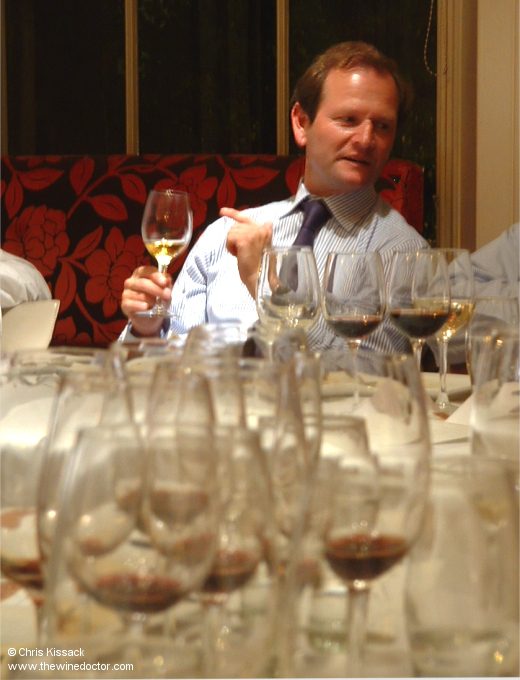
There was just such a tasting in Edinburgh only last week. Pierre Lurton was in town, showcasing a fantastic array of wines in association with Bibendum, and I was honoured to be in attendance. The venue was Home House (tel. 0131 523 1523), an attractive town house near the top of Leith Walk in Edinburgh which has for many years been run as a private club. Under new management for a little over a year now, it has seen extensive refurbishment and redecoration and it was the perfect venue for a function such as this. The guest of honour was naturally Pierre Lurton, who was travelling with some colleagues from Bordeaux including Georges Haushalter, directeur général of Compagnie Médocaine des Grands Crus, a significant Bordeaux négociant. Haushalter, who was seated on my right during dinner, explained that they were on something of a grand tour, having just travelled up from a similar tasting with Bibendum in London the previous day and with another planned for Reykjavik on the next.
A welcome aperitif was found in the shape of Ruinart's non-vintage Blanc de Blancs, which I found to be really very impressive, certainly way beyond my expectations. I think sometimes my opinion of wines such as this are perhaps unfairly coloured by my experience of them at the annual Champagne tasting arranged by the CIVC, when the wines shown are usually very youthful, have not long been disgorged and are often swamped with sulphur. These bottles, however, gave a lot of pleasure the wine being complete, creamy and certainly endowed with plenty of clean, aromatic fruit.
Dinner began with a tomato consommé with basil caviar and pepper confetti
followed by vanilla-poached lobster with quinoa salad and lemon yoghurt, and
here we tasted the 2005 Ygrec. Pierre stressed that this was not Yquem's second
wine, although I doubt there were many people in the room who were under that
allusion. It is, of course, Yquem's dry wine, and from a great vintage such as
2005 you might expect to find a wine of extremely high quality. My issue with
many white wines from this vintage, however, is that the acidity is often low,
and this is true of Ygrec as it is with many other wines. Nevertheless, the wine
possessed much structure and grip, and it certainly had a forceful aroma that
leapt out of the glass; I enjoyed it very much. Then came veal and braised Angus
beef, followed by a roulade of duck with a sticky morel sauce, and with these
two dishes we tasted and drank the four red wines. Here Petit Cheval, Cheval-Blanc's second wine which was created with the 1988 vintage, showed its position
clearly, as although a very good wine it had nothing of the presence of the
three grands vins. Of these three wines it was without doubt the 1989 that stole the show,
being pure and fresh and characterful, but it may be that one day the 2004 will
match it; on the night it showed more structure than any other character, being
youthful and rather closed down to start with at least, but I feel it has plenty
of potential. The 1996 surprised me with its quality; this vintage was hugely
successful for the left bank, but the estates of St Emilion and Pomerol fared
less well. But how much of this is due to the climate favouring the left bank
appellations, and how much is due to the vintage generally favouring the
Cabernets over Merlot? Cheval-Blanc is, of course, dominated by Cabernet Franc,
and perhaps this fact goes some way to explaining the appeal of this wine.
With cheeses, including a delicious Jacques Carles Roquefort, Lanark White and Criffel, followed by a lime parfait and a salted butter ice cream, we enjoyed - and this is most certainly the correct language to use - two vintages of Yquem, the 1997 followed by the 1988. As you might expect these were both fabulous, and the main distinguishing feature was the maturity; the absolute quality was very similar, and as far as scoring is concerned I couldn't drive a wedge between them. Both vintages have a reputation as being very successful for the appellation as a whole, and although I think one or two commentators have suggested that 1997 Yquem is not quite the quality you would expect for such a great vintage, on this occasion it was showing in a delightful fashion. With the passing of time I suspect we shall see this for the high quality wine it is.
All the wines were double-decanted an hour or two before the dinner, the second decant being back into the bottle in which the wines were served, The more mature wines opened up in the glass very nicely, so I am sure this was the right approach to take. My notes, presented below, are as made at the dinner. On reviewing my previous opinions of the wines, however, I find that whereas my Cheval Blanc scores match up in a quite precise fashion, I have been more generous with my scores for Yquem. I think there are several reasons for this, notably my previous Yquem tastings were in the more clinical environment of a formal tasting, rather than an opulent dinner, and seeing the wines work so well with food has in part been responsible I think. But secondly, I think in recent years I have achieved a firmer grasp of what makes Yquem so great, this being in my opinion the tension and balance that can be perceived in the wines, rather than the raw power and sweetness.
And the torch? You need that if the night bus terminates some distance before you reach your home, if the taxi you had arranged to take you the final leg doesn't come through, if there are no other cabs available for another hour, and you have to walk the last 3.5 miles home along pitch-dark country roads at 1am. The things we do for wine. (10/6/08)
Cheval-Blanc and Yquem - Tasting Notes
The following wines were tasted in June 2008. Click
to locate stockists.
Ruinart Blanc de Blancs NV: An attractive aperitif served by the staff of
Home House whilst the other wines were decanted. Not a detailed note, but a seam
of beautifully fresh white fruits on the nose, and this follows through onto the
palate, although what is most impressive here is the gentle, mouthfilling
creaminess of it, carried along by gently balanced acidity, and matched by a
fine, prickling mousse. The complete package is exceedingly attractive and I
couldn't resist going back for one or two glasses more - perhaps the mark of any
good wine. 17/20
![]()
Chateau d’Yquem 'Y' 2005: Ygrec is
Yquem's dry wine. An attractive, straw-gold hue. The nose has an amazing presence,
the aromas leaping out of the glass and easily detectable even without lifting
the glass from the table. It has a delightful character, putting on a powerful
and rich display of dried and candied fruits, with notes of smoke, ash and a
herby complexity alongside. Overtly dry on the palate despite this exuberance,
and as is typical of the 2005 vintage it doesn't show a lot of acidity. But it
has a lot of grip, force and structure nevertheless. There is a little
brightness to it, so it remains fresh even though there is still a wealth of
spice and oak here. Impressive wine and it appeals despite the lack of defining
acidity thanks to the other structural elements. 18/20
![]()
Le Petit Cheval (St Emilion) 2001:
Cheval-Blanc's second wine. A hot and smoky nose here, showing dark,
spiced black fruits with a firm black pepper edge. Warm but despite this fairly
well defined aromas. The palate surprises as it is a little lighter than I
expected. The palate shows a lot of impact but not a lot of texture, especially
through the midpalate where it is lean and rather stretched out. There is a good
bitter grip though. This is an attractive wine, certainly of character, but the
hollow middle means this will never be great. But it is the second wine and we
should expect less, and in its favour it does have some appealing fruit elements
and some length. Good. 16.5/20
![]()
Chateau Cheval-Blanc (St Emilion) 2004: This has a deeper hue than the 2001
Petit Cheval alongside which it was served. It is not so expressive as the
slightly more mature wine, and it is clear tightly bound up, although even this
youthful wine opens up with time, revealing sensuous aromas of violets. On the
palate it shows some really rich fleshy substance, and here the structure of the
wine unsurprisingly surpasses any display of aroma or flavour. It is rather soft
and caressing, yet shows great character, freshness and acidity. It has a very
bright finish, and great length. Although youthfully reticent at present, this
could be really great. I would expect to see this score creep up in the future.
17.5+/20
![]()
Chateau Cheval-Blanc
(St Emilion) 1996: An attractive hue here, although this
wine - from a vintage which was very successful on the left bank but not so on
the right. At twelve years it is showing some early maturity, with complex and
appealing aromas of iron and tea leaves. Fresh, characterful, expressive, and
the immediate impression is of a wine that is a success, taking into account the
quality of this vintage for the region. The palate follows through, showing a
fine presence, with a delicious, sappy, rounded character. It has a little
weight, shows a touch of grip at the finish, and remains fresh and very complete
throughout. A really lovely style here. 17+/20
![]()
Chateau Cheval-Blanc
(St Emilion) 1989: A fascinating nose to this wine,
which is now approaching the end of its second decade. Initially it showed some
gamey and slightly mushroomy aromas, but then it opened out to reveal more
complexity, with aromas of mint, salty rock and iron. It is certainly enticing!
The palate is fresh, a touch fleshy with a nice texture to it, and although
maturing nicely it is still in possession of some tannin and extract. This is a
wine of fine substance, meaty and yet also stylish. A fabulous bottle. 18.5+/20
![]()
Chateau d'Yquem (Sauternes) 1997: This wine has a rich, golden hue, as might
be expected! The nose is just fabulous; there is evident richness here, in the
shape of some smoky botrytis, but what really sets the wine apart is the
beautiful, crystal-like clarity it possesses. This characteristic carries
through on the palate, which has a fine, cool purity and freshness, presented in
a seemingly paradoxical fashion, as it is intertwined with great richness and a
creamy vanilla seam which opens out, broadening across the palate. Wow! An
amazing texture, with bright botrytis flavour and high quality candied fruits. I
think this is an exquisite wine, and the lingering flavour affords plenty of
time to reflect on this. And it will go for years yet. I find this much more
impressive than my previous tasting in November 2004. 19.5+/20
![]()
Chateau d'Yquem (Sauternes) 1988: A great Sauternes vintage I think. Another
rich and deeply coloured wine, and there is no less impact on the nose, which
shows a great, intense, concentrated pile of sweet fruit. On the palate, plenty
of flesh, plenty of texture, this is a wine absolutely loaded with character but
also showing great freshness and style. There is fabulous depth here, and this
wine although divine in its composition now, another fine balance of rich
sweetness and acidity, it has a huge amount of potential for the future. Truly
remarkable. I find this much more impressive than my previous tasting in November
2004. 19.5+/20
![]()
![]()
Home - Site index - Site updated October 07, 2008 - © The Winedoctor 2000 - 2008 - Wine Scores - RSS
