Home > Wine Guides > Bordeaux Wine Guide > Margaux
Margaux
Bordeaux Wine Guide:
Introduction
History & Geography
Region 1: Graves
Region 2: Sauternes
Courtiers & Négociants
Region 3: Margaux
Region 4: St Julien
Region 5: Pauillac
Region 6: St Estèphe
Region 7: Médoc, Médoc
Osmosis & Extraction
Region 8: St Emilion
Region 9: Pomerol
Bordeaux - the Future?
Appendices:
Médoc 1855 Classification
Sauternes 1855 Classification
Graves Classification
St Emilion Classification
Cru Bourgeois Classification
Travelling north from the ancient wine regions of Graves and Sauternes we come to the Médoc, and first of all to the wines known as Margaux. There are a number of villages here, some of which will be vicariously familiar - Cantenac, for example, as in Brane-Cantenac, Cantenac-Brown and Boyd-Cantenac - but it is Margaux that has come to dominate, giving its name not only to the appellation as a whole, but also the region's only Premier Grand Cru Classé estate, Chateau Margaux.
Margaux - The Eternal Underperformer?
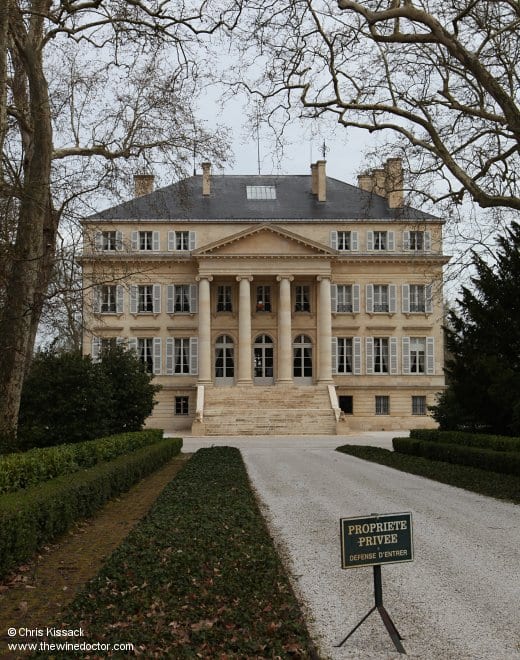
On my first visit to Chateau Margaux I was struck by the grand chateau, which I could view from the end of the driveway, peering through the vertical bars of the imposing gate. I was not fortunate enough to enter this magnificent edifice, and instead I was gently guided through the cellars, barrel-making area and naturally the chai, before finishing up with the tasting of a single vintage. It would have been fine for a tourist with a passing interest, but it hardly suited the needs of someone with a much deeper curiosity concerning the estate and the wine. Nevertheless, I managed to take what I could from the experience. One of my companions, however, a Bordeaux proprietor who had not long parted with $32 million in the purchase of a handsome property and vineyard south of Bordeaux, was not so pleased. Perhaps unsurprisingly, this wine magnate was expecting a rather more personal slant to the service; I believe a letter of complaint was to follow.
Personal service or not, there is no doubt that Margaux the chateau now acts as standard-bearer for Margaux the appellation. The wines are superlative and typify what is most exciting about the wines of the commune, but this has not always been the case. Although today, under the direction of the Mentzelopoulos family, together with Paul Pontallier running the chai, the estate has been turning out wines worthy of first growth status for several decades, there was a period during the 1970s when the wines were very sorry indeed. And yet in this Chateau Margaux still acted as a representative benchmark for the appellation; after all, Margaux as a whole has long been dogged by the existence of numerous underperforming properties.
Looking through the recent history of the deuxièmes crus during the 20th
Century only serves to emphasise this point of view. Here we have the two Rauzan
estates, Ségla and Gassies, the first of which has been revitalised with the
financial backing of Chanel, although even before that the wines were often
good, in my opinion. But this is not typical; Gassies has been struggling for
years, and although there have been murmurings of a recovery I will need to be
convinced. Durfort-Vivens is perhaps in the same position, and some would levy
similar criticism at Brane-Cantenac, although others would happily provide vocal
support for the efforts of the Lurton family, and certainly some recent vintages
have been quite impressive. Lascombes is perhaps even more controversial than
all of these combined; for many years a source of dismal wines, the estate has
been born again under the aegis of Alain Reynaud and Michel Rolland, with
appropriate financial backing from American investors. Unfortunately to some the wines, no matter the quality, simply don't taste like Margaux any
more; others, however, are lapping them up. It is perhaps one of the greatest
controversies in the appellation in recent years. Should a Margaux not taste
like a Margaux?
Looking beyond to the troisièmes crus, tasting many vintages from the latter 20th Century would reveal a similar litany of disappointments. Here, only Palmer has provided a reliable consistency in combination with true greatness in the wines. Others, from this level and from those below, are catching up though. Nevertheless, for Margaux, inconsistency has been the watchword of the past few decades.
Margaux - The Appellation
This inconsistency is particularly disheartening when one considers that Margaux has, of all the Médoc communes, perhaps the most readily identifiable style. St Estèphe is perhaps the most serious contender, with its hard, stony, gravelly character. Pauillac and St Julien are less convincing contenders for the crown, as although both have readily identifiable qualities, and accepting that each has, at various times and by various commentators, been described as the epitome of claret, I do not think they quite match a good Margaux in terms of freshness of perfume. Nor would I want them too; this is about regional identity, typicité, if you will.
It is this perfume that can help identify the wine when tasted blind, showing typically a light yet gravelly quality, sometimes tempered by a palate of red fruits, sometimes darker, accompanied by quite typically an array of floral aromas, which at its best can be captivating, if not truly haunting. It is the apparent loss of these characteristics that are lamented, I think, in the new direction taken by certain properties at the turn of the century (or thereabouts) such as Kirwan and Lascombes. Personally, although I enjoy freshness and delineation in a wine and will always mark down wines that I feel are over-extracted, lacking focus and perhaps even lacking typicity, I do not find these wines to have gone over too far for me to react in this way. Although they offer much more impact and texture than they used to, I think the unique Margaux character is still there, underneath it all. But this is a personal thing; there are many who recoil in faux horror at the sight of the new bottles. I think it will be most interesting to see how these wines fare in ten years time; will the characteristics of the appellation, the terroir, show through with some age? With a few bottles in the cellar, I am looking forward to discovering the answer to this question.

The above map of Margaux - even though it illustrates only the very core of the appellation - goes some way to illustrating what a disparate region Margaux is. To the north is Margaux, the first growth itself, accompanied by numerous nearby neighbours, with another cluster a little further to the southeast around the aforementioned Cantenac. A number of properties disappear off the map, and further again to the southeast there are a couple of significant properties in the southern Haut-Médoc, namely La Lagune and Cantemerle, which are occasionally lumped in with those of Margaux when it comes to tasting. The work of the Dutch engineers is clearly visible on this map, the region criss-crossed with drainage channels and ditches, facilitating the use of the land which would otherwise be little more than swamp. The terroir thus released to the vine is predominantly limestone, clay, chalk and sand, but as is the case throughout the Medoc there are gravel croupes dotted here and there, and it is on these minor promontories that the best vineyards are to be found.
Margaux - The Classifications
Notable Chateaux
Premiers Crus, 1855
Deuxièmes Crus, 1855
Ch. Brane-Cantenac
Ch. Durfort-Vivens
Ch. Lascombes
Ch. Rauzan-Ségla
Ch. Rauzan-Gassies
Troisièmes Crus, 1855
Ch. Boyd-Cantenac
Ch. Cantenac-Brown
Ch. Desmirail
Ch. Ferrière
Ch. Giscours
Ch. d'Issan
Ch. Kirwan
Ch. Malescot St-Exupéry
Ch. Marquis d'Alesme Becker
Ch. Palmer
Quatrièmes Crus, 1855
Ch. Marquis-de-Terme
Ch. Pouget
Ch. Prieuré-Lichine
Cinquièmes Crus, 1855
Cru Bourgeois
Ch. d'Angludet
Ch. La Gurgue
Ch. Labégorce
Ch. Labégorce-Zédé
Ch. Siran
For a full listing see my pages on the 1855 and Cru Bourgeois classifications
It isn't really possible to turn anywhere of note in Bordeaux without running into a classification of some sort; Pomerol is the only notable exception. Here in Margaux the estates of the commune have been classified many times, but as is the case with Sauternes it is the list drawn up prior to the Exposition Universelle de Paris in 1855 that has stuck, for the rest of eternity it seems. This ranking is of historical interest and acts as a useful framework for organising tastings, writing up notes and any debate of the region. It is not, however, in my opinion, useful as a true guide to which wines of quality. There are too many exceptions for the list to be valid. Nevertheless, in recent years, a number of estates have gathered themselves together and began to raise their game. Looking forwards, rather than backwards to this classification, it seems to me that perhaps the future for Margaux is rosier than than this guide has so far suggested.
Few would argue that, today, Chateau Margaux is rightly placed, but a few decades ago it did not deserve its seat at the head of the table. And, as I have already expounded, the ranking of the majority of the second growth estates is open to question. But at the next level and lower, there are a few noteworthy estates that have been quietly turning out wines of quality for years, or are at least recently revitalised and thus offering us hope. Looking beyond the obvious candidate, Palmer, I have previously enjoyed a number of vintages of Malescot St-Exupéry, although I know the wines have not appealed to other critics. This is to my advantage, however, as it means the prices remain affordable. I would also look to Giscours and her sister property, du Tertre, as recently improved, and of course Ferrière, where the delightful Claire Villars has been succeeding in her revitalisation of the estate. There are other success stories, of course, but this handful jump out as the most notable at this time.
Beyond the Cru Classé chateau, of course, we have those classified as Cru Bourgeois. There are a few good wines to be found here. Chateau d'Angludet has been frequently under-rated in my opinion, and a taste of the 1982 vintage at a little over twenty years of age was sufficient to convince me of the potential of this particular vineyard. Siran is another well worth looking out for. As Margaux continues to climb out of the sleepy doldrums that seemed to plague it during the latter 20th Century, I think we can expect to see even better wines from these properties, as well as the underperforming Cru Classé estates.
- Next instalment: St Julien
![]()
Home - Site index - Site updated October 10, 2008 - © The Winedoctor 2000 - 2008 - Wine Scores - RSS