Home > Producer Profiles > Bordeaux Profiles > Chateau de Rayne-Vigneau
Chateau de Rayne-Vigneau
As is the case with a number of other estates around Sauternes and Barsac, where the land has seen cultivation and habitation for many centuries, the very early history of Rayne-Vigneau is rather patchy. Not all hope is lost, however, as there is some information at least about the origin of the name, which would seem to originate from the late 17th century when the estate was in the ownership of Etienne du Vigneau. Otherwise little is known as to the events at Rayne-Vigneau until the 18th century, when the owner was a Baron de Reyne, which accounts for the Rayne of Rayne-Vigneau. Having married into the de Pontac family, a locally notable dynasty with a considerable estate, it is likely he acquired the property as part of his wife's dowry, and over the ensuing years it seems the estate was referred to variably as Cru de Vigneau and also Vigneau-Pontac.
It seems reasonable to suppose that under the Baron's tenure, and following his death that of his wife, what was eventually to become Rayne-Vigneau was managed as a successful estate. Texts at the time rank it highly, alongside reputable names such as La Tour Blanche, and at the time of the 1855 classification Rayne-Vigneau was ranked third, behind the aforementioned La Tour Blanche and, of course, Yquem. The Baroness even saw her 1861 vintage trump all comers, including Yquem, in the Paris Fair tasting in 1867. She bequeathed the estate to her brother Viscount Gabriel de Pontac, and the property continued down this line of inheritance, next coming to Gabriel's son Albert, and it was he that determined the name of the estate would be Rayne-Vigneau in honour of his ancestors.
Albert
cared for the estate until his death in the 1920s, when it passed to
his son-in-law the Vicomte de Roton, who held a similarly length tenure, not
meeting his end until he saw 98 years of age. Rayne-Vigneau passed then to his son Vicomte
François, who managed the estate through difficult times, eventually putting
it up for sale in 1961, exactly one hundred years after the estate's
award-winning 1861 was harvested. It was purchased by Georges Raoux, who did not
seem to provide the investment and enthusiasm that is required in Sauternes, and
this is not an unusual tale for the commune during the latter 20th century, the
region having had to deal with their wines being increasingly perceived as
unfashionable, as well as all the other ravages of the preceding century,
including phylloxera, oidium, war and depression. He only held tenure for a
decade, before selling up to Mestrazet in 1971.
The firm of Mestrazet, with the direction of Jacques Merlaut (better known for the revitalisation of estates such as Gruaud-Larose, Chasse-Spleen, Citran, Ferrière, La Gurgue and Haut-Bages-Liberal), had set about acquiring a number of Bordeaux properties, of which Rayne-Vigneau was just one. Other significant acquisitions included Grand-Puy-Ducasse as well as a number of cru bourgeois estates, perhaps most significantly Meyney. By the time of the acquisition Rayne-Vigneau was much in need of investment and this showed through in the wines. Under Mestrazet, subsequently with financial investment from the Vignerons de Val d'Orbieu, a leading Languedoc co-operative, and most recently from the French bank Crédit Agricole, which acquired a stake with a 95 million Euro investment, Rayne-Vigneau has been revitalised.
This revitalisation was notable for more than just the improvement in the wine, as during the 1980s it was at Rayne-Vigneau that the concept of cryo-extraction was first put into use. It perhaps resembles in some respects the natural process for making ice wine, although in Sauternes it is perhaps more a response to the climate and the condition of the grapes at harvest, rather than a unique method of increasing the sugar content (although that is certainly one effect). Botrytis cinerea requires very specific conditions, and with a damp harvest there is a danger that the beautifully shrivelled and sugar-rich berries will turn to grey rot, and that the quality will be reduced or even ruined altogether. This was a particular problem with the 1982 harvest, and Jean Merlaut, Jacques' son, together with Professors Chauvet and Sudraud from the University of Bordeaux and the newly installed régisseur Patrick Eymery (of Chateau Guiraud), agreed to some trials of freezing the berries in order to remove water, leaving only the rich, botrytised juice, thereby potentially eliminating the problem of a wet harvest and the swollen, water-logged grapes that result. Naturally, however, the process has its problems and also its detractors, who claim that concentration in this way will only accentuate the flaws already present in the wine, a reasonable argument. Nevertheless, today it is a method accepted and utilised by many, not just Rayne-Vigneau.
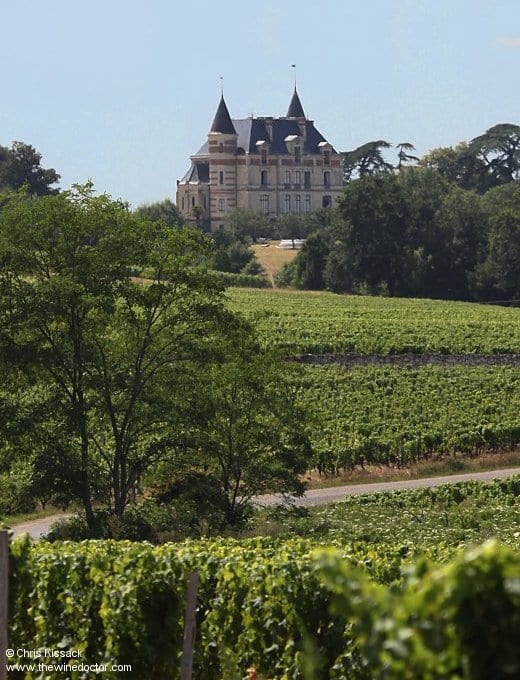
The Rayne-Vigneau vineyard has a perhaps enviable location, adjacent to Yquem and the Ciron, one of the rivers of the region, with Sigalas-Rabaud and Rabaud-Promis to the north. The soils are a mixture of sand and clay, curiously mixed with a cornucopia of precious and semi-precious stones including onyx, sapphire, amethyst and opal, all of which were of great interest to the amateur geologist Vicomte de Roton when he owned the estate during the early 20th century. The vines are naturally dominated by Semillon, although there is a significant proportion of Sauvignon Blanc which accounts for 20% of the vineyard, reflecting a curious decision by the INAO to permit only this variety to be planted when the vineyards were repopulated by Mestrazet during the 1970s. They average about 30 years of age, again largely because of that extensive replanting. Harvested in tries, today the fruit is pressed after cryo-extraction (if deemed necessary) in a dedicated cooling room maintained at a temperature of -5ºC, and then fermented in both stainless steel and oak, before ageing in barrel for up to two years. The grand vin is naturally Chateau de Rayne-Vigneau, and there is a second wine named Madame de Rayne.
It is heart-warming to see the recovery made at Rayne-Vigneau over recent years, as with such an exalted position for its vineyard, it would seem here is an estate with great potential. My own experience suggests to me, however, that there is still work to be done, and that some of this potential must at present remain unrealised. In great vintages the wines are very pleasing, not top-tier, but certainly very good and not completely out of place when lined up against more successful peers. In lesser vintages, however, they still fail to shine, at best good, but just as often less than that, despite the hope that must be offered by novel techniques such as the freezing of berries. Good wines, but still with room for improvement. With such a significant percentage of Sauvignon Blanc, one wonders why they do not go down the route of producing a dry white, as so many of their neighbours such as Suduiraut, Guiraud and Rieussec have done, thereby eliminating the impact of this variety on the sweet wine. (26/7/07)
Contact details:
Address: Chateau de Rayne-Vigneau, 33710 Bommes
Telephone: +33 (0) 5 56 76 61 63
Fax +33 (0) 5 56 76 63 70
Chateau de Rayne-Vigneau - Tasting Notes
Chateau Rayne-Vigneau
(Sauternes) 2009:
Residual sugar 160 g/l. More Sauvignon Blanc here than in some, accounting for
28% of the blend.
Yellow plum cream on the nose, with oak and honey, touches of smoke and a pithy depth. An
appealingly fat palate, with lemon meringue flavour, bright and also a touch
herby. Good acidity, balanced sweetness, fleshy too. Very attractive.
From my 2009 Bordeaux
en primeur assessment. 17.5-18.5+/20 (March 2010)
![]()
Chateau de Rayne-Vigneau (Sauternes) 2007: Honeyed on the nose, lightly oaked, bright and fresh two, with a very slightly
high-toned edge. The palate is nicely styled, with lots of substance, a meaty
sweetness, peach and nuts. A good, substantial finish. This is a delightful
wine. From my tasting of
2007 Sauternes at
two years of age. 17+/20 (October 2009)
![]()
Chateau
de Rayne-Vigneau (Sauternes) 2006: This wine needs a little persuasion to reveal
itself on the nose, but it soon gives off the aromas of honey, lemons and thyme.
Good flesh on the palate, a fine, grippy, rather chalky structure, giving the
wine considerable substance in the mouth. It seems a touch meaty, with a fresh,
mentholated finish. From my tasting of
2006 Sauternes at
two years of age. 15+/20 (October 2008)
![]()
Chateau
de Rayne-Vigneau (Sauternes) 2005: Bright honeyed fruit here, and a really appealing
vigour and concentration. Delicious entry, cool, gently fleshy, bordering on
unctuous, but with a lightly floral, fruity and minerally lift. Lots of flare
and character, good grip, and a light, acidic freshness. Good if somewhat steely
finish. From my tasting of
2005 Bordeaux at two
years of age. 16.5-17+/20 (October 2007)
![]()
Chateau de Rayne-Vigneau (Sauternes) 2004: A pale, yellow-gold. Rather
subdued on the nose initially, then minted honey, lemon zest and still some
traces of oak. Sweetly textured, but on the palate also rather quiet, although
it has a nice texture, and appealing freshness, and nicely defined fruit. But no
depth or complexity here, and certainly little in the way of botrytis in
evidence today. Good. 15.5+/20 (February 2007)
![]()
Chateau de Rayne-Vigneau (Sauternes) 2004: A floral nose, exotic fruits, sweet
with vanilla oak notes. Lovely freshness immediately apparent on the palate,
although this goes hand-in-hand with a leaner style, with sweet but simple
pineapple and peach fruit. Nice acidic cut, though. Not much botrytis.
Complexity may come with time. Good wine. From my
2004 Bordeaux
assessment. 16+/20 (October 2006)
![]()
Chateau de Rayne-Vigneau (Sauternes) 2003: Lovely botrytis character here, with
herb-tinged honey-quince aromas. A big, refreshing style on the palate, carrying
plenty of weight with a full, barley-sugar richness, but with quite sufficient
acidity. Still has a little oak to shed. But should make fine drinking. Very
good. From my
2003 Bordeaux
assessment. 17.5/20 (October 2005)
![]()
Chateau de Rayne-Vigneau (Sauternes) 2000: A fine, orange-gold hue.
Some light botrytis character on the nose, not the most expressive wine I have
to say. Creamy, slightly woody on the palate, slightly stretched out too.
Grippy, with a bitter edge, moderately sweet, and overall rather delicately
flavoured. Not bad. 14.5+/20 (February 2007)
![]()
Chateau Rayne-Vigneau (Sauternes) 1986: This wine has a moderately deep, golden hue,
and on the nose an elegant, pure and yet richly honeyed character. It possesses
a lovely lift on entry, leading to a rather firmly composed midpalate, which has
a creamy richness, with a
slightly bitter tannic structure running through the core. Well defined, and not the
most delicate of Sauternes, rather grippy in a slightly masculine fashion, but
this is still really rather fine and very well composed. A
Christmas Wine. 17.5/20 (December 2006)
![]()