Home > Producer Profiles > Bordeaux Profiles > Chateau Palmer

Chateau Palmer

Chateau Palmer is one of a large collection - ten in all - of third growth properties located in Margaux. In terms of sheer quality Palmer leads this pack by a length, producing wine of such a high standard that it frequently wipes the floor with the Margaux second growths, and if we look back a few decades we can see the wines challenging those of Chateau Margaux for the best in the appellation. Indeed, were it not for the renaissance of Chateau Margaux following its purchase by the Mentzelopoulos family in 1977 Palmer may well have been the top wine of the appellation today.

Chateau PalmerThe origins of Chateau Palmer lie in the Gascq estate, which predates it by several centuries. The Gascq family were an influential Bordeaux dynasty that not only held sway over an impressive estate, but were also active in the local parliament. Their landholdings were spread over much of the Médoc, and in 1748 they were augmented by the acquisition of some land near Margaux, following the dissolution of the Issan estate. Within a very short period of time, the wine of Chateau de Gascq was well established on the marketplace. This was the situation when, in the early 19th Century, the vineyard was purchased by a General Charles Palmer, who served under Wellington in the English army, and who had arrived in Bordeaux on his way back from the Battle of Toulouse in 1814. He acquired the estate from Brunet de Ferrière, the widow of Blaise Jean Charles Alexandre de Gascq for the sum of just 100000 francs. In 1816 Palmer began a program of expansion, acquiring new land and planting more vineyards, and within two decades he owned 163 hectares of land, of which 82 hectares were planted to vines, as well as buildings in Issan, Cantenac and Margaux. He installed a vineyard manager named Gray, and set about marketing his wine in the gentlemen's clubs of London where it was apparently well received. It even graced the table of the Prince Regent, but unfortunately did not stand up well against the Prince's own wines, a finding no doubt influenced by Palmer and the Prince having had rather an acrimonious history. It did nothing to help the sale of his wines, and as a consequence Palmer poured money and effort into his estate in an effort to improve the wine, uprooting old vines, replacing with new and experimenting wildly with different varieties. Sadly, but perhaps unsurprisingly, this was to no effect other than the depletion of Palmer's finances, which rapidly went into freefall. His political career - he had been active in the parliament in the UK, as his father had been - began to falter. His wife, Mary Elizabeth Atkins, left him, and he was forced to begin selling off his assets, culminating in the sale of what remained of the Palmer estate to Françoise-Marie Bergerac in 1843.

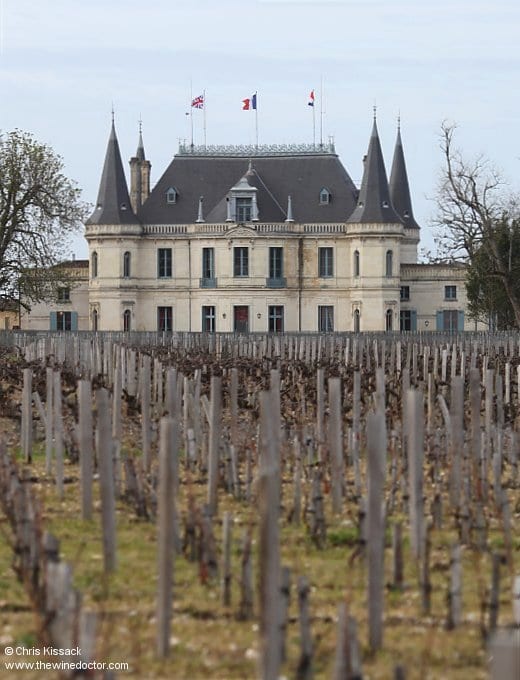
Palmer returned to London, where he lived out his days in Mayfair, forced to watch from the sidelines until his death in 1851. During this time the property came into the ownership of the Caisse Hypothécaire de Paris, in 1844, before being purchased by the Péreire brothers in 1853. Emile and Isaac Péreire made numerous significant improvements, and were also responsible for building the turreted chateau, rather similar in style to Pichon-Baron, that stands today. Not long afterwards the property was ranked as a troisième cru in the 1855 classification, a judgement which, I suggest, failed to reflect the true potential of Palmer. It did not, however, discourage the Péreire family, who having made their fortune developing Arcachon as a fashionable resort for sufferers of tuberculosis, had no shortage of finances to invest. There was another expansion, and by 1870 the estate covered 177 hectares, with 109 hectares planted to vines. Nevertheless, during the early years of the 20th Century there was another downturn; Palmer was not immune to the effects of the various vine diseases that ravaged Bordeaux at this time, nor the war or economic depression that followed. As a consequence, the Péreire family were forced to sell, initially letting small portions of the estate go one at a time, in a piecemeal fashion. In 1938 what remained of the estate was purchased by a syndicate of the Sichel, Ginestet, Mialhe and Mähler-Besse families, forming the Société Civile de Chateau Palmer in the process. To this day the descendants of the Sichel and Mähler-Besse families run the estate, the property having seen something of a new revitalisation, which can probably be traced back to the 1961 vintage, when Palmer produced one of Bordeaux's most exalted wines of the 20th Century. In the 1950s it was Frédérick Mähler's son-in-law Jean Bouteillier, and after him his own son, Bertrand. Since 2004 Thomas Duroux has been CEO at Palmer, having first gained experience during three years spent as winemaker at Ornellaia, in Tuscany.

PalmerThe 52 hectares of vineyards are located in Margaux and Cantenac, situated on crops of gravelly stone. These stones vary in type, including quartz and quartzite, chalcedony and lyddite. They form a fairly deep surface layer, up to four metres deep, over the bedrock. Planting density is high at 10000 plants per hectare, with an unusually high proportion (47%) of Merlot for the commune, with 47% Cabernet Sauvignon and 6% Petit Verdot. Merlot accounts for over 40% of the blend, and as much as 60% in some older vintages, and Petit Verdot is also a relatively significant component, accounting for up to 8% in recent vintages. What happens in the vineyard is not biodynamic but much attention is paid to pest management using biological methods, although there is sometimes a need to spray to prevent disease. The fruit is harvested by hand, the estate having a long-term contract with a group of Danish students who travel down each year to pick the grapes. Vinification is temperature-controlled in cone-shaped stainless steel, in a vatroom refurbished as recently as 1995. The wine is pumped over the skins, which macerate for up to 20 days, and malolactic is encouraged before the wine goes into oak where it spends up 21 months, with regular topping up. It is racked four times in the first year cellar, and blending decisions are also made at this time. In the second year it receives an egg white fining before being bottled unfiltered. The grand vin is Chateau Palmer; this sees up to 21 months in oak of which 45% is new. There is a second wine now called Alter Ego de Palmer but previously called Réserve de General; this sees up to 17 months in oak, of which 20% is new.

Palmer has a keen following, and I have observed many flock to the wines at tastings. I agree that they are indeed very good, although in many recent vintages I do not find them sitting so distant from the rest of the Margaux pack. This may well be because of an overall improvement across the appellation, the result of new investment at many properties, such as Kirwan and Lascombes, to name just two. That is not to say, however, that they are not of very fine quality indeed. Of recent vintages that should soon be approaching their drinking windows, the 1994 and 1996 were both very fine and both exhibited really excellent potential. The 2001 was good, and certainly had potential. Mature vintages, however, have been wonderful, with the 1981, 1982 and 1989 all very fine examples. Only the 1975 disappointed, but as a whole that tasting was disappointing. Fine wines indeed here. (2/12/04, updated 27/4/07)

Contact details:
Address: Chateau Palmer, 33460 Margaux
Telephone: +33 (0) 5 57 88 72 72
Fax +33 (0) 5 57 88 37 16
Internet: www.chateau-palmer.com

Chateau Palmer - Tasting Notes

Click to locate stockists.

2007

Chateau Palmer (Margaux) 2007: Alcohol 12.5%, and 50% new oak. Just 40% of the harvest went into the grand vin this year, and Merlot is the lead variety at 49%, with 44% Cabernet Sauvignon and 7% Petit Verdot. This is expressive, showing spicy complex fruit presented in a fresh and appealing style. Fine, fresh and mineral style on the palate, not weighty but elegant, sappy and harmonious. A complete and well composed style, and a ripe tannin core. A very lovely expression. A lighter style of Palmer but it captures the vintage rather nicely, and has very good potential. From my 2007 Bordeaux en primeur assessment. 16-17+/20 (April 2008)

Alter Ego de Palmer (Margaux) 2007: Alcohol 12.5%, and 30% new oak, a blend of 60% Merlot and 40% Cabernet Sauvignon. The second wine, accounting for 50% of the harvest in 2007. A fresh and floral nose, slightly meaty, with a sandy mineral character. On the palate, a fresh and immediate stony quality, not fleshy but structured, with obvious tannins coming through. Fresh, gently textured, harmonious and sappy, with a clean finish. From my 2007 Bordeaux en primeur assessment. 14.5-15.5+/20 (April 2008)

2001

Chateau Palmer (Margaux) 2001: Ripe and plump on the nose, with some nutty oak, and some stylish, slightly exotic fruit notes. Similarly full, ripe and plump on the palate. Underneath there is a grippy structure with a tannic finish. But this can't distract from the ripe berry fruits and evident finesse, even at this youthful stage. I think this will develop a lovely integration, but needs 7-8 years at least. 16.5+/20 (November 2004)

Alter Ego de Palmer (Margaux) 2001: A lovely nose. Cashew nuts (oak), elegance and peppery fruit. A stylish palate, with rounded, integrated fruit and a seamless feel at first, although the tannins soon burst through. This is good - and excellent for a second wine. Needs 5-7 years. 16+/20 ()

1996

Chateau Palmer (Margaux) 1996: Beautiful nose. The typical Margaux perfume is detectable here, with mineral-meaty notes alongside. Style evident again, but also full, with a firm tannic backbone. This is developing well but really needs at least another 4-5 years before broaching for pleasure. 17+/20 ()

1994

Chateau Palmer (Margaux) 1994: A moderately deep intensity. An elegant, toffee and perfume nose. Sweet, rounded and voluptuous palate. Lovely extract and an exotic character on the palate, with a precise balance showing through into the finish. This is fabulous and has real potential. From a Bordeaux 1994 blind tasting. 17.5+/20 (July 2004)

1989

Chateau Palmer (Margaux) 1989: We have clearly taken a step up in quality here. A lovely colour. A wonderful, complex and fragrant nose, with hints of fresh coffee grounds. The forepalate is rich, round and full, and although this sensation persists the midpalate is dominated by the tannins which give this wine such structure. Lots of fat, ripe fruit, yet quite elegant and perfumed with it. The tannins persist after the finish. A great wine. Needs five years at least. From a Bordeaux 1989 blind tasting. 18.5+/20 (May 2000)

1982

Chateau Palmer (Margaux) 1982: There is just a moderate tawny tinge to this wine. The nose shouts class, with a combination of floral elegance and power, together with lots of blackcurrant fruit with a gravel, mineral and cordite edge. Gorgeous texture on the palate, amazing structure, and beautifully balanced. Lots of tarry yet fine fruit. A harmonious wine, which undoubtedly has years ahead of it. I felt the combination of elegance with power should have made this wine easy to identify blind. From a 1982 vintage twenty years on blind tasting. 18.5/20 (April 2002)

1981

Chateau Palmer (Margaux) 1981: This wine has a fairly similar hue, although perhaps just a touch more purple. Rich and smoky on the nose, a touch tarry, with dense fruit, exotic nuances and notes of currants and weeds. Before I even taste it I know this is wonderful stuff. On the palate this is a more weighty wine, perhaps even a little lush, although this is supported by strong acidity. Firm with good structure, the tannins are fully integrated leading to a smooth and harmonious finish. Again quite lengthy with some acid. From a Bordeaux 1981 blind tasting. 18/20 (September 2001)

1975

Chateau Palmer (Margaux) 1975: This has a wonderful colour, and this is followed by a sweet, burnt, plum jam nose, although it has a lean citrus edge. The palate, however, is hard and drying out. There is still a little tannin present, but the fruit has largely faded. Good weight though, soft acidity, and a bit of yeast extract character. On the way downhill, and somewhat disappointing after an initially promising nose. From a Bordeaux 1975 blind tasting. 14/20 (August 2002)

Home - Site index - Site updated October 07, 2008 - © The Winedoctor 2000 - 2008 - Wine Scores - RSS