Home > Producer Profiles > Bordeaux Profiles > Chateau Larcis Ducasse

Chateau Larcis Ducasse

The history of Larcis Ducasse can be traced back to at least the 18th Century, as documents from 1777 inform us of the existence of the property, and also clearly indicate that there was ongoing viticulture on the estate. The wines were purchased by the Libourne négociant Pierre Beylot, from the same family that established Chateau Peyraud. During the 19th Century the estate was in the ownership of Pigasse of nearby Pavie for a short period of time, and at one point it was divided into two, but subsequently reunited some years later. The estate established a reputation for good wines, winning a gold medal in the Exposition Universelle in Paris in 1867, by which time it was in the ownership of the Ducasse family. Within a few decades the estate passed from the hands of Ducasse, coming to Hanri Raba in 1893. He and subsequently his wife and son André, who took over the running of the estate following Raba's death in 1925, invested heavily in the property. During World War II André died without an heir, and so the ownership of the estate passed to a niece, Hélène Gratiot Alphandéry, in 1941. With the help of the régisseur Pharaon Roche she ran the estate until 1990 when her own son, Jacques Olivier Gratiot, took hold of the reins. Today the estate remains in the ownership of the Gratiot Alphandéry family, as evinced by the label, but since 2002 in has been under the management of right bank whirlwind Nicolas Thienpont, of Pavie-Macquin and numerous other estates, with consultation from Stéphane Derenoncourt and Julien Lavenu.

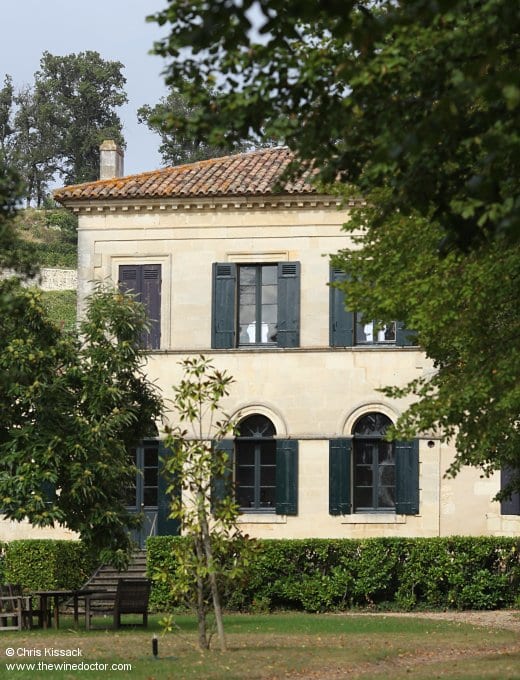
Larcis DucasseThe vineyard is located to the southeast of St Emilion, to the east of Chateau Pavie (these slopes are often referred to as the Côte de Pavie), lying on the boundary between the communes of St Emilion and St Laurent-des-Combes. There are 10.8 hectares of vines altogether, planted on a range of soil types. At the bottom of the slope, towards the Dordogne, the soils are naturally richer in alluvial deposits of sand, with some clay and chalk. Moving up the slope, there is a greater predominance of clay and limestone, as well as some molasses du Fronsadais, soft chalk with silt and clay. Towards the top of the slopes, chalk and then limestone and clay-limestone, with chalk beneath. The vines are 78% Merlot, the balance being 20% Cabernet Franc and 2% Cabernet Sauvignon, with an average age of 35 years, and planted at a density of 7500 vines/ha (older vines planted at 6000 vines/ha are gradually being replaced). The vineyard is managed on a sustainable basis, with light ploughing to aerate of the soil and interplanting with cereals in the winter. The labour is largely manual, namely debudding, leaf thinning and a green harvest in summer, and naturally the ripe fruit is also harvested by hand. The fruit goes over four sorting tables, and is destemmed, and is then vinified in temperature-controlled cement tanks. The wine undergoes malolactic in barrel, which are 60% new each vintage, and they rest here for up to 20 months. The grand vin is labelled as Larcis Ducasse.

Reviewing recent vintages of Larcis Ducasse, I don't think I am exaggerating when I say that, particularly since the involvement of Thienpont and Derenoncourt, many critics and wine drinkers alike have been swooning over the wines. The 2005 Larcis Ducasse is the obvious example, selling at four or five times the price of the 2004 or 2006 vintages, thanks to almost universal effusive praise, but most notably from Parker who awarded a tentative barrel score of 96-100. Other critics - Michel Bettane, Jancis Robinson, and others - also admire the wine, but I also see many comments which give me concern - "jamminess"...."hot on the palate"...."oily in a Californian way" - are comments from the tasting team at Farr Vintners at en primeur. Very few tasters mention freshness or acidity, except for Jancis who merely describes it as "uncomfortable". It is perhaps surprising that another Pavie-like row hasn't erupted.

When such diverse opinions exist perhaps the only way to decide for yourself is to taste the wine. Fortunately, I have twice had the opportunity to do this, and it is clear to me that for my palate this is not a 100 point wine. Or, indeed, a 20 point wine. Yes, the point-gathering opulence is there, but to me it was a little over the top, teetering on unbalanced, lacking the freshness and elegance that I look for in all wines, whether they be from the left or right banks, or indeed from anywhere outside Bordeaux. I must make clear, however, that my opinion of this wine is not purely negative; the 2005 Larcis Ducasse is a good wine, and most probably along with the 2004 and 2006 these wines are much better than the Larcis-Ducasse of old. It is just that I don't feel sufficiently moved to buy or drink them. Vive la différence, I suppose. (28/11/07)

Contact details:
Address: 33330 St Emilion
Telephone: +33 (0) 5 57 24 70 84
Fax +33 (0) 5 57 24 64 00
Internet: www.nicolas-thienpont.com

Chateau Larcis Ducasse - Tasting Notes

Click to locate stockists.

2007

Chateau Larcis Ducasse (St Emilion) 2007: This is appealingly aromatic, with notes of vanilla, plum and bright summer pudding fruits. The palate is full, sweet and creamy, although it soon reveals a very hard extract beneath which is only partially covered by the overlying fruit. Firm acidity, a well structured wine, showing a chewy and drying grip at the finish. The extraction here is borderline, as with the 2005, so it will be interesting to see how this fairs once in bottle, but I think it could be very good indeed. From my 2007 Bordeaux en primeur assessment. 16-17+?/20 (April 2008)

2006

Chateau Larcis Ducasse (St Emilion) 2006: Nutty and creamy fruit on the nose. A nice palate, a little jammy, plump and rounded, with some nice, ripe, grippy tannins beneath. Nicely put together so far, but I find it lacks freshness and vigour. Muted, lacking direction. Good but would be better if it had a touch more vivacity. From my 2006 Bordeaux assessment. 14-15/20 (April 2007)

2005

Chateau Larcis Ducasse (St Emilion) 2005: An evocative nose, showing some rather hot and feral fruit character laced with some spicy plum. It starts off nicely on the palate, showing quite a high level of grippy tannins, but a good associated ripeness too, and also a nice acid backbone. There is good weight, and a lot of structure here. It is quite heavily extracted but there is a lot of substance to balance this out. Nevertheless, I find it to be teetering on the brink of being overdone. It is better than I rated it when tasting en primeur. From my tasting of 2005 Bordeaux at two years of age. 16.5-17.5+/20 (October 2007)

Chateau Larcis Ducasse (St Emilion) 2005: A property next door to Pavie, run by Stéphane Derenoncourt and Nicolas Thienpont since 2002. M 80%, CF 15%, CS 5%. An incredibly dense and opaque wine. The nose has appeal, still showing rather obvious toffee-caramel-vanilla ice cream character from the oak, with blueberry fruit. On the palate the wine is lighter than might be expected, and seems rather out of kilter if not disjointed. There is lovely ripeness and texture, but it is on the edge of tinny over-extraction. It will appeal to many, but not to me. More freshness, vibrancy and elegance, please. From my 2005 Bordeaux en primeur tasting. 15.5-16.5/20 (April 2006)

2004

Chateau Larcis Ducasse (St Emilion) 2004: A lovely, very forward and open blackberry nose with a herby nuance. Svelte style, with supple tannins taking up position in the background, creamy texture nicely masking the structural elements. Great acidity, and very good style. From my Bordeaux 2004 assessment. 16.5+/20 (October 2006)

1985

Chateau Larcis Ducasse (St Emilion) 1985: The most youthful colour of the two St Emilions, and indeed one of the most youthful appearances of any wine here. Lovely scents on the nose, pure crushed fruit with a floral, violet edge. Toffee, liquorice and cough-candy notes bring up the rear. Medium bodied, with hard, mineral-edge fruit. There are still some spicy tannins and some peppery acidity. The more elegant, floral characteristics show through on the finish. From a Bordeaux 1985 tasting. 17.5/20 (September 2002)

Home - Site index - Site updated October 10, 2008 - © The Winedoctor 2000 - 2008 - Wine Scores - RSS