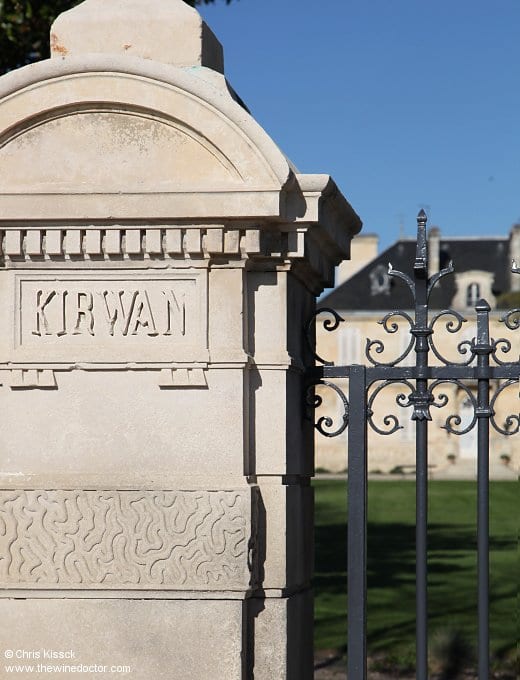
Home > Producer Profiles > Bordeaux Profiles > Chateau Kirwan
Chateau Kirwan
Chateau Kirwan gained its name in the 18th Century, having previously been the property of Renard de la Salle, a Bordeaux nobleman, when it was known as La Terre Noble de la Salle. In 1710 the estate was sold to Sir John Collingwood, a merchant who had established his trade in the quayside warehouses of Bordeaux. With his keen interest and knowledge it was Collingwood that established the estate as a working vineyard. Subsequently, Collingwood's daughter married Mark Kirwan, an Irishman, and the property took on a new name, one which has lasted through to modern day. Kirwan established a very good reputation for his estate, and his vineyard was one of many to be visited by Thomas Jefferson, onetime ambassador to France and subsequent US President. Jefferson had a passion for wine, and many Bordeaux estates played host and sold their wine to this travelling oenophile. His records from 1780 tell us that he was very impressed with the wine of Quirouen which, allowing for difficulties in pronunciation must surely refer to Kirwan.
The history of all Bordeaux chateaux of note always include at least two difficult periods; the French Revolution of the late 18th Century, and the economic depression of the early 20th Century (not to mention oidium and phylloxera). Kirwan is no exception. In 1789 the estate was seized, although Kirwan, perhaps by virtue of his country of birth, escaped unharmed. Under Napoleon he subsequently regained the estate, expanding it to incorporate the nearby Ganet property. In the history of Kirwan this has been the only major change in the vineyard area, and the property remains today as it was during Napoleon's time. Mark Kirwan died on the estate in 1815, forty years before his and his father-in-law's efforts were rewarded with classification as a third growth in 1855. The property subsequently came into the hands of Camille Godard, a botanist. Godard went on to become Mayor of Bordeaux, and in 1882 he bequeathed his fortune to the city. This funded the splendid Parc de Bordelais, 30 hectares of botanical paradise in central Bordeaux, designed by Eugene Bülher, and stocked with specimens of sequoia, magnolia, walnut and cypress, to name a just a few of the species provided by Godard. Sadly, Chateau Kirwan did not have the same attention lavished upon it, and at the turn of the century it was sold at auction, the purchasers being the négociant firm Schroder & Schyler.
Times,
however, were hard; the depression and
two World Wars, following hard on the heels of phylloxera, had a significant
impact on life at Chateau Kirwan. It was not until 1950 that Kirwan
showed the first signs of a turnaround. The renaissance was led by the next
generation of the Schyler family, Jean-Henri. What land that was fallow - or
even planted for the production of hay - was replanted with vines. He restructured the
vineyards, and in the next decade introduced chateau-bottling. The wines had a
commercial outlet through Schroder & Schyler's businesses across Europe, and
Jean-Henri sought new contacts in North America to ensure continued commercial
success. In 1991 the services of Michel Rolland were engaged, and I feel the
quality of the wines improved as a result. They were not without controversy,
however, as some belittled the loss of
Margaux typicité, allegedly
relinquished in favour of extraction and new oak. Whatever your opinion of the
wines, though, it is undeniable that with
commercial success comes financial rewards and thus fresh investment, and there has been
no shortage of this in recent years, with a restoration of the chateau and a new
barrel cellar being just two of the activities. And although the estate is still
home to Jean-Henri, in the early 21st Century it is Yann, Natalie and Sophie
Schyler that have taken the reins at Chateau Kirwan.
The vineyards of Chateau Kirwan lie on the Cantenac plateau, with near neighbours Prieuré-Lichine and Desmirail. The soils here are sandy, and dominated by gravel topsoil. The vines have an average age of 27 years, and comprise 40% Cabernet Sauvignon, 30% Merlot, 20% Cabernet Franc and, unusually, a high proportion (10%) of Petit Verdot. They are uprooted at fifty years of age, and replanted once the land has lain fallow for up to five years. Each year the vines see a green harvest. When the true harvest takes place the grapes see a sorting table before fermentation in small, temperature-controlled, stainless steel vats. The grand vin, Chateau Kirwan, which never accounts for more than 65% of the harvest, then sees up to 18 months in oak, one third new each vintage, before blending and bottling. This accounts for 16000 cases, whereas since 1993 there has also been 4000 cases of a second wine, Les Charmes de Kirwan.
Over the past few decades Kirwan has not been a highly regarded or sought-after wine. It has seemed somewhat lost in the motley collection of Margaux third growths, which range from luminaries such as Palmer, down to less illustrious and less frequently encountered properties such as Marquis d'Alesme-Becker. Nevertheless, reports of significant improvements in the wines of the property - with positive notes on the 2000 vintage particularly prominent - make the wines of Chateau Kirwan worth evaluating. Doubtless investment and innovation, including the introduction of the second wine, have helped considerably in the improvements here. Tasting and assessing the wines, particularly very recent vintages made in the opening years of the 21st Century, I feel that these are good although not compelling wines. They do show a lot of ripe fruit and not too much in the way of gravelly, perfumed character, but many of these features will become more apparent once the primary flavours and notes of oak have resolved - certainly this is the case with the admirable 2003, as shown by my tasting notes below. Thus I am not so ready to criticise the wines for loss of typicité as others may be. Those who nevertheless maintain a dislike of the style will no doubt welcome the news that in early 2007 Rolland terminated his contract with Kirwan, apparently due to pressure of work. This decision may be related to his establishing a new company, the Rolland Collection with David Lesage, his son-in-law, in order to market his wines outside of the négociant system. What effect this will have on the quality of the wines, only time will tell. (5/5/05, updated 26/4/07)
Contact details:
Address: Chateau Kirwan, 33460 Cantenac
Telephone: +33 (0) 5 57 88 71 42
Fax +33 (0) 5 57 88 77 62
Internet:
www.chateau-kirwan.com
Chateau Kirwan - Tasting Notes
Chateau Kirwan (Margaux) 2007: Black
fruits and exotic spices on the nose. Soft on entry, not very well defined, and
then showing a lot of extract in the midpalate. A very sharp, green apple
acidity, and not a lot of direction here. Lots of extracted tannin throughout,
and a drying finish. This seems overdone to me. From my
2007 Bordeaux
en primeur assessment. 13-14+/20 (April 2008)
![]()
Chateau Kirwan (Margaux) 2006: This has some nice fruit on the nose,
seemingly quite concentrated. Quite fresh on the palate, nicely rounded, a touch
spicy. Quite a firm Margaux character. It has a little vigour - which means it
is quite good for this vintage - and is nicely balanced. I quite like this. From my
2006 Bordeaux
assessment. 16-17+/20 (April 2007)
![]()
Chateau Kirwan (Margaux) 2005: This
is not as giving as some other wines on the nose, but it does show a presence of
nutty oak with some rather reserved, smoky dark fruit. The palate has a very
well defined structure with a lovely acid backbone, and well covered tannins. It
is firm, nicely composed, and rather complete in style. The grip shows at the
finish. The flavour is tightly wound up today, but this also has very good
potential. From my tasting of
2005 Bordeaux at two
years of age. 17+/20 (October 2007)
![]()
Chateau Kirwan (Margaux) 2004: A
little subdued on the nose, reticent but not completely shut down, showing just
a little appealing perfume of fruit. Another wine showing a lot of tannin on the
palate, but there is good texture to match, and appropriate acidity. Nicely
composed in fact. Closed on the palate, so difficult to make a judgement on
character, but the intrinsic quality is all there. From my 2004 Bordeaux
assessment. 16-17+/20 (October 2006)
![]()
Chateau Kirwan (Margaux) 2003: Another wine with a deep, concentrated
colour. A lovely, gravelly perfume. On my last tasting this showed density and
structure, but now it has opened out to reveal Margaux typicité, but
still a wonderful depth of fruit. There is a fading note of nutty oak. Middle
weight, moderate texture, showing some rather bare structure at the moment, with
a lot of tannins but it has reasonable acidity too. It needs time, and still
shows fine potential. 16.5+/20 (November 2006)
![]()
Chateau Kirwan (Margaux) 2003: Macerated cherry fruit with a pleasing although
atypical toasted brioche character to the nose. Full, creamy palate, firm and
structured, but with cherry fruit overlaid. Ripe and a little brawny, rather
one-dimensional and simple. But it is young, and the structure and balance are
there. Very good potential here. From my
2003 Bordeaux
assessment. 16.5+/20 (October 2005)
![]()
Les Charmes de Kirwan (Margaux) 2003: The second wine of Kirwan. Again
there is maturity of colour on inspection of this wine, something that does seem
to mark the 2003 vintage at the moment, at only four years of age. The colour is
oxblood at the core, with a pink rim. The nose remains fresh, however, perfumed
and gravelly with some fading notes of nut behind it all. The palate is
reserved, quite elegant, sappy and broad, with some flesh. There is a bit of
grip but it is not overdone despite the vintage. Although there is a feral note
rearing up at the finish I find this appealing for a 2003. Good. From the 2007
CIVB tasting. 15.5/20 (October 2007)
![]()
Chateau Kirwan (Margaux) 2002: A blend of classic, crunchy
blackcurrant fruit, with a layer of nutty oak. The palate is round, showing less
seductive texture than previous vintages. But there is a hint of cream, and
elegance, and good tannic structure. Black fruit flavour. This is good. 16+/20 (November 2004)
![]()
Les Charmes de Kirwan (Margaux) 2002: Good colour. Sweet berry fruit
on the nose, with a little oak. Rounded texture, a slightly hard tannic
structure which reflects the vintage. But here we have enough fruit and texture
to cope I think. Less substance than the 2001 or 2002 though. This is passable.
Needs 1-2 years before it will be at peak. 13.5+/20 (November 2004)
![]()
Chateau Kirwan (Margaux) 2001: Lovely nose; exotic and captivating,
with a melding of black fruit and cashews. Full, creamy and seductive palate.
Soft but ripe tannins, nicely integrated, and with correct acidity. Another very
good example of this underrated vintage. 16.5+/20 (November 2004)
![]()
Les Charmes de Kirwan (Margaux) 2001: A touch of the exotic notes found in the
grand vin here. Cashew nut oak. Medium bodied. Seamlessly put together,
but a little soft and unfocussed. Showing little tannin, but there is structure
and it has correct acidity. Will be ready shortly - needs 1-2 years. 14/20 (November 2004)
![]()
Chateau Kirwan (Margaux) 2000: Dense, dark nose, with black fruit, but
otherwise really quite closed. Full palate, with sweet fruit, and good structure
too. Strong, tannic background, culminating in a brutish, tannic finish. There
is plenty of potential here. This is very good indeed. 17+/20 (November 2004)
![]()
Les Charmes de Kirwan (Margaux) 2000: Excellent depth of colour in
keeping with the vintage. Good nose here - dark black fruits, honeyed oak. Rich,
creamy, full on the palate. Simple, primary flavour at present but obviously
there is room for development here. Very good for a second wine. Needs 3-4
years. 15.5+/20 (November 2004)
![]()
Chateau Kirwan (Margaux) 1999: A deep colour. Quite gravelly on the
nose, quite perfumed, very clearly Margaux. Full palate, not creamy but it has
flesh, and has style and an attractive balance. Nicely integrated, a little
firm, especially on the finish. Firm tannins here. This should provide good
drinking in 4-6 years time. Showing better than my tasting in 2004. 16+/20 (November 2006)
![]()
Chateau Kirwan (Margaux) 1999: Charming nose, of soft, nutty black fruits.
Showing good structure, leading through to a noticeably tannic endpalate. Cherry
fruit, correct acidity. Seems more Merlot-dominate in character, and I prefer
the more classic 1998 - an underrated left-bank vintage. 15.5+/20 (November 2004)
![]()
Chateau Kirwan (Margaux) 1998: An appealing nose. Seductive, in fact;
black fruits, with cashew nuts. Soft, rounded palate. Complex fruit notes, but
no great depth or secondary development otherwise. There are some tannins in the
background, and this wine is approaching its drinking window - it needs 2-3
years more. I hope some interest will develop. 16+/20 (November 2004)
![]()
Chateau Kirwan (Margaux) 1994: A really quite dense hue, and good
concentration to the rim. It has a big, open nose, full of ripe, dark plummy
fruit. Soft, glossy, sweetly textured palate. Rounded, creamy, nicely
integrated. Firm and structured, with just a little sooty tannin in the finish.
This is an impressive effort for this chateau. From a
1994 Bordeaux tasting at ten
years of age. 15.5+/20 (July 2004)
![]()
Home - Site index - Site updated August 29, 2008 - © The Winedoctor 2000 - 2008 - Wine Scores - RSS