Home > Producer Profiles > Bordeaux Profiles > Chateau Haut-Batailley

Chateau Haut-Batailley

Haut Batailley is the smaller sibling of neighbouring Batailley, having split from the larger estate in 1942. Thus much of this estate's history is as for Batailley, from its possible Medieval origins through to the early 20th century, before the division, when it was under the control of two brothers by the name of François and Marcel Borie. Thus, much of this profile mirrors exactly that written in my profile of Chateau Batailley.

The name of the original Batailley estate suggests a military origin, a battle perhaps, and indeed this may be so. The vineyards of modern Bordeaux were, in many cases, the scenes of Anglo-French conflicts of varying degrees of ferocity during the course of the wars which are known, collectively, as the Hundred Years' War. The location of Batailley, a few miles to the west of Latour, itself the location of one such siege, was reputedly the site of just such a skirmish near the end of the war. An alternative explanation concerns a local vigneron named Batailley, who was credited with planting the vineyards here, although the case for this is less robust. It is also a less bloodthirsty tale, and thus obviously of less interest; I prefer the suggestion of battle myself. Whatever the explanation, by the end of the 18th century there is a vineyard here named Batailley, one which was to give rise to the Batailley and Haut-Batailley that exist today.

At this time the vineyard was in the ownership of the Saint-Martin family, three siblings of whom two were of the cloth, one a nun and one a priest. Two of the three, the two sisters Marianne and Marthe, sold their portion of the estate to Jean Guillaume Pécholier in 1791. The estate was now in two parts, although this is not the origin of the split that gave birth to Haut-Batailley. From Pécholier it passed to his son, Amiral de Bédout, and following his death in 1816 the estate was sold by auction; it was purchased, not quite in its entirety, by Daniel Guestier of Barton & Guestier. He acquired most of the estate immediately, purchasing further shares and land, including plots adjacent to Lynch-Bages and Grand-Puy-Lacoste, later on. He was responsible for considerable investment in the property, renovating the chateau and improving the winemaking facilities. When he died in 1847 Batailley had garnered a good, although certainly not exalted, reputation, and the scene was set for the estate creeping in as a cinquième cru in the 1855 Classification of the Médoc.

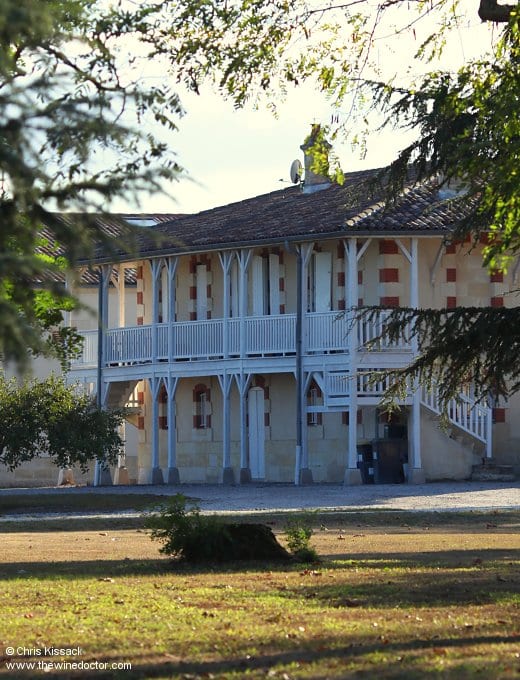
Haut-BatailleyThe estate was inherited by Guestier's three children, divided rather unevenly with two daughters taking a quarter each and the son, Pierre-François, taking half. This state of affairs continued onto the next generation, each of the offspring of the two daughters taking on their quarter share respectively, but by 1866 the family decided to sell the estate, all involved relinquishing their respective shares, and it was acquired by a Parisian banker named Constant Halphen. By this time the estate had expanded considerably, from the 39 hectares extolled by Guestier to a very respectable 55 hectares, and its reputation was largely maintained under Halphen, when the vineyards were tended by the brothers François and Marcel Borie. Upon Halphen's death in 1932, the Borie brothers purchased the estate and continued to make the wine for another decade, before in 1942 it was divided into the two properties we know today as Batailley and Haut-Batailley. This was not the result of some convoluted family struggle, rather it was to stave off future difficulties with the inheritance of the estate. The larger part, which came to Marcel, and which included the chateau, naturally kept the vineyard's original name of Batailley. François, who that year had purchased Ducru-Beaucaillou, kept the smaller part of the estate which, when augmented by some vines purchased from Duhart-Milon in 1951, became Haut-Batailley. It is at this point, then, that the two properties go their own ways.

Naturally, François was largely preoccupied with Ducru, and Haut-Batailley was somewhat off his radar, and it remained this way until his death in 1953. Whereas Ducru passed to his son Jean-Eugène, who also went on to acquire a controlling stake in Grand-Puy-Lacoste, Haut-Batailley went to his daughter, Françoise de Brest-Borie. Management of the estate, however, was left to Jean-Eugène and today his son, François-Xavier, looks after it.

The vineyards of Haut-Batailley lie to the east of the D206, which runs southwest out of Pauillac, facing the vineyards of Batailley itself, and also include those around Chateau Couronne, a petit chateau which also came to François Borie in 1932. Just to the east is the Petit-Batailley vineyard which belongs to Latour, and is largely utilised for the second wine Les Forts de Latour. There are 22 hectares planted to vines, with the usual gravelly terroir. The vines are 65% Cabernet Sauvignon, 25% Merlot and 10% Cabernet Franc, and are planted at a density of 10,000 vines/ha, with an average age close to 35 years. the harvest is manual, the fruit destemmed, and then fermented in stainless steel with temperature control, being going into oak for up to 20 months. Up to 40% of the barrels will be new each vintage. Before bottling the wines see a light filtration. The grand vin is Chateau Haut-Batailley (10000 cases per annum), and there is a second wine Tour d'Aspic (1700 cases per annum). The wines of Couronne are no longer independently seen, it seems.

I have a sneaking admiration for the wines of Haut-Batailley. Whereas those from Batailley have occasionally seemed a touch brawny and tweedy, those from Haut-Batailley have frequently turned out to be more pleasurable, a little brighter and more nimble on their feet, and certainly they have given great value for money. The last time I tasted the two side by side was with a tasting of the 1995 vintage at ten years of age; Haut-Batailley was clearly, to me, the more appealing of the two. Haut-Batailley also has all that is required for the cellar, and yet despite all this is frequently released at a very attractive price that has made it a must-buy wine in many vintages. I certainly have a long string of vintages tucked away in the cellar. starting with the 1994, but taking in great left bank vintages such as 1996 and 2000. I look forward to drinking them, and expect they will give as much pleasure as many other bottles, some of which will no doubt be considerably more expensive. (23/3/07)

Contact details:
Address: 33250 Pauillac
Telephone: +33 (0) 5 56 59 05 20
Fax: +33 (0) 5 56 59 27 37

Chateau Haut-Batailley - Tasting Notes

Click to locate stockists.

2004

Chateau Haut-Batailley (Pauillac) 2004: An unusual character here, a rather burnt and feral nose, with notes of rubber. On the palate it is big, ripe and fleshy, with lots of chewy tannins and that rubbery note comes through here too, alongside some berry fruit. A touch oily in terms of texture too. Not showing well today and difficult to judge. This is one I would like to reassess but this was not possible today as I tasted this wine at the very end. From a 2004 Bordeaux tasting at four years of age. Not scored. (November 2008)

1998

Chateau Haut-Batailley (Pauillac) 1998: From half bottles. This has a vibrant hue still, very attractive, dark but not advanced in its maturity. A complex nose is apparent, with little wisps of sweetly baked fruit, then burnt raspberry, later a violet perfume which is momentarily intoxicating. Behind it all, a seam of green peppercorn to which some - but not me - may have an adverse reaction. A lovely freshness follows on the palate which possesses a lean minerality behind some rounded fruit. It has good flesh and substance, and a good grip of charcoal-edged tannin. There is some acidity behind it all, beneath the leafy fruit and peppercorns again. A short finish. It drinks well, perhaps in a rather simple and foursquare fashion, but it has appeal. From a tasting of 1998 Bordeaux. 16.5+/20 (August 2008)

Chateau Haut-Batailley (Pauillac) 1998: From a half bottle. A fairly deep colour although with no real evidence of maturity. An attractive nose, very cedary with some dusty black pepper notes. Nicely textured on entry, a little chalky through the midpalate, but with plenty of freshness and decent substance. Showing some very nice nuances of flavour in the floral-violet arena, with a little meaty bacon and mineral character too. The tannins are softening up, presenting no more than a gently drying finish; this is certainly approachable now (in this format), but is certainly on the way up and I'll keep the rest of mine a little longer yet. 16.5+/20 (September 2006)

1995

Chateau Haut-Batailley (Pauillac) 1995: A fairly dense hue, showing only early maturity, although with a very fine sediment giving it a very slightly murky appearance. A good nose which takes a couple of hours in the decanter to open up, giving a really quite dense and meaty style of fruit, with nuances of claretty iron filings and stone, chalky redcurrant and violets, as well as a little green edge, of peppercorn and roasted thyme. Nicely textured, a very substantial mouthfeel although this is influenced somewhat by that fine sediment, and a firm, stony, dry and reserved midpalate leading to a precise finish. A very slightly sappy feel to it, very slightly loose-knit, but overall it holds together well. Shows some ripe, grainy tannin in the finish. Drinking well now, although a good future too, although this is the last of my bottles - which were bargains, as many young clarets were 10-12 years ago. From a 1995 Bordeaux tasting. 17+/20 (March 2010)

Chateau Haut-Batailley (Pauillac) 1995: A dark, fairly opaque hue. A great nose, stuffed with smoky graphite and maturing mineral fruits. This expressive wine certainly has the desired style, with a medium to full-bodied, plump, ripe succulent palate infused with black olives and sensible extract, underpinned by a fine structure of tannins. Dry, balanced, with super mature flavour, but still showing a grippy tannic finish. Lovely, still with potential for future development. From a 1995 vintage ten years on tasting. 17+/20 (December 2005)

1990

Chateau Haut-Batailley (Pauillac) 1990: This is a dark wine, which shows some maturity but still has a garnet-red core. A lovely nose, quite rich and open, displaying sweet, nutty, roasted fruits. The palate is big and structured, with plenty of tannins still obvious from the midpalate onwards. Not as sweet or as full as some other wines, but has plenty of mouthfeel. Some cigar-smoke elements alongside the fruit. Classic Haut-Batailley. From a 1990 Bordeaux horizontal tasting. 17+/20 (May 2003)

1982

Chateau Haut-Batailley (Pauillac) 1982: One of the more youthful looking wines in this flight, perhaps somewhat surprisingly in view of the identities of the subsequent wines. Smoky blackcurrant fruit on the nose, with a stony edge and some burnt toffee character coming out with aeration. Still quite tannic on the palate, making the wine a touch austere. There's plenty of texture and body, and good acidity. The wine even seems a little backward, although with time it opens out to reveal some smoky elegance. Very drinkable. From a 1982 Vintage Twenty Years On tasting. 17+/20 (April 2002)

1981

Chateau Haut-Batailley (Pauillac) 1981: Again a beautiful and youthful colour. Dense blackcurrant fruit on the nose, with some tarry, smoky, pencil lead notes. Rich and quite opulent on the palate. Balanced acidity and integrated tannins provide an attractive structure. Sweet and lengthy finish. From a 1981 Bordeaux tasting. 17/20 (September 2001)