Home > Producer Profiles > Bordeaux Profiles > Chateau Gazin
Chateau Gazin
The modern history of Gazin begins in the early 18th Century with the proprietor Antoine Feuilhade, a lawyer and politician of considerable wealth who wielded some power locally, thanks to his taking up the positions of both Mayor of Libourne in 1735 and, later on, regional Admiralty Commissioner. But it is likely that the true history of the estate stretches back further than this, and writing in his tome Grands Vins Clive Coates discusses the possible role of the Knights Templars or perhaps the Knights Hospitalier of St John in the evolution of Gazin. Although the location of Gazin was once a stop-off for pilgrims en route to Santiago de Compostella, and there was once also a hospital on the site in ancient times, eight centuries ago, there is no real evidence for this fanciful tale. If we are to limit ourselves to the evidence, we must start with Feuilhade, who acquired the property, including a sizeable vineyard, as an old man in 1772.
Gazin: A History
The estate did not remain with his family for long, however, as the heir to the estate, Jean Feuilhade, died just two years after his father. It thus passed to the family of Antoine's brother, Arnaud, and having no passion for a viticultural estate they subsequently sold the property to a ship builder named Capitan-Bayonne, who also acquired nearby Chateau Rouget. He and his family held tenure at Gazin during much of the 19th Century, expanding the vineyard, and developing a reputation for excellent wine, one of the best of the region in fact. The estate passed to Capitan-Bayonne's nephew, a man named Fabre, and it remained with the Fabre family until the latter quarter of the century when they relinquished their hold on these two estates, with Gazin being acquired by a gentleman called Cabanes, and then by Léon Quenedey, a négociant.
It was Quenedey who owned the estate at the turn of the century, and by now
Gazin's dominance of the region was coming to an end, its reputation fading
through the 20th Century. It is a common tale, the sequence of phylloxera,
oidium, war and depression being a story told many times on this website. In
1917 it passed from Quenedey to Louis Soualle, who also acquired La Dominique,
before both properties came to his daughter who was wed to Edouard de
Bailliencourt, a family with noble heritage having once been in the service of
the French regent, six centuries beforehand. Since that time they have been
known as the Bailliencourt dit Courcols, this addition to their name, meaning
short neck, was an honour bestowed upon them by King Philippe Auguste in
1214. Their ownership of these properties, however, turned out to be disastrous;
La Dominique was in ruins when it was sold in 1969. Ten years later, when
Edouard died, it was necessary for the family to decide on Gazin's fate. Only
one heir wished to continue, this being Etienne de Bailliencourt; he purchased
the shares belonging to his siblings, an action financed by the sale of several
hectares of vines to near neighbour Chateau Pétrus. It must have been a
difficult time for Etienne; he had on his hands a vineyard or questionable
quality, particularly after the frosts of 1956 had laid waste to so many of
Bordeaux's vines necessitating extensive replanting (thus he had many young
vines). This was not the beginning of Gazin's reversal of fortunes; the
introduction of machine harvesting, a decision taken by Bailliencourt in 1979, should tell us this.
The awaited turn-around came not quite a decade later, when Etienne took a backseat and his son, Nicolas de Bailliencourt, assumed responsibility for the running of the estate. All the changes that you might expect came into play - the machine was replaced by the hand, the chai has been rebuilt and equipped anew, and in 1986 a second wine Hospitalet de Gazin was introduced. The services of Pomerol guru Jean-Pierre Moueix were engaged, to consult on vinification and to provide marketing. The wines of Gazin, in the early years of the 21st Century, reflect this renewed vigour. Today it is Nicolas & Christophe de Bailliencourt dit Courcol who run the estate together, with winemaker Mickaël Obert, a graduate of the École Supérieure d’Oenologie and from the École Nationale Superieure d’Agronomie de Montpellier, who replaced the now retired Jean-Pierre Gasteuil in 2005.
Gazin: The Vines and the Wines
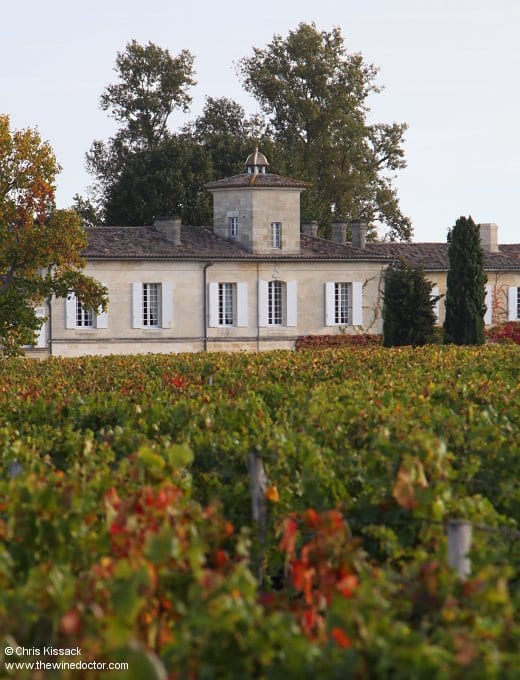
The Gazin estate covers 26 hectares, with the area planted to vines amounting to 23 hectares, of which 17 hectares are on the Pomerol plateau which is renowned for being the source of the best wines of the appellation. The fruit of those vines that have a less favourable position is more likely to be the basis for Hospitalet de Gazin rather than the grand vin. The vines are in an exalted position, neighbouring vines belonging to Pétrus and l'Evangile. On the plateau the terroir is clay, the other vines have their roots embedded in gravel or sand. They are predominantly Merlot which accounts for 90%, then 3% Cabernet Franc and 7% Cabernet Sauvignon, planted on rootstocks 420A, 101.14, 3309, 5BB, S04 and Riparia, with a density of 5500 vines/ha. The average age of the vines is 35 years and there is an ongoing program of planting in order to maintain this vineyard profile. At the centre of the vineyards is the château, a two-storey house most probably erected by Capitan-Boyanne or possibly the Fabre family, during Gazin's golden era in the 19th Century, and here too are the cellars and associated buildings. The vines are, of course, now harvested by hand, with eventual yields between 35 and 45 hl/ha, the fruit then transferred to these cellars where it is fermented in small temperature-controlled cement and stainless steel vats, with a maceration between 20 and 30 days depending on the vintage. The young wine then goes into oak which is 50% new for up to 18 months, were it undergoes malolactic fermentation, then a sequence of rackings before an eventual egg white fining prior to bottling. There may also be a light filtration if it is required. The total output can exceed 8000 cases of the grand vin, Chateau Gazin, with 2000 cases of the second wine, l'Hospitalet de Gazin.
It is clear that Gazin has, in the past, enjoyed great success. Today the wines perhaps reflect that. They are not quite the top tier of real Pomerol, perhaps not even the second tier, for they do not quite match the consistency that can be found at La Conseillante or Vieux Chateau Certan, for instance. Nevertheless, some wines have been excellent, most notably the 2005, the oft under-rated 2004 and even the surprisingly delicious 1999. In fact there have been no real disappointments in all my experiences since the current incumbents took control, with just a few wines, such as the 2002 and 2006, showing the weaknesses of the vintage. Looking back, to before the tenure of Nicolas and Christophe, I have sampled the 1982 vintage twice; once it was merely satisfactory, once it was delightful. I would be unable to give any firm judgement without assessing this vintage again. That, unfortunately, is unlikely to happen. (12/2/08)
Contact details:
Address: 33500 Pomerol
Telephone: +33 (0) 5 57 51 07 05
Fax: +33 (0) 5 57 51 69 96
Internet: www.gazin.com
Chateau Gazin - Tasting Notes
Chateau Gazin (Pomerol) 2007: This is a very dark
wine, with a nose rich in the aromas of nutty oak, and some brooding, somewhat
exotic fruit. A lovely vigour on entry, and a well defined and precise palate.
this is fresh and elegant, and balanced, although there is a firm grip
underneath. Overall, though, a good wine which I hope translates through into
the finished product. From my
2007 Bordeaux
en primeur assessment. 16-17+/20 (April 2008)
![]()
Chateau Gazin (Pomerol) 2006: Rather subdued on the nose, with some clean berry
fruit all that is showing. Rather delicate, nicely composed, a lighter style.
Decent acidity, and a gentle tannic structure. Rather pretty, but not very
substantial. I have had better. From my
2006 Bordeaux
assessment. (April 2007) 14-15/20
![]()
Chateau Gazin (Pomerol) 2005: This has some delightfully lifted aromatics on the
nose, with a dense, meaty, plummy character beneath. It is elegant, with notes
of white flower petals, and on the palate there is a similar style, although in
combination with much structure. Lots of appeal, but very firm, upright, and
unsurprisingly a big, tannic finish. But there is plenty of fruit here to cope
with this. Great potential here. From my tasting of 2005 Bordeaux
at two years of age. 18-18.5+/20 (October 2007)
![]()
Chateau Gazin (Pomerol) 2005: A densely coloured wine, with a raspberry-blue
periphery. Restrained fruit on the nose, but there is no lack of style here.
Notes of pepper. The palate has a lovely, soft and supple entry, leading to a
well balanced midpalate. Gently creamy, but firmly structured without
over-extraction, with a pile of tannin through the midpalate and finish. This
has very good potential. From my 2005 Bordeaux en
primeur tasting. 17-18/20 (April 2006)
![]()
Chateau Gazin (Pomerol) 2004: A dark, minerally, mint-edged black fruit nose
with nuances of liquorice. Lovely, complex, balanced style on the palate again
here. A really velvety feel to the tannins, beautifully composed with
appropriate fruit and texture, with fine, fresh acidity. Delightful quality
through to the finish. Excellent. From my
Bordeaux 2004
assessment. 18/20 (October 2006)
![]()
Chateau Gazin (Pomerol) 2002: This is more restrained than the 1999. It has
some dark fruits, is slightly nutty, elegant and balanced. A fine presence on
the palate, with some good grip beneath. An absolutely lovely style considering
the vintage. Great grip, good substance, fresh, perhaps not the midpalate
concentration that I would like but still a good wine. 16+/20 (February 2007)
![]()
Chateau Gazin (Pomerol) 2001: A wonderfully dense colour here, with a pure and intense fruit aroma.
Lovely brambly fruits, perfumed and vibrant, with a fine, dried character. Plums
and spiced fruit cake follow these early impressions. A very admirable although
slightly austere texture and composition, this is a stylish rather than
immediately seductive wine. Fine ripe tannins, and a good dry finish.
Impressive. From a tasting of
2001 Pomerol. 18+/20 (February 2008)
![]()
Chateau Gazin (Pomerol) 2000: Still obviously very youthful on the
nose, although really rather closed down. Rounded, with a soft texture, peppery
acidity, and firm tannins at the core. But other than this, little impact here.
This is really difficult to judge in this state, but based on the structure
alone I have given a likely score. From a
Bordeaux tasting with
Bibendum. 16.5-17.5?/20 (April 2007)
![]()
Chateau Gazin (Pomerol) 1999: A very alluring nose here, with lovely, deep,
well defined fruit. Smoky, blackberry character, flashy and seductive. Full,
creamy, stylish and rounded. Soft structure though, with the tannins only really
showing through the midpalate. Fresh, crisp acidity beneath. This is very
stylish, elegant yet with substance. Very good. 17/20 (February 2007)
![]()
Chateau Gazin (Pomerol) 1993: A real baby of
a wine here, with a coffee and toffee tinged nose, packed with fruit.
Sweet, tannic, fat, luscious wine on the palate, with good acidity.
Plenty of potential here. From a
Pomerol tasting. 17+/20 (May 2002)
![]()
Chateau Gazin (Pomerol) 1989: More youthful
on the nose, with a coffee edge to the rich, black cherry fruit. Big,
firm, and structured on the palate, with tannins that are ripe and
pleasing, but need more time to integrate. Plenty of lack fruit, spice,
strong acidity, and lots of potential. From a
Pomerol tasting. 17.5+/20 (May 2002)
![]()
Chateau Gazin (Pomerol) 1982: Wonderful deep
pile of fruit and sweet toasty oak. This is intriguing, powerful, and
seems so young. Lovely firm fruit on the palate, with smoke and a real
sense of power, combined with a full, rich texture. Fine acidity. Last
time I tasted this I thought it was drying out, which illustrates how
markedly bottle variation can affect your opinion of a wine. From a
Pomerol tasting. 18/20 (May 2002)
![]()
Chateau Gazin (Pomerol) 1982: A
deep red wine with a caramel, tawny rim. A stony, mineral
nose is followed by a dry, somewhat fruitless palate.
Sharp tannins, correct acidity, what fruit is present has
a spicy edge to it. Finishes well. This wine is drying
out - drink up. From a Pomerol
tasting. 15.5/20 (June 2000)
![]()
![]()
Home - Site index - Site updated October 10, 2008 - © The Winedoctor 2000 - 2008 - Wine Scores - RSS