Home > Vintages and Regions > Bordeaux > Bordeaux 2007

Bordeaux 2007

A film is to be made of Robert Parker's life, we are told, or at least so Decanter's April Fool story, released during the primeurs in the spring of 2008, would have us believe. And with two films of that famous 1976 Judgement of Paris tasting either underway or completed at the time of writing, it seems that Hollywood and Bordeaux might make good bedfellows. Budding script writers, eager to get in on the act, might find that the 2007 Bordeaux vintage has the right ingredients for a similarly good story; prolonged desperation through a chilly summer with no apparent hope of reprieve until almost the last minute, a miraculous change of fortunes when all looked lost, and it all - well, almost all - turns out alright at the end. Yes, 2007 is the Hollywood vintage.

The Hollywood Vintage

The story begins with budbreak and flowering. Please don't switch off, for once this is not an academic inspection of the life cycle of the vine. In 2007 these processes were absolutely central to both the problems and the eventual salvation of the vintage; problematic, because it was so irregular, but a saving grace in that it was remarkably early, with many of the warmer terroirs showing budbreak in March. Early flowering is not without risk, as a cold snap could easily devastate the process, and thus drastically reduce the volume of the harvest. And when frost comes in Bordeaux, it can strike mercilessly, as was seen in 1956, when it wiped out more than just flowers and fruit, many vines died too. Sixty years on there is less worry about frost, but nevertheless there were some cold nights in late March, never quite reaching 0ºC, but certainly cold enough to dissuade the vines from their early awakening. And thus although early, budbreak was a patchy and prolonged affair. This set the scene, consequently, for an irregular and prolonged flowering, and then later in the year an erratic veraison - when the fruit changes colour as it ripens.
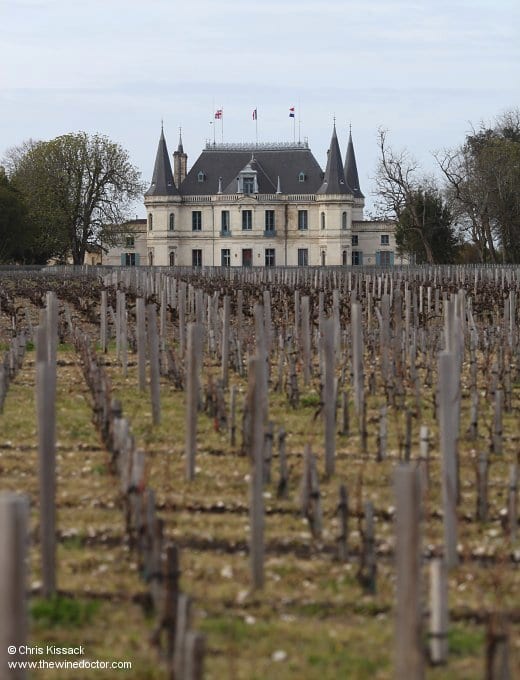
Bordeaux 2007

As the development of the vines progressed, the weather provided another sequence of problems for the vigneron. Summer temperatures were disappointingly low, and the grey and damp, drizzly days of June, July and August engendered the arrival of diseases such as oidium and mildew. Active spraying was necessary, and the most successful chateaux will be those with the financial wherewithal to make continuous passes through the vineyard, separating out and dropping rotten or mouldy fruit and regularly applying appropriate treatments. The cool weather also discouraged the ripening of the fruit, resulting in a remarkably long growing season. The one hundred day rule - the time from flowering to harvest is often said to be 100 days - did not apply in this vintage; some vines needed as long as 130 days to ripen their fruit. The vines struggled on, but in late August, when many are looking towards harvesting the fruit (indeed, the 2003 harvest began in August), the vintage appeared to be a washout. Yields were down because of coulure (failure of flowering) and fruit loss due to disease, and the development of what was left was very retarded. Fortunately, the early flowering, irregular as it was, did maximise the ripening time available to the vines, even if the weather was less than wonderful. And on August 30th came the Schwarzenegger moment, the first hint of reprieve, of salvation, as the sunny weather suddenly arrived. Indeed, the harvest was saved, as it remained warm and dry for the next two months; without this dramatic turnaround, I do not think there would have been a 2007 vintage for Bordeaux at all. It is commonly said that there are no bad vintages in this region anymore. Perhaps 2007 is the year that shows this new maxim to be true, but they also came perilously close to disproving it.

As for harvest itself, this ran from September into the next month, and some properties still had the majority of their fruit on the vines as October arrived. The cooler weather had had a remarkable effect on the maturation of the fruit, and this was particularly true for the clay terroirs where Merlot is usually planted, and so in so in 2007 the usual process of ripening was reversed, or at least equalised to some extent. It is usual for the Merlot to ripen before the Cabernet, but in 2007 many vignerons found themselves picking their Cabernet before the Merlot. This is a very unusual sequence of events for the region. As for the dry whites, these were harvested in good condition in early September, and the fruit for Sauternes and Barsac was brought in under fine and dry conditions, with a good development of botrytis in the interim. This shows in the wines, which for these sweet wine communes are very good indeed, the best in the vintage; more on that with my Sauternes notes.

To sum up, the 2007 growing season was characterised by:

Tasting the Wines

I travelled up and down Bordeaux for four days in early April, in the company of Richard Bampfield MW, Margaret Rand, John Stimpfig and Tom Cannavan, and I would like to thank them all for their companionship during these four days of tastings. It was a tight schedule, but one that was well organised, and we made all of our appointments on time. During the trip we managed to get a good overview of the vintage, looking at representative wines from all the appellations of the Médoc, Graves, St Emilion and Pomerol, and of course Sauternes and Barsac.

Firstly, broad and sweeping dismissals of the vintage are inaccurate and either reveal a judgement made without tasting, or a hidden agenda. This is a comeback vintage, when drinkable wines were plucked from the jaws of the distillery or the compost heap; many wines are not great, in fact a large number are unremarkable early drinkers, perhaps even mediocre, but there are also some very, very good wines in the mix. Viewing the wines in the context of recent vintages, they obviously pale in comparison to the 2005s, which occupy a league of their own, but the distinction with 2006 is not so easily made. It is not so much a question of absolute quality, but one of style. The 2006s, some of which I had the opportunity to reassess alongside the 2007s, show more punch, more tannin and more substance on the palate, whereas this more recent vintage has softer tannins and is easier to taste than the 2006s were this time last year. In fact, I will be revising my opinion of a few 2006s, most notably Haut-Bailly and Pichon-Baron, upwards. But back to 2007; softer tannins are one thing, but some of the 2007s are problematic. There is greenness in some wines, and over-extraction in others, although this latter problem is less apparent on the right bank than I would have expected. A large number show very bare structure through the midpalate, with no flesh to cover the tannins and acidity, sometimes they are overtly hollow and washed out here. And many have a short finish to complete the picture.

Bordeaux 2007

Having given my criticisms, these must be balanced with appropriate praise. The green wines were in the minority, and most had ripeness of fruit and tannins, even if they were so barely laid out. The firm acidities will appeal to many; this is especially so in the sweet wines, which I will discuss in more detail in my review of that commune. The wines were generally clean and reflect hard work in the vineyard. On the right bank, I sensed that over-extraction was less of a problem than it has been in recent years, and perhaps for some this is a response to the vintage. Although short, many will drink nicely in ten years or even less. And the best wines, of which there are a handful, are brimming with nascent excellence. I found these to be focussed on the right bank; even the best wines on the left bank pale into comparison with these, and with other vintages.

Where the pulse starts to quicken is with the dry white wines, which are elegant and balanced, but not racy or punchy. They are good, but in a different style to the 2006 vintage which so far I prefer. True tachycardia only arrives with the Sauternes, however, which have ripeness, texture, some botrytis and brilliantly fresh acidity. If you enjoy drinking sweet wines with something provided to cut through the sweetness and texture, this vintage could be the next best thing to 2001 for you.

I start, as ever, with the Graves region. (8/4/08)

Home - Site index - Site updated May 16, 2008 - © The Winedoctor 2000 - 2008 - Wine Scores - RSS