Home > Producer Profiles > Loire Profiles > Prince Poniatowski
Prince Poniatowski
The title of prince is no affectation, as Poniatowski is from the Polish royal family, a descendent of Poland's last king, Stanislaw August Poniatowski; this fine heritage is represented on the Poniatowski labels, which bear an emblem derived from the Polish flag. The Poniatowski family moved to France in 1855, and it was reputedly in a Paris restaurant, Au Petite Riche, that Poniatowski's grandfather discovered the joys of Vouvray. In 1918 he learned that the vineyard from where his favourite wine originated was up for sale; he promptly bought it, and the Poniatowski's have had a presence in Vouvray ever since. Through the latter quarter of the 20th Century it was Philippe Poniatowski that was in charge at the domaine, the third generation of the family to take on the responsibility. Having spent his wartime years with the French Resistance he afterwards turned to industry, and he had great success leading a number of large French companies. In 1970, as the last company was nationalised by the French government, he looked once more for a change in direction. This time, realising that no other member of the family took an interest in their Vouvray estate, he turned to wine.
The
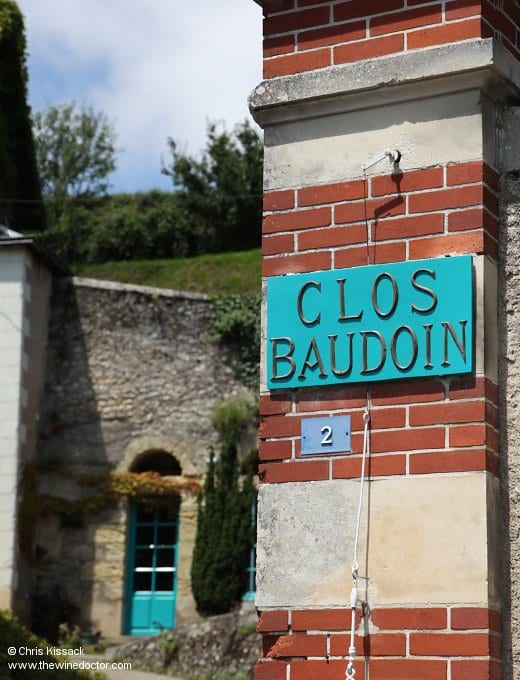
Clos Baudoin vineyard has long been the jewel in the Poniatowski crown; a
small plot of vines in the Vallée de Nouy directly above the house and cellars,
it is accepted by many as one of the Loire's greatest terroirs, and was regarded
with the status of a 'grand cru' long before the vineyards of
Vouvray were subject to
appellation law. It was named after Abbott Baudoin in 1707, but had been
cultivated by many generations of vignerons before that time. The
other vineyard of note is the Clos de l'Avenir, a small plot of vines
purchased by Poniatowski in 1987. These are the estate's two main labels; a
third, Aigle Blanc, is made from fruit grown elsewhere, mostly the Haut
Lieu or Le Mont vineyards, or it may include 'declassified' fruit from Avenir or
Baudoin.
Declassified fruit may also find its
way into his sparkling cuvée, Aigle d'Or. With regard to vinification,
Poniatowski has long favoured natural methods, allowing the wine to reflect the
vintage with transparency. After harvesting the fruit underwent a low-pressure
pneumatic pressing, before fermentation in large wooden vats, followed by
racking, filtration and bottling the ensuing spring. Eschewing chaptalisation
means that the wines may range from bone dry, to sweeter and even full-blown
moelleux styles according to the nature of the vintage.
With the passing of the years, however, Philippe Poniatowski realised that he could no longer tend to his vines in the manner he once did. With no-one else eager to take on the mantle, he looked for a buyer for the estate, and he entered negotiations with the owner of a local bottling company. When François Chidaine, a Montlouis vigneron, got wind of this it wasn't long before he and Poniatowski had struck a deal. As a result the Polish prince held onto the land, whilst the native of Montlouis tended the vines and made the wines. This was in 2002, and it was the beginning of a five-year arrangement which not only gave Chidaine access to some excellent sites in Vouvray, it gave him the option to purchase at the end, an opportunity which he could not refuse. In late 2006 the deal was struck, and today these vineyards are in the sole ownership of Chidaine. I give more detail on this, and on Chidaine's wines, in my Chidaine profile.
If I were to rank the producers of Vouvray it s not likely that I would put Poniatowski in the top tier, a level more correctly associated with Huet and Foreau (of Clos Naudin), to name just two. Nevertheless the wines tasted here were secured at a very good price, which made them a very attractive proposition and certainly fine for casual drinking; they give much pleasure, some of the wines being very good indeed, but to be precise these are not examples of truly great Vouvray. It will be fascinating to see how some of these wines develop in coming years, especially the younger cuvées, particularly in the light of the Chidaine wines which are, in my opinion, of a much higher, purer quality. (16/11/06, updated 18/8/09)
Contact details:
Address: Vallée de Nouy, 37210 Vouvray
Telephone: +33 (0) 2 47 52 71 02
Fax: +33 (0) 2 47 52 60 94
Prince Poniatowski - Tasting Notes
Poniatowski Vouvray Clos Baudoin
Moelleux 1997: This has a golden hue, tinged with a richer, bronze-orange.
The nose is certainly interesting, with a chalk and straw character, alongside a
slightly peculiar baked marmalade aroma. It doesn't suggest great richness
though, and this is indeed the case on the palate, as this is a wine of well
defined structure, with a nicely chalky acidity backing up a small array of
rounded, straw-tinged autumnal flavour. Slightly bitter, good grip, not a rich
or luscious style, not the purest or most concentrated either. But the structure
confers good potential for the cellar I think, and it was good value too!
From a tasting of the 1997
Vintage at ten years of age. 16.5-17+/20 (December 2007)
![]()
Poniatowski Vouvray Aigle d'Or Brut 1993: An elegant straw gold hue and a moderate sized bead. Nose: very
expressive, mineral, lemon, straw, rocky, talcy, nuances of toffee, praline and
cream. Very dry palate with firm acidity. Full of very dry minerals. Very
reserved and detached mouthfeel at first, but developing a warmer, broader, more
creamy and mouth caressing character with time. Cooler it tastes like a mouthful
of pebbles, a little warmer and it resembles more closely a mouthful of nettles
and pepper. More than a little length too. I like it. 16.5/20 (August 2006)
![]()
Poniatowski Vouvray Aigle Blanc Moelleux 1990: A fairly rich,
mid-golden hue. Quite a typicité on the nose, although this is not a hugely
expressive wine. There are little notes of honey and minerals, with a lemon
twist, which has some appeal though. Quite fresh on the palate, fleshy entry and
midpalate, with decent acidity. Maturing flavours, easy to drink, although
lacking in serious impact, depth and complexity, there is a little rounded,
honey-toffee note on the endpalate, wrapped up in a tantalising nuance of
vinosity, but it is a flash in the pan. Overall, merely good. 15.5/20 (August 2006)
![]()
Poniatowski Vouvray Clos de l'Avenir Moelleux 1990: Vibrant,
straw-gold hue. Fresh and vibrant, honey and lemon, lots of stony minerals,
golden and sweet. Rich, elegant, creamy, persistent and elegant. Some bitter
grip on the finish. Nicely composed, balanced acidity, grippy, fresh, lots of
style. It has elegance rather than exuberance. Bordering on excellent. Lots of
potential still to be found here. 17+/20 (November 2007)
![]()
Poniatowski Vouvray Clos de l'Avenir Moelleux 1990: An elegant
lemon-straw-gold hue. Lots of character on the nose. with honey-soaked minerals,
tea and flower petals. Full, rich and yet nicely balanced on the palate,
presenting some sweetness and also some subtle but appropriate acidity.
Structured, rather grippy, with a very serious, restrained style. Very good
presence, a wine that should continue to do well in the cellar. 17+/20 (August 2006)
![]()
Poniatowski Vouvray Clos Baudoin Moelleux 1990: A similar mid-golden
appearance, and although this wine bears a quite typical nose it does not evoke
as many images and sensations as the 1989. It certainly has some good mineral
character, in a firm, chalky, forceful style, backed up by some classic straw
notes. The palate shows all the richness and warmth of the vintage, and whilst
nicely balanced it is not quite as precise as the preceding vintage. But it has
a welcome and quite creamy style, and caresses the palate with some considerable
texture. Long finish. This wine needs more cellar time to show its best. 17+/20
(August 2006)
![]()
Poniatowski Vouvray Aigle Blanc 1989: From a half bottle. A soft and
buttery cork, but it came out in one clean piece. The nose shows plenty of good,
minerally character, with straw-covered fruit and also a rich, funky element
which has a more musty, cheesy style than I noticed last time. Fortunately with
a little air it shows more of the cheese than the must, although I suspect some
would still find it very off-putting. The palate carries some sweetness, from the
residual sugar, giving it a rich character with good acidity to counterbalance
the flesh and cheesy fruit. Nice wine, packed with broad character and vibrant
spicy, stony, rock-dusty minerality. A touch bitter and grippy on the finish, but
at least it has some backbone. From a
1989 vintage twenty years on tasting. 17+/20 (November 2009)
![]()
Poniatowski Vouvray Aigle Blanc 1989: From a half bottle. A very soft,
deeply discoloured cork that needed careful extraction. It takes an hour or so
to open out, but when it does this wine shows well, with a classic, minerally,
funky, dusty earth and straw character. Good weight on the palate, with a
pleasing gentle richness somewhere just above that of a sec-tendre, with
a nice, powdery-mineral definition. Well balanced, fairly complete wine,
certainly full of character. A different style to the vin de tris that follows,
and displaying a greater honesty and more sense of terroir. I think I
prefer it somewhat. Should hold up well in the cellar I think. Very good. 17+/20
(August 2006)
![]()
Poniatowski Vouvray Aigle Blanc Vin de Tris 1989: From a half bottle.
Rather a minerally and papery nose, with a dense and really quite aromatic
character, although there is a big wet-wool element to it, which gives a
somewhat unclean note, and that comes through on the palate too. There is
neither great precision here, nor great intensity or interesting flavour. What
it does have is an attractive, marmaladey, toffee and Demerara sugar sweetness,
and a little honeyed apple too, although it is not as concentrated or rich as
these characteristics might suggest; what sweetness it has is countered by a
slightly dilute mouthfeel and that papery, woolly minerality. A slightly plump,
soft and certainly very drinkable wine though. From a
1989 vintage twenty years on tasting. 16.5/20 (November 2009)
![]()
Poniatowski Vouvray Aigle Blanc Vin de Tris 1989: From a half bottle.
Moderate depth of colour, a sensible mid-golden hue. Quickly opens out on the
nose, to offer very organic aromas of damp wool with a mineral undercurrent,
followed by a subtle cinder toffee sweetness. It is attractive, but not
stunning. A more pleasing entry than I would have expected, quite nicely filled
out through the midpalate, a touch fleshy even, rounding out nicely on the
finish. Very quiet acidity, lending a little plumpness to the mouthfeel, and
enveloping the minerally, sweet, organic character. I suspect this is at peak,
and although it will nicely for years yet I don't expect further significant
improvement. 16.5/20 (August 2006)
![]()
Poniatowski Vouvray Clos Baudoin 1989: From a half bottle. A great
nose at first, all chalk and minerals and gunpowder and flint. The palate is
fleshy and also carries that flinty, gun-powdery element to it. It has a gently
sweet feel, although it is broad, fairly well defined and it certainly has
character. There are golden honey-tinged fruits with a purity that appeals, but
also the trademark Chenin bitterness which pervades the midpalate and finish and
does detract a little. It also seems just a little out of focus at times, soft
and disconnected, but this is countered by its softly sweet nature.
Nevertheless, this is certainly a very drinkable wine. From a
1989 vintage twenty years on tasting. 17/20 (November 2009)
![]()
Poniatowski Vouvray Clos Baudoin 1989: From a half bottle. A pale
golden hue, and a very expressive nose, laden with rocky, mineral
characteristics with complex nuances of quinine and herbal tea. It has an almost
ethereal, light, honey-tinged nature, and yet lovely definition, making this a
delight before it even hits the mouth. When it does so it has a lovely, pure,
intense, fresh precision, softening and opening out on the midpalate, but
keeping that fine definition. Expansive, rocky, mineral and honey character like
the nose, carried by a sweetly tender, caressingly sweet texture. Good length.
Very good indeed. 17.5/20 (August 2006)
![]()
Poniatowski Vouvray Clos Baudoin Moelleux 1989: A fine golden hue
here. The nose has a delightful combination of wool and honey, mineral and
stone. The palate opens with a very welcoming fleshy sweetness, backed up by a
gritty substance. There is depth to this wine as well as superficial flattery.
Nuances of stones, powdery mineral, honey and sweet fruit follow, but all the
time there is freshness, definition and acidity. This is my favourite of all
the Poniatowski wines, purchased a few years ago when I (and many others) took
advantage of the selling off of many wines from the cellars when the domaine
changed hands, moving from the ownership of the Polish royal family to
François
Chidaine. Nice wine. From a
1989 vintage twenty years on tasting. 17.5+/20 (November 2009)
![]()
Poniatowski Vouvray Clos Baudoin Moelleux 1989: A rich, golden hue
here. The nose is very expressive, with a plethora of rocks, minerals, rather
ethereal, honey-tinged, wool, smoke and quartz character. There is certainly
some evolving complexity here. Creamy, elegant and quite fine on the palate.
Rich and yet paradoxically reserved, broad, beautifully balanced and sublime,
just gliding across palate. Fine, defined, delineated. Notes of powdered rocks
and minerals at the end. This is tender, pervasive and long. Very impressive,
although worthy of more time in the cellar I am sure. Certainly my favourite of
the older Moelleux wines tasted here. 17.5+/20 (August 2006)
![]()
Poniatowski Vouvray Aigle Blanc 1984: This was a fairly depressing
vintage, so that this is still even drinkable should perhaps be reward enough.
Surprisingly though, it has an attractive depth of colour, and an appealing nose
too, full of plump but sour fruits, backed up by a wealth of minerals, freshly
struck flint, smoke and stone. The nose is the best part of this wine though,
with its vibrant and expressive minerality and woolly Chenin notes. The palate
is firm, upright, powerful and sour, with fresh lemon fruit on the palate.
Nevertheless, as I noted with my last bottle nearly three years ago, this is
holding up remarkably well considering the vintage; there is certainly no lack
of substance here, but I can't help thinking it might be better for a little
cushion of residual sugar, or even a gentle, creamy layer of pétillance.
Nevertheless this is still very interesting to drink despite these deficiencies. 14.5/20
(September 2009)
![]()
Poniatowski Vouvray Aigle Blanc 1984: A good depth of colour here; it
still has a vibrant, rich and polished golden hue. Pure minerals and crushed
rocks on the nose, which is quite potent, with good organic wool aromas. Dry and
very full structure on the palate, very dominant, with firm acidity carrying a raft
of rather austere mineral and stone flavours, with a little grip too. Rather a
lemony twist on the finish, with a firm bite here. Holding together quite
nicely, a well knit texture on the finish, with a decent length with more than a
hint of bitter lemon and quinine. Full marks for longevity and certainly a
decent drink, although not the finesse of a truly great Vouvray. For label
images and more see my Wine of the Week
write-up. 16.5/20 (August 2006)
![]()