Home > Producer Profiles > Loire Profiles > Olga Raffault
Olga Raffault
As is the case with just a few wines I can think of, my first experience of the Chinons of Olga Raffault was a vicarious one. My wine-drinking friends recalled with a passion the wines from this estate that they had drunk in the past, and what excellent value they had been. I thought I should taste them for myself, but during the years that followed I never came across a bottle. And my luck didn't improve even when I started to actively seek out the wines, as I soon discovered that there was no longer anyone importing the wines into the UK. One merchant added a couple of bin-end mature bottles to their list, only for them to be snapped up before I even realised they were for sale. In the face of such bad luck there is only one thing for it; a visit to the domaine itself was in order.
Olga Raffault established her vineyard in Savigny-en-Véron, and during her
tenure here became a leading figure in the appellation, much in demand for her
experience and opinion. In the early days she managed the estate with the help
of Ernest Zenninger, a German prisoner of war who worked on the estate. For him,
this was just the beginning of a life spent working with the vines, a new
vocation born of the war that raged on in the background. But with the passage
of time new hands are needed, and the estate passed from Olga to her son Jean
and his wife, Irma. Today it is the next generation that is in charge, this
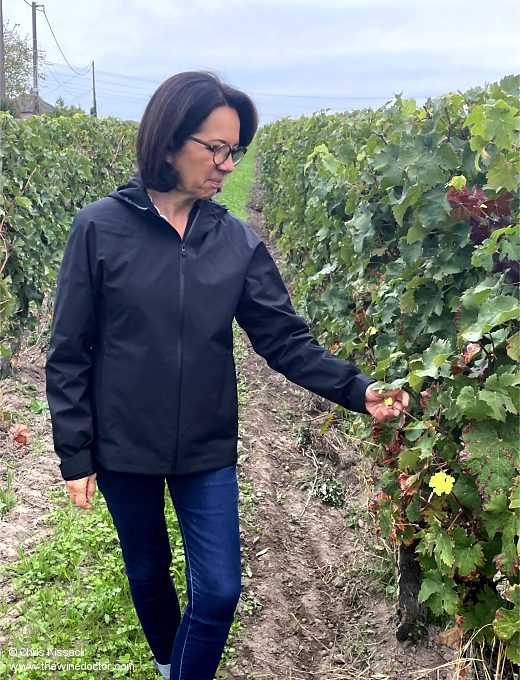
being Olga's granddaughter Sylvie (pictured right, trying to deny the existence of the
camera) together with her husband Eric de la Vigerie, who is responsible for
making the wine. Naturally, there is another admittedly rather young generation waiting in the
wings.
The vineyards, some of which lie just a stone's throw from the EDF Centre Nucléaire and very close to the Vienne, total 25 hectares in all, 24 of these for Cabernet Franc, with just 1 hectare devoted to Chenin Blanc. As you might expect, a domaine of this size incorporates all of Chinon's classic terroirs, the sandy, the gravelly and of course the classic limestone of the region, and there are also some areas of flint. The vines have an average of 30 years behind them, and receive only organic fertiliser, with ploughing of the rows between the vines, in keeping with lutte raisonée. Yields are controlled with a green harvest where necessary, come September the fruit is harvested mostly by hand, with the produce of the gravel and limestone terroirs receiving the best treatment. The portfolio of wines fashioned from this fruit results in three red cuvées of Chinon, partnered by one example each of white and rosé. Le Champs-Chenin is the white cuvée; the fruit which is 100% Chenin Blanc is sourced from a clay and limestone terroir and gently pressed before temperature-controlled stainless steel fermentation at 20°C. Once finished the wine is kept on its lees before bottling. The rosé is produced by the saignée method after between eight and twelve hours of skin contact, the fruit having originated from sandy and gravelly terroir. As with the white, this too sees a very cool fermentation in stainless steel before bottling soon after.
It is the three red cuvées, however, that I wanted to experience most. These
start with Les Barnabés, from sand and gravel terroirs in
Savigny-en-Véron. The fruit is fermented in stainless steel at no more than 25°C
and is intended for youthful consumption. Next comes Les Peuilles, made
from hand-harvested fruit from a clay and flint terroir in Beaumont-en-Véron.
Once fermented, at no more than 30°C also in stainless steel, this wine will go
into large wooden foudres for between six and eight months before
bottling. Lastly comes Les Picasses, undoubtedly the most classic and
ageworthy wine from the domaine, and some would say also one of the finest
examples of the whole appellation. Naturally it comes from a limestone
terroir, a lieu-dit where the vines have reached a respectable fifty
years of age. The fruit is hand-harvested and the final yield is typically in the
order of 30 hl/ha and after fermentation, which is again carried out in stainless steel controlled to less than 30°C, followed by a maceration of 25-30 days, the wine
that results goes into large foudres where it will rest for between
12 and 14 months before bottling. From some vintages it undoubtedly has the
potential to age with some considerable grace, always with an elegant feel, developing an
increasing level of complexity as it does so.
Tasting through several vintages of Les Picasses
quickly reveals the quality of the
wine, with several examples which were admirable despite not being from
particularly fashionable years. I was disappointed with the 1995, but would not
write off more mature wines from the domaine on the basis of this encounter with
a single bottle. There are many who like to drink their Picasses at ages far
greater than a mere twelve years! The younger vintages displayed a lot of classic
elements, together with ripeness, freshness and elegance, and certainly have the
substance required for some time in the cellar. The 2002 was perhaps the prime
example of this, although other less 'classic' vintages such as the 2003 and
2000 were of extremely good quality and should not be ignored by those who are
drawn to Chinon. (25/9/07, updated 3/9/08)
Contact details:
Address: 1, rue des Caillis Roguinet, 37420 Savigny-en-Véron
Telephone: +33 (0) 2 47 58 42 16
Fax: +33 (0) 2 47 58 83 61
Internet: www.olga-raffault.com
Olga Raffault - Tasting Notes
Click
to locate
stockists. Latest notes:
Olga Raffault Chinon Les Picasses 2000: Moderate colour, and a glossy
appearance. What I remember from my tasting at the domaine is macerated
cherries, but that characteristic is less obvious now. Instead, on the nose we
have crunchy fruit, smoke and notes of celery or celery seed. A fresh and appealing weight which is quite mouthfilling
and cleanly styled. There are firm acids, a sappy juicy character, and a fairly structured and savoury
style. Overall this is really appealing, on the way up in terms of complexity I think, but giving much
pleasure now. 16.5+/20 (July 2008)
![]()
Olga Raffault Chinon Les Picasses 2002: This has an appealing colour,
with a little hint of mahogany maturity. The nose gives us some smoky fruit. It is fairly firm on entry,
but then it softens in the midpalate, where it shows a touch of cream, but always keeping a dry,
spicy, tannic structure and reserve. It is even a little austere I think, but it
has a lovely texture, through to a promising tannic grip on the finish. This is rather
ungiving at present and needs to be left alone, but it has fine potential. It
should be excellent with time. 18+?/20 (July 2008)
![]()
Older notes:
Olga Raffault Chinon Les Barnabés 2005: Lots of fresh and primary fruit
on the nose here, with a very lifted, light, perhaps rather mineral character.
This is also the case on the palate, where it has a very fresh demeanour, with a
slightly confected sweetness to the primary fruit. Light-footed, a touch simple,
but from a sandy terroir and intended for early drinking. With that in mind,
good. 15/20 (July 2007)
![]()
Olga Raffault Chinon Les Picasses 2003: Rich, with a little confit
fruit character at first, which is noticeable and in keeping with the vintage,
but not off-putting or over the top. And there is so much more to give pleasure,
an array of cranberry, liquorice, bitter green peppercorns and smoke. This is
delightful! The palate is rich and rounded in style, with a little toffee and
liquorice coating some acidic fruit, laced with mint and peppercorn. Still quite
fresh and lifted, with an attractive balance and character. A second bottle
tasted later was wonderful. Great potential for the cellar. 18+/20 (July 2007)
![]()
Olga Raffault Chinon Les Picasses 2002: This is immediately apparent
as being a much more classic style after the 2003, with a nose that speaks much
more clearly of Chinon. There is ripe raspberry and redcurrant fruit, with a
slightly exotic, wild and feral edge, smoked and meaty, although also coated
with a little toffee. It has well defined juicy fruit and a clear, mineral,
stony element on the palate, with a fresh, slightly detached, elegantly composed
persona. Very good indeed, with really fine potential here. A second bottle
tasted later was just as good. 18+/20 (July 2007)
![]()
Olga Raffault Chinon Les Picasses 2001: This has an obvious green
olive character on the nose which certainly won't appeal to all. Rather lean
fruit too. It has quite straight acidity and has a lightness and freshness which
are perhaps the most appealing elements. It is a shame about the aromatics, and
I am not convinced these will alter significantly in the cellar. Pleasant
enough. 15/20 (July 2007)
![]()
Olga Raffault Chinon Les Picasses 2000: This is quite surprising, as
when discussing Chinon it is not a vintage I think of as being favourable. But
here is an attractive wine, with vibrant scents of macerated cherries on the
nose, and a firm palate which has more texture and depth than I expected. Good
structure, not a lot of complexity at present, but this will come. Not as
convincing as the 2002 or the 2003, but still with a lot of potential, as
confirmed by my tasting of a second bottle within a week or two. Very good
indeed. 16.5+/20 (July 2007)
![]()
Olga Raffault Chinon Les Picasses 1998: Another surprisingly good
wine, and not from one of the greatest vintages. It isn't showing too much on
the nose today, but it has an appealing texture and weight on the palate. It is
a little unusual in that it seems so subdued, but it may well become a wine of
some character with time I think. 16+?/20 (July 2007)
![]()
Olga Raffault Chinon Les Picasses 1995: This is showing obvious
maturity, in terms of colour and aromatics. It has a rather lean composition,
though, and I find the structure to be somewhat naked on the palate. It is as if
the primary fruit and texture has faded, leaving no attractive secondary
characteristics, just some inadequately covered tannin and acidity. On the basis
of this bottle, not very attractive really. Ideally I would like to taste again;
perhaps this bottle has just been open too long? 14?/20 (July 2007)
![]()
Olga Raffault Chinon Les Picasses 1990: A quite mature hue in the
glass, with a deeply
pigmented core fading out to a dusky, almost oxblood rim with a tinge of
orange-pink at the edge. It has an immediately meaty character, the wine
releasing these aromas from the bottle before I even have a chance to pour it
into the glass. Beyond this, the nose is one of subtle complexities, showing a
rather hard core of iron-bound fruit, with notes of black olives and some chalky
minerality. It is lean and
ungiving on entry, but shows a little flesh through the midpalate, just enough
to cover its bones, although it has a lovely silky-sweet character, which vies
for your attention, its competitors being some peppery tannins and a nicely
perfumed, violet tinged fruit. Rather drying tannic on the finish, but mixed
with a nice texture too, and overall
this wine still shows a good level of well balanced structural components. And
there is rather a nice length, where a little sweet fruit persists on the palate. To be
critical, although there is some attractive feminine perfume to it, it does seem
a little angular here and there, the flesh underneath that appealing texture is
a little deficient, and it is a little hot on the finish. A little more
integration would be more appealing, but I am not convinced the wine has the
stuffing necessary to give the tannins time to settle out. Nevertheless, it has
a very elegant style, and it has freshness, and both of these are
under-rated components of a wine. This is good to
drink. For label images and more see my
Wine of the Week write-up.
16.5/20 (November 2007)
![]()
![]()
Home - Site index - Site updated October 12, 2008 - © The Winedoctor 2000 - 2008 - Wine Scores - RSS