Home > Producer Profiles > Loire Profiles > Langlois-Chateau

Langlois-Chateau

The origins of Langlois-Chateau lie in the union of the 23 year-old Edouard Langlois with a young 19 year-old woman from the Vendée - that's Muscadet country - named Jeanne Chateau. Although he had been born to a rural family in 1873, Edouard worked as a vigneron and cellarman in St-Hilaire-St-Florent, just downstream of Saumur and today practicably a suburb of that town. It was here that the newlyweds founded their new winemaking business in 1912, aided by Baron de Bodman who owned Chateau de St-Florent and a number of local vineyards and cellars, the latter being essential as Langlois-Chateau was to focus on the production of sparkling wine above all other styles. Tragically, as Europe was torn apart by the Great War which erupted in 1914, so too was the union of Langlois and Chateau. At 42 years of age Edouard Langlois was killed, just three years after starting up his new venture. In a story that somewhat mirrors that of Nicole-Barbe Clicquot, it was down to the young widow to take on the running of the estate, here assisted by her son Alexis and son-in-law Maurice Leroux.

Langlois-ChateauThe family built up a successful business during their tenure, but in 1973 valuable aid came in the shape of Bollinger who acquired a controlling stake in the business, thus bringing expertise, distribution services, contacts and of course the potential for investment. Aided by Maurice's son Jean Leroux, the business was run by Michel Villedey of the Bollinger family. Unsurprisingly it was rapidly developed, and the portfolio expanded to take in many of the appellations of the Loire, although it is fair to say that the house is still most readily associated with the sparkling wines of the region. Today Villedey remains in control, assisted by production manager François-Régis de Fougeroux in the cellars, and he has at his disposal an impressive facility at St-Hilaire-St-Florent, which in recent years has seen considerable expansion and is now a bustling winery with extensive cellars and an attractive tasting room.
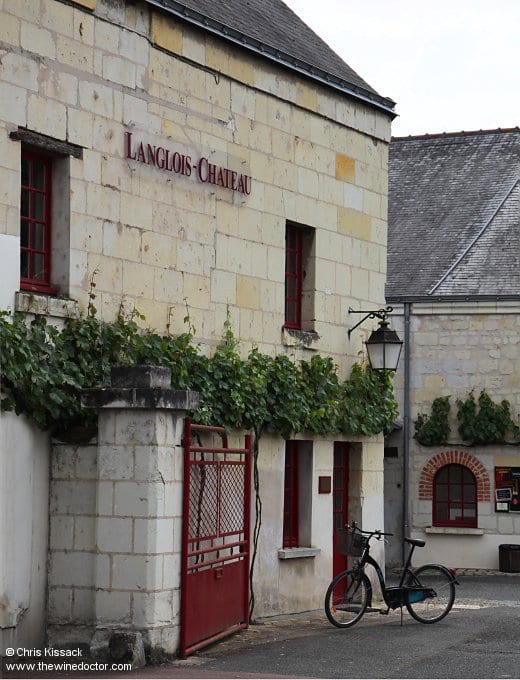
As is perhaps the norm Langlois-Chateau does not cultivate massive swathes of vines; there are vineyards in their ownership, but there are also long-standing contracts with dozens of local growers to provide fruit which is vinified in the production of the sparkling wines, mostly bottled as Crémant de Loire. As mentioned above there are bottlings from across the myriad of appellations of the Loire, a diverse range encompassing Muscadet from the Domaine du Grand Maison and Sancerre from the Chateau de Fontaine-Audon, as well as appellations a little closer to home such as Chinon, Bourgueil and Saumur. But a visit to Langlois-Chateau in sleepy St-Hilaire-St-Florent, home to all the leading sparkling wine producers including Gratien & Meyer and Bouvet-Ladubay, is a visit to taste their sparkling wines, and perhaps to tour their cellars. The fruit is sourced from across six regions, the Côtes de Saumur, Coteaux de St-Léger, Puy Notre Dame, Bas Layon, Haut Layon and Montreuil-Bellay, providing a varied mix of terroirs, predominantly the clay and the typical limestone tuffeau of the region but also a little sand and even some schist close to the Layon. Purchased fruit is brought in as grapes rather than must or wine, giving a greater degree of control than might otherwise be the case, and quality is further ensured by demanding hand harvesting into small 25 kg crates. The pressing is pneumatic and light and the primary fermentation occurs in temperature-controlled 100 hectolitre steel vats, with each terroir fermented separately. As these are all Crémant de Loire the process is méthode traditionelle, which dictates that the secondary fermentation be in bottle.

The range of sparkling wines opens with a non-vintage Crémant de Loire which is based on Chenin, with 20% Chardonnay and 20% Cabernet Franc in the blend. Of the Chenin, 10% is reserve wine, and the wine will spend at least two years on its lees before disgorgement, but it remains a very fresh and vibrant style. This is also true of the Rosé, which is purely Cabernet Franc, the colour derived from a twelve hour maceration before the must is taken off the skins. This wine will then spend eighteen months on its lees before disgorgement. A step up is the Réserve, a single vintage wine with the same varietal composition as for the non-vintage cuvée, comprised from selected wines from across all six terroirs which are then refermented before three years on the lees. Finally as far as Crémant de Loire is concerned there is Quadrille, a special selection from four distinct terroirs of clay and limestone at Montreuil Bellay which provides red varieties for the blend, with white varieties grown on more sandy limestone soils at St-Hilaire-St-Florent, St-Léger-de-Montbrillais and Dampierre-sur-Loire. Cabernet Franc and Cabernet Sauvignon are 15% and 5% of the blend respectively, the balance being 30% Chardonnay and 50% Chenin Blanc. Once the secondary fermentation is completed the wine spends four years on the lees before disgorgement. The richness engendered by this process clearly shines through on tasting. Finally there is a red cuvée Carmin Dry, a Vin Mousseux de Qualité, made purely from Cabernet Franc, again sourced from a vineyard of clay and limestone. The wine has a short maceration to give colour and a little structure, and then eighteen months on its lees before disgorgement. The result is enticing and makes a delightful antidote to those bored with New World versions of this wine which often have rather noticeable residual sugar. These are, in fact, all wines worth seeking out, especially when one considers the prices. (16/8/07, updated 14/5/08, 13/8/08)

Contact details:
Address: 3 rue Léopold Palustre, St-Hilaire-St-Florent, 49400 Saumur
Telephone: +33 (0) 2 41 40 21 40
Fax: +33 (0) 2 41 40 21 49
Internet: www.langlois-chateau.fr

Langlois-Chateau - Tasting Notes

Click to locate stockists.

2007

Langlois-Chateau Coteaux de Saumur 2007: The first vintage for this wine at Langlois-Chateau, sourced from Les Bougrons, a hill-top vineyard in the midst of the Saumur-Champigny appellation. The botrytis was "the best seen in ten years", the alcoholic potential was 18%, the eventual alcohol 13.5%. A gentle gold hue, fresh, waxy, a touch savoury. Creamy and slightly gritty, fresh with a low level sweetness. A very clean style with some appeal. From a tasting and dinner at Langlois-Chateau in 2010. 16.5/20 (February 2010)

2006

Langlois-Chateau Saumur Blanc 2006: A very pale hue here, and with a slightly herby, chalky, sherbetty nose. I am surprised to find in quite soft on the palate, with subdued acidity, and a gentle and rounded character. It has a little midpalate substance but otherwise it is rather flat and undistinguished. I don't find this particularly exciting. 13/20 (March 2008)

2004

Langlois-Chateau Saumur Vieilles Vignes 2004: This has a great, honeyed, smoky minerality, a creamy edge alongside a nice, gritty, minerally fruit. The palate is supple yet vigorous, with great acidity. Lively, finely textured, with lots of substance, although it maintains a very linear, direct and well-framed style. A really delicious, surprisingly vivacious wine. From a tasting and dinner at Langlois-Chateau in 2010. 17+/20 (February 2010)

2003

Langlois-Chateau Saumur Blanc Vieilles Vignes 2003: A golden, creamy, honeyed nose, stylish and very true to its Chenin origin. A very nicely made wine overall, showing good weight, with a gently silky texture but with decent structure underneath. Alongside the nice acidity there is a little grip. It has a short finish, but is really very good for what I often find to be a disappointing vintage for dry whites. 16.5/20 (March 2008)

Langlois-Chateau Saumur Vieilles Vignes 2003: A good nose here, stuffed with sweet and herby fruit. This has a nice weight on the palate, showing a firm and appealing presence. I like the minerally character this wine possesses, and its stony grip. This is dry and structured, with fresh red fruit. A good wine, especially within the context of the vintage which had a tendency to produce soft, baked, overly-tannic wines in many regions. 15.5/20 (March 2008)

Langlois-Chateau Saumur-Champigny Vieilles Vignes 2003: This cuvée has notes of ripe confit fruits on the nose in keeping with the character of the vintage, dried red-black fruits, cherries especially, tinged with a little coffee. It has a dark, beautiful and evocative style. Lots of dry structure on the palate, loaded with tannin, still fresh though, a cool style despite the richness, the velvety feel and grippy underpinnings. Thankfully, not remotely baked or cooked. From a tasting and dinner at Langlois-Chateau in 2010. 17+/20 (February 2010)

2002

Langlois-Chateau Crémant de Loire Quadrille 2002: This is essentially an extra-brut cuvée with just 4 g/l residual sugar. Disgorgement is according to demand, which will induce some variation in the wines produced; this particular sample has seen out six years on its lees. Lightly honeyed fruit on the nose, rich in tone but also lifted with elements of citrus fruits, even complex nuance of orange peel. This is much better than any previous taste of Quadrille I have had. There is a lovely swirling of flavour on the palate, a melange of variety-based Chenin character with lees-derived elements alongside. Rather svelte overall, elegant too, but with a firm mousse. A superb effort! From a tasting and dinner at Langlois-Chateau in 2010. 17.5+/20 (February 2010)

Langlois-Chateau Crémant de Loire Brut Réserve 2002: A pale straw-gold, with a plentiful bead of moderately small bubbles. The nose is slightly nutty, rather stony, with an elegant note of praline. Full, exuberant, slightly sherbetty on the palate but with an attractive, stony, minerally character. Nicely precise, sharp, with a bright and vivacious style over that little note of praline again. An exemplary wine which is ready now but no doubt will do well in the cellar for a few years. 16.5+/20 (July 2008)

2001

Langlois-Chateau Crémant de Loire Brut Réserve 2001: The same composition as the non-vintage, but longer on the lees and obviously a single vintage. There is more complexity on the nose as a result, and a more appealing depth on the palate. There is a slightly organic twist too it, with a little more creaminess, but it is still fresh and appealing. 16-16.5/20 (July 2007)

Langlois-Chateau Crémant de Loire Quadrille 2001: A couple of weeks ago I visited Langlois-Chateau, first for a tasting of the 2009 vins clairs, second for dinner (at which I was more impressed than I expected to be by the still wines, more on that when I write up my notes). On the way out this gift was thrust into my hand, so there's my disclosure as to the origin of this bottle. A good, rich-golden colour in the glass, especially for the Loire. The nose is similarly rich, with evolved and leesy aromas of honey and Brazil nuts, and some of this character comes through on the palate too, alongside notes of orange peel and dried toffee. Yet there is a very dry texture, with a stony feel to it, the texture of fruit grown predominantly on the limestone around Saumur. The midpalate concentration could be a little broader though. Overall it is a nice wine, although admittedly I find the richer autolytic character elements rather incongruous alongside the lovely and Saumur-typical elements of citrus and stone. The 2002, tasted at Langlois-Chateau, was far superior and I would have no problem recommending that vintage over this. 15.5/20 (February 2010)

2000

Langlois-Chateau Crémant de Loire Quadrille 2000: A real step up here, this cuvée is positively exotic compared to the straight vintage and non-vintage that went before. There are nuances of butter and cinder toffee which carry through onto the palate, although it still has that incisive acidity and remains very fresh as a result. I like the little bitter edge to its grip. Another good wine. 16.5-17/20 (July 2007)

1999

Langlois-Chateau Saumur Vieilles Vignes 1999: This has a somewhat more evocative nose than the 1999, intensely mineral now, suggestive of flint, volcanic rocks, even touches of quartz. There are also with notes of honeycomb. Overall, wonderfully scented, and on the palate a fine freshness, rich and supple, appealing and evolved. And yet it is so fresh and vigorous. A super wine. From a tasting and dinner at Langlois-Chateau in 2010. 17+/20 (February 2010)

1996

Langlois-Chateau Saumur-Champigny Vieilles Vignes 1996: An obviously more mature hue here, ageing gracefully here, elegant and rather chalky but aromatic fruit. A fine style on the palate, fresh but still showing a firm tannic backbone. Firm, but with sweet fruit still, lots of substance here. A remarkable showing from this wine, exhibiting lots of panache, seductive now and yet still on the up. Fine continued potential here. From a tasting and dinner at Langlois-Chateau in 2010. 17.5+/20 (February 2010)

Non-Vintage: Brut

Tasting notes are ordered by date of tasting, most recent first. I have tried to indicate whether it is a tasting of a new release, or of a wine I have cellared.

Langlois-Chateau Crémant de Loire Brut NV: Current release. A pale straw-coloured hue here, and a moderate size of bead, presented as a few sparse streams of bubbles. Rather yeasty on the nose, with lemony freshness, countered by a little hint of oiled wood and praline. Fresh and firm, lemony in style on the palate, with orange peel and nuts. There is a tingling undercurrent from the mousse, and a soft, creamy underbelly. This is delicious. 16.5/20 (July 2008)

Langlois-Chateau Crémant de Loire Brut NV: Current release, tasted at the domaine. Quite a pale hue. The nose has plenty of very clean fruit, with a somewhat steely edge. It is floral, fresh and delightfully acidic. It is uncomplicated but nevertheless very honest, nicely composed and refreshing. Overall, a good and well defined character that is very true to its origins. 16/20 (July 2007)

Non-Vintage: Brut Rosé

Tasting notes are ordered by date of tasting, most recent first. I have tried to indicate whether it is a tasting of a new release, or of a wine I have cellared.

Langlois-Chateau Crémant de Loire Brut Rosé NV: This is 100% Cabernet Franc, the fruit left in the press overnight to impart colour to the must, then after fermentation in bottle it is left on its lees for 18 months. A vibrant salmon-pink hue, vivacious style, good substance too. Bright and vigorous mousse. Fresh and appealing. Good. From a tasting and dinner at Langlois-Chateau in 2010. 16/20 (February 2010)

Langlois-Chateau Crémant de Loire Brut Rosé NV: Purchased July 2007. Richly coloured, salmon-pink. Stony, redcurrant, strawberry and cream nose. A little herb and leaf, but subtle. Firm palate, lots of substance, firm and incisive mousse, lively acidity, but even a little grip through the finish. This has certainly fleshed out a little when compared with my tasting note from last year, as it has a much rounded, flashier feel to the palate, although still plenty of firm grip. Very enjoyable aperitif on a warm, Sunday afternoon. 16/20 (April 2008)

Langlois-Chateau Crémant de Loire Brut Rosé NV: Current release, tasted at the domaine. An attractive, very pale pink hue. There is admittedly not much to be found on the nose here save for some redcurrant leaf, but the fruit seems a little more obvious on the palate where it has a nice vanilla-tinged strawberry, raspberry and redcurrant character with a nettly prickle. The mousse is rather gentle but creamy, perhaps more pétillant than mousseux. Clean and attractive, with a hard, perhaps slightly metallic core, but I like this wine. A second bottle within a week or two was the same. 16/20 (July 2007)

Non-Vintage: Carmin Dry

Tasting notes are ordered by date of tasting, most recent first. I have tried to indicate whether it is a tasting of a new release, or of a wine I have cellared.

Langlois-Chateau Carmin Dry Vin Mousseux de Qualité NV: Purchased July 2007. A vibrant colour here, and an intense red-black, frothing purple appearance. The nose carries blackcurrants, blackberries and black pepper, and is much less acetic than I recall from my tastings last year. Lovely, lively, exuberant sweet and crunchy blueberry and blackcurrant fruit on the palate, but with a firm backbone of acidity and not over-the-top on texture. A finely crisp finish. It is short but that hardly matters; it is delicious. and great value for money. 16.5/20 (May 2008)

Langlois-Chateau Carmin Dry Vin Mousseux de Qualité NV: Purchased July 2007. There is a little volatile acidity which blows off at first, which I do not think I have noted previously. It has a great colour, so deep and covered with a thick layer of purple bubbles. It has a nose of blackberries, smoke and liquorice, and on the palate a wealth of deeply flavoured berry fruit. There is good, fresh acidity, and some considerable tannin at the end. A wonderful lingering flavour. This is really exceptional value for money, and great fun on a relaxing, unseasonably warm Saturday afternoon. 17/20 (November 2007)

Langlois-Chateau Carmin Dry Vin Mousseux de Qualité NV: Current release, tasted at the domaine. This is visually very appealing as you might imagine, and on the nose there are lots of dark red, smoky, intense fruits, together with some liquorice, which all comes through nicely on the palate. There is a rounded character, and appropriate but not sweet dosage which gives a soft, ripe creamy feel, although there is an attractively bitter grip and a dry finish. Nicely defined acidity helps to keep it fresh. Again, a second bottle within a week or two was the same. Lots to admire here, very good indeed. 16.5-17+/20 (July 2007)