Home > Producer Profiles > Bordeaux Profiles > Chateau Trottevieille
Chateau Trottevieille
Chateau Trottevieille, an estate which lies to the east of St Emilion on the limestone plateau, has perhaps the most fanciful explanation for the derivation of its name of all Bordeaux. The proprietors themselves suggest that the name derives from la trotte vieille, which may be translated as the old trotting lady. It seems that there once lived here an elderly woman who would regularly trot down to the crossroads at the foot of the vineyards in order to here the news from the drivers of passing coaches. It isn't, to me, a very convincing tale, but nevertheless I repeat it here so that you may judge for yourself.
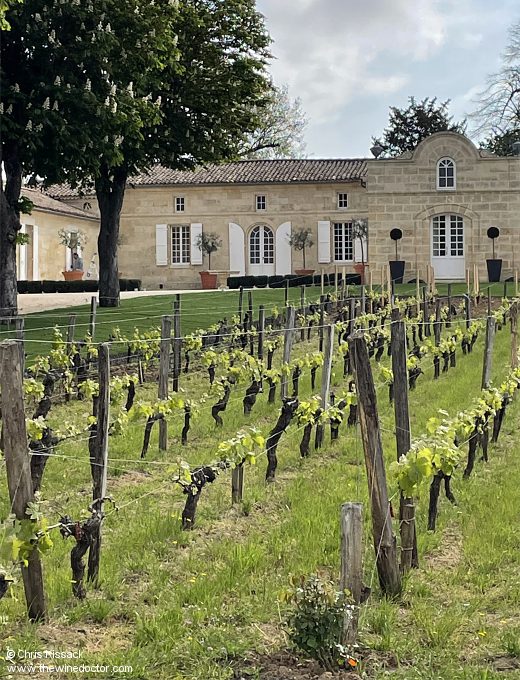
The current owners became involved with the property in 1949, when it was acquired by Marcel Borie of Borie-Manoux, who subsequently passed the estate to his son-in-law Emile Castéja. Today the estate and vineyards, which are graced with an attractive single-storey chateau which dates from the 18th Century, is in the ownership of Société Borie Manoux, part of a portfolio that also includes Batailley and Lynch-Moussas. As such it is the only Premier Grand Cru Classé estate in St Emilion in the ownership of a Bordeaux négociant, although it is Philippe Castéja, Borie's grandson, that runs the show, with the help of Christophe Dussutour in the vineyard and chai, and consultation from oenologists Gilles Pauquet and Denis Dubourdieu.
The vineyards cover 10 hectares of the St Emilion commune and have a
favourable south-southwest aspect, with soils of clay perhaps 35 cm deep over a
limestone bedrock, entirely typical for the region. The vines are 50% Merlot,
the balance being 45% Cabernet Franc, and a bit-part for Cabernet Sauvignon
which makes up the remaining 5%. These are planted at a density of 7500
vines/ha, and although they have an average age of about 50 years they include
one ancient block which dates back to the pre-phylloxera era. Yields are
controlled using appropriate single or double Guyot pruning and debudding, with
a green harvest during the summer, and although figures naturally vary from year
to year 2006, as a guide, saw overall yields of 33 hl/ha, with a figure of 29
hl/ha for the grand vin. The harvest is naturally manual, and the fruit
fermented in temperature-controlled concrete vats, where the embryonic wine
rests for between three and four weeks before transfer into barrel for
malolactics and subsequent ageing. Here the wine will stay for between 18 and 24
months, depending on the vintage, using between 90% and 100% new oak. The
resulting grand vin is bottled as Chateau Trottevieille, whereas
the second wine is La Vieille Dame de Trottevieille (typically 3000 cases
per annum).
Opinions differ, but referring to Trottevieille's exalted position as a Premier Grand Cru Classé in his 1982 tome Bordeaux (reprinted 1991) David Peppercorn describes Trottevieille as one of the two "weakest crus", although later he goes on to say it is worthy of its position. In late 2005, in anticipation of the 2006 revision of the St Emilion classification, there was no shortage of speculation (such as on Jean-Luc Thunevin's fascinating Garagiste blog) that Trottevieille was a candidate for demotion, showing that today there are some who still concur with Peppercorn's first thought. Some seem to think that since 2000 the property has had something of a renaissance, and that quality has improved. I have tasted a few vintages that straddle the turn of the Century, and I would not disagree, although I do not have that many data points. In the light of a great vintage, the 1998 was good but perhaps not good enough when tasted against its peers; one must remember that the thirteen Premier Grand Cru Classé properties are the crème de la crème of all St Emilion. The 2003 showed somewhat better, however, and the 2004 was really pleasant, stylish and fresh. One obviously looks to the hyped-up 2005 to trump them all, but on tasting it at two years of age this didn't seem to be the case. It would be informative to taste these in a line up in order to re-examine this apparent disappointment. (5/12/07)
Contact details:
Address: 33330 St Emilion
Telephone: +33 (0) 5 56 00 00 70
Fax +33 (0) 5 57 87 48 61
Chateau Trottevieille - Tasting Notes
Chateau Trottevieille (St Emilion) 2005: A bright and aromatic style on the nose,
although it is complicated by nuances of slightly jammy fruit, with little hot,
feral nuances. On the palate though it initially seems much more composed than
the nose suggested, although through the midpalate there is a layer of feral,
cherry fruit laced with peppery spice, backed up by a huge, chewy grip of
tannin. There is a slight bitterness on the edge too. A decent style. From my
tasting of
2005 Bordeaux at two
years of age. 15.5/20 (October 2007)
![]()
Chateau Trottevieille (St Emilion) 2004: Another very expressive nose here, with
some plush plum fruit and perfumed fruitcake. Fine palate, with some elegant
red-black fruits. The fruit amply covers the tannins, good acidity, rounded,
with a creamy style. Grippy, complete. Very good wine. From my Bordeaux 2004
assessment. 17+/20 (October 2006)
![]()
Chateau Trottevieille (St Emilion) 2003: Rather closed, an appealing
nutty character, quite full, expansive and structured. But not so evocative in
terms of flavour. Closed down. But there are some nicely judged tannins. Ripe.
Could be really good, and seems to surpass the 2001, but is a touch difficult to
judge at the moment. 16-17+?/20 (February 2007)
![]()
Chateau Trottevieille (St Emilion) 2001: Evocative nose, smoky
blackberries, deep fruit, very attractive in short. The palate has a touch of
sweetness to the fruit, is full and extracted, with an appealing structure.
Flavoursome and well rounded, impressively worked, but doesn't quite have the
direction, the definition, that I would like. 16/20 (February 2007)
![]()
Chateau Trottevielle (St Emilion) 1998: Philippe Castéja talked us
through the wine. Another small site, just 10 ha, situated on very shallow soils
- just 35 cm above base rock. Planted with Merlot 50%, Cabernet Franc 45%,
Cabernet Sauvignon 5% although Merlot is over-represented in the 1998 blend. A moderate density of hue.
Red fruits, smoke and cashew nuts on the nose. Very fresh, with red fruits, yet
still with a velvet edge to the texture. It is lighter than the other wines, but
has elegance and balance on its side, and for that I like it. Soft, supple
tannins, and correct acidity. Stylish. From a tasting of
1998 St Emilion. 16/20 (May 2004)
![]()
Home - Site index - Site updated September 07, 2008 - © The Winedoctor 2000 - 2008 - Wine Scores - RSS