Home > Producer Profiles > Bordeaux Profiles > Chateau Trotanoy
Chateau Trotanoy
Any history of the vineyards of Pomerol must include some mention of Trotanoy. In an appellation where history can sometimes seem to be in short supply, Trotanoy is one of the more venerable estates, dating back to the time when viticulture was being established in the region. At the time it was in the ownership of the Giraud family, royal courtiers from nearby Libourne, and it was most probably they who were the first to plant vines on the estate, beginning the shift away from arable polyculture towards what we know is the case for Pomerol today, a situation in which the vine dominates the landscape absolutely.
Trotanoy: a History
At this time the Giraud land was referred to as Trop-Ennuie, as evidenced by documents from the late 18th Century; literally translating as "too annoying" it is commonly said that it refers to the Trotanoy soils which, being a mix of thick clay and gravel, are tiresome to work, either by hand or by plough. Nevertheless the work must have paid some dividends because during the 19th Century the estate was comfortably positioned with the best of the appellation, including Vieux Chateau Certan and La Conseillante. It was also one of the largest, with 25 hectares to its name, and naturally there was a sizeable production to match, although this was destined to change. From 1898 the estate became more parcellated, due in part to the Napoleonic rules of inheritance and also to inheritance taxes, which saw some of the vineyards sold off. With world war and economic decline this trend would only continue, and after just 30 years the estate, now incorporated as the Société Civile du Chateau Trotanoy, was reduced to less than half its previous size, just 11 hectares. The Giraud era was drawing to a close.
The first change of hands, after more than two centuries, came shortly after World War II when the Girauds sold to the Pecresse family. Small-time viticulteurs who owned a number of other minor properties, the new proprietors did not hold onto their acquisition for long; in 1953 it was sold once again, this time coming to the Moueix family of Libourne. It was Jean-Pierre Mouiex that struck the deal, and today the property is administered, managed and marketed by the next two generations of this right bank dynasty, Christian and Edouard Moueix, on who I have already given a little more history in my Petrus profile, as well as Christian's cousin Jean-Jacques Moueix, who resides at the property.
The Vines and Wines
The Trotanoy vineyard comprises just 7.5 hectares positioned partly on the
Pomerol plateau, partly on the slope to the west. The lower parts on the
west-facing slope are rich in a dark clay which characterises much of the
Pomerol appellation, whereas those parts higher up contain much more gravel. The
subsoil contains gravel and sand, and deeper still is the crasse de fer,
the rock-hard layer of iron-rich soil which lies beneath many of these
Libournais
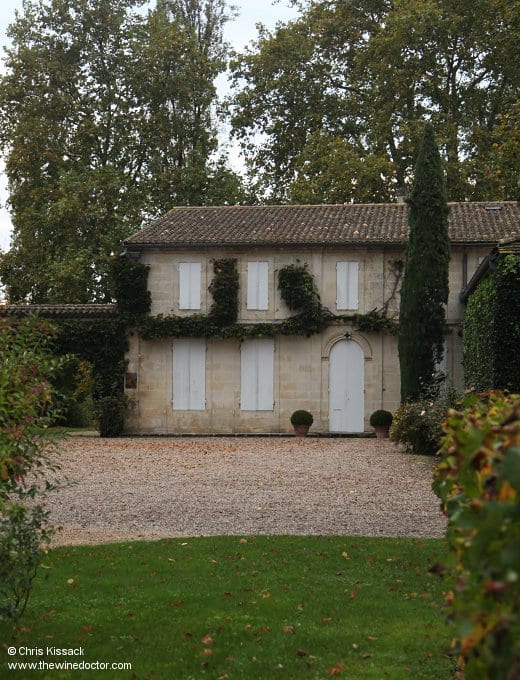
vineyards. At the centre sits the chateau, where Jean-Jacques resides, a rather
modest but attractive house dating from the late 19th Century. The vines that
surround it are 90% Merlot and 10% Cabernet Franc, and as the majority survived
the devastating frost of 1956 they have a venerable
age, approximately 40 years on average.
Like Petrus, the vineyard of which is a little larger than that of Trotanoy, the harvest here may be finished in less than two days, even if the pickers are restricted to working in the afternoon after the warmth of the day has lifted the morning dew. The hand-picked fruit is delivered to the cellars, where it is vinified in small concrete vats for up to ten days, followed by a week of maceration on the skins. Up until 2007 it was oenologist Jean-Claude Berrouet that oversaw operations in the cellars, as he also did at Petrus, but with his retirement he has been replaced by Eric Murisasco here and at the other Moueix properties except for Petrus, where Jean-Claude's son Oliver has taken over. The vinification here is handled in much the same way as Petrus; it sounds wrong to describe it in this way, but we should remember that although Petrus and Trotanoy are separate estates, under different administrations, they are in truth under the control - as far as viticulture and vinification are concerned - of one man, Christian Moueix. Perhaps one of the most notable differences between the two estates is that whereas Petrus sees 100% new oak each year, the barrels at Trotanoy are typically only one-third to one-half new each vintage, and the wines is kept within typically for 18 months prior to bottling.
As is the case with other exalted estates of the right bank such as Le Pin and Ausone, my experience with the wines of Trotanoy is limited largely to very recent vintages. Both the 2008 and 2007 were tasted in the Moueix offices on the quai du Priorat during the primeurs week. The disadvantage of this is that each note refers to a youthful barrel sample rather than the wine in question, and sadly opportunities to reassess once in bottle and not commonplace. One advantage, however, is that in each case I have tasted the wine in a setting which allowed some contrast and comparison with its peers, including La Fleur-Pétrus, Providence, Hosanna and others. In both vintages Trotanoy largely outperformed these wines, the 2008 having excellent potential for the future, whereas the 2007 was not quite up to the same level but was very fine for the vintage. As for the 1961, this wine was superb; I suspect it was not the best example of this wine, which has a heady reputation, but it was nevertheless very fine indeed. (11/6/09)
Contact details:
Address: 54, quai du Priourat, 33502 Libourne
Telephone: +33 (0) 5 57 51 78 96
Fax: +33 (0) 5 57 51 79 79
Internet: www.moueix.com
Chateau Trotanoy - Tasting Notes
Chateau Trotanoy (Pomerol) 2008: Rather serious and reserved nose, with a firm,
plum skin quality. The palate is very fleshy though, with a very nice fruit
quality. Good tannins, ripe although substantial and meaty. They are very well
covered by the fruit, although being critical there is a little hint of flatness
to the texture through the midpalate. But there is a fine substance to it, and a
big tannic finish. This could be excellent. From my
2008 Bordeaux primeur assessment. 17-18+/20 (April 2009)
![]()
Chateau Trotanoy (Pomerol) 2007: Very direct, well defined, fresh and lifted
plums and black fruits here. This is delightful. An attractive substance follows
on the palate, with good flesh supported by appropriate acidity and ripe
tannins. Approachable, stylish, with good grip and substance. This sample has
vigour and definition, and I like it very much. Really very good potential here.
From my 2007 Bordeaux
en primeur assessment. 16.5-17.5+/20 (April 2008)
![]()
Chateau Trotanoy (Pomerol) 2005: Dark, pure and defined
fruit on the nose,
cleaner than some other wines, purer and certainly appealing, with aromatic
wood spice. On the palate a very structured and upright style of Pomerol, with
tightly packed and rather polished fruit, and a mildly stony, reserved texture.
There is good substance here though, and overall a balanced and direct rather
than overly-fleshy or generous style. This will make good drinking in 10 years,
or maybe even longer than that. From a
2005 Bordeaux
tasting at four years of age. 17.5+/20 (November 2009)
![]()
Chateau Trotanoy (Pomerol) 1961: A deep, dense, very impressive
colour. The nose is gorgeous, aromatic, pure, with dark fruits, clean and well
defined. There is a little seam of coffee and spice too. The palate follows in
the same vein, a pure and well delineated style, clean, firm, structured but
with an elegant sweetness. The tannins give a good backbone to the sweet berry
fruit, as matches the lifting acidity very well indeed. Rich yet nicely
delineated. A delicious, lingering finish too. This must have been an absolute
blockbuster in its day. From a 1961 Bordeaux tasting. 19/20
(June 2007)
![]()