Home > Producer Profiles > Bordeaux Profiles > Petrus

Petrus

Is Petrus today the most famous estate in Bordeaux? If this is so it would hardly be surprising; Petrus is one of a trio of right bank wines, the others being Le Pin and Ausone, which now sell at astronomical prices, typically thousands of pounds, dollars or Euros per case if not per bottle, and when you are expensive you can also be newsworthy. I suspect such widespread knowledge of the wine is largely vicarious; indeed, as Clive Coates wrote in 1995 in Grands Vins, "Many of the top wines of Pomerol, I suspect, are known more by their reputation than by actual tasting experience". In the case of Petrus such knowledge is perhaps based on occasional tabloid news reports of expensive dinners at Michelin-starred restaurants as traders and bankers blow their recently acquired bonuses in the most conspicuous fashion possible. Such dinners frequently seem to include Petrus, usually squeezed between the vintage Krug and the Yquem; this particular Pomerol has, in circles devoted to conspicuous consumption at least, become something of an icon.

And yet in the mid-20th century, just a few decades ago, Petrus was a little known estate in an appellation regarded as a minor satellite of St Emilion; the wines were sometimes difficult to sell, and the prices were low. It has been a meteoric rise to stardom under the tenure first of Madame Edmond Loubat, and then the Moueix family, for this modern-day prince of Pomerol. But this is very recent history, and the Petrus story begins at least a century earlier.

Petrus: Arnaud, Loubat, Lacoste & Moueix

The oldest reference to the Petrus estate comes in the early years of the 19th century, long after most Médoc estates sprang into life, and indeed lagging far behind those of nearby St Emilion, a number of which have Roman origins. The origins of Petrus are probably not quite so ancient, although they are certainly a little mysterious. The name itself refers to St Peter, who makes clear his allegiance to the estate by appearing on the label, equipped with the keys to the Pearly Gates - or to the cellars at Petrus, perhaps. Why this name should be chosen is unknown, although as some very old vintages are labelled as Petrus-Arnaud, the latter half of this pairing being 19th century proprietors, it is plausible that Petrus was the name of a previous owner. When reference to Petrus was first made the leading estate appears to have been, if the price of the wine is any way to judge, Vieux Chateau Certan. Close behind, however, came a number of estates very well known today, including Trotanoy, La Conseillante and Petit-Village. Petrus, at this time in the hands of the aforementioned Arnaud family, was another one of this number. As the reputation of the appellation grew it was the trio of Vieux Chateau Certan, Trotanoy and Petrus that came to define themselves as appellation leaders, a Pomerol trinity so to speak. The wines sold at higher prices than their peers, although at a similar price to lesser growths on the left bank, an illustration of how Pomerol was perceived to be minor appellation.

PetrusIt was during the early 20th century, particularly between the two World Wars, that Petrus broke away from the rest of the pack. Having been incorporated by the Arnauds with the creation of La Société Civile du Chateau Petrus, Pomerol's leading domaine now began to come into the ownership of Madame Edmond Loubat, who acquired shares in a piecemeal fashion, eventually becoming the sole owner by the end of World War II. Loubat managed and marketed the estate with the help of a family who, during the years that have since passed, have proved themselves to be a central part of the Petrus story, if not the central plot. Indeed, in time, they came to own it; the family in question was named Moueix.

Jean-Pierre Moueix and his son and grandson, Christian and Edouard, are surely some of the most important names in the story of not just Petrus but Pomerol as a whole. The Moueix dynasty started with Jean-Pierre's father Jean, who was originally from farming stock, from Corrèze, but who had settled in Paris with his wife Anne-Adèle Monange, where they had set up a successful chain of shops selling dairy produce. But having seen his brother Antoine purchase Chateau Taillefer in 1923, Jean decided that there was more to life than selling cheese; he and his betrothed purchased Chateau Fonroque and then settled at the estate. But this was perhaps a bad time to buy; economic depression during the post-war years meant that the wine was difficult to sell. It was against this backdrop of hard times that their son, Jean-Pierre Moueix, unable to find a buyer for their wine and clearly deciding strength came with diversification, established Etablissements Jean-Pierre Moueix. Through this business he traded in other wines, and the company flourished. Today Jean's château is still home to a Moueix, but any fan of the right bank appellations will think first, upon hearing this distinctive name, of the quay-side business of Jean-Pierre's descendents, Christian and Edouard, before they think of Alain Moueix at Fonroque. Together the father-and-son team own, market or manage some of the most significant names in Pomerol.

Madame Loubat's faith in her vineyard and her wine meant that prices rose; every reference to her that I have seen mentions this part of her character. The Telegraph obituary of Jean-Pierre Moueix, who died in 2003, penned by Nicholas Faith, describes her determination "not to allow her wines at under the - then exorbitant - value she placed on them", or as the Times (and a very similar article in the Scotsman) put it, writing on the same sad occasion, "she never made the mistake of underestimating the value of her product". That's three obituaries in British newspapers for a French négociant none of which could avoid touching on his dealings with Loubat and Petrus - as I wrote above, Petrus is newsworthy. Despite the high price merchants, most notably the UK merchant Ronald Avery, bought her wine, and I would suppose they must have managed to sell it too. Much of this side of the business was naturally handled by Jean-Pierre Mouiex, or JPM as he was sometimes known, and Moueix and Loubat formed a formidable friendship. When the latter died without issue in 1961 it was perhaps only natural that Moueix should inherit a share of the estate. What was not bequeathed to Moueix was divided into two equal parts and passed to the offspring of Loubat's two sisters, Madame Lacoste and Monsieur Lignac. Just three years later Moueix bought Lignac's share, gaining control over the property. In time Marie-Louis Lacoste (referred to as Madame Lacoste-Loubat on the label, but Lily to her friends) sold her remaining share to the Mouiex family, and they have retained control ever since, running the estate with the help of oenologist Jean-Claude Berrouet for many years, in recent times replaced by his son Olivier. Upon Jean-Pierre's death one might expect the estate to have been bequeathed to Christian, but instead it went to another son, Jean-François, who is head of Groupe Duclot. As such Jean-François administers the estate, and has sole distribution rights within France, but it is Christian and Edouard that see to the vineyard, the vinification, marketing and export distribution.

The Petrus Scandal

Although Lily Lacoste relinquished control over Petrus it was inevitable that her name should continue to be associated with the estate, especially so considering the deal that was struck involved her retaining at least 1200 bottles of the wine. In fact it was these bottles that kept her name in the newspapers; once again, for perhaps all the wrong reasons, Petrus was proving very newsworthy, thanks to an apparently scandalous affair.

The scandal erupted in late 2002 when it seemed that several hundred bottles of Petrus had disappeared from the cellar of Lily Lacoste. At this point well into her 90s, it seemed as though someone may have taken advantage of a frail, elderly and trusting soul. In late 2002 her confidant Michel Chasseuil - who replaced Michel Loulière as her advisor - declared that 400 of the bottles were missing; in addition she had sold her other property Lafleur, and donated Latour à Pomerol to a Catholic charity, and the suggestion was that in doing so she had been badly advised. Her nephew Guy Pétrus-Lignac was also  suspicious of these perhaps questionable dealings, quite naturally so as heir to her fortune. As a response there was a move to make Lily Lacoste a ward of court, to protect her, but she and Chasseuil, as well as her friends and relatives, questioned the need for such a move. Subsequently a farcical game of legal musical chairs ensued, as Chasseuil was sacked and Loulière reinstated, followed by Loulière's second dismissal. A new legal team was put into place, but they were dismissed by a state-appointed protector. Slowly but surely, however, the case began to unravel.

Lily died in 2006, just a few months short of her 100th birthday, but that wasn't enough to stop the legal proceedings against the accused. As it turned out, the three that found themselves in the frame were André Border-Vidal, a wealthy octogenarian friend of Lacoste, the aforementioned Loulière and one François Burel, the general secretary of the charity which had benefitted so much from Lacoste's generosity. The opinion of Jean-Claude Chanseau, psychiatrist, was at the time of these dealings Lacoste was no longer sufficiently in possession of adequate mental faculties, the obvious conclusion being that she was indeed manipulated for the good of others. At the time of writing this profile, however, no formal charges have been brought against the trio, and the court has yet to decide whether or not to continue with the proceedings.

Petrus: The Vines & Wines

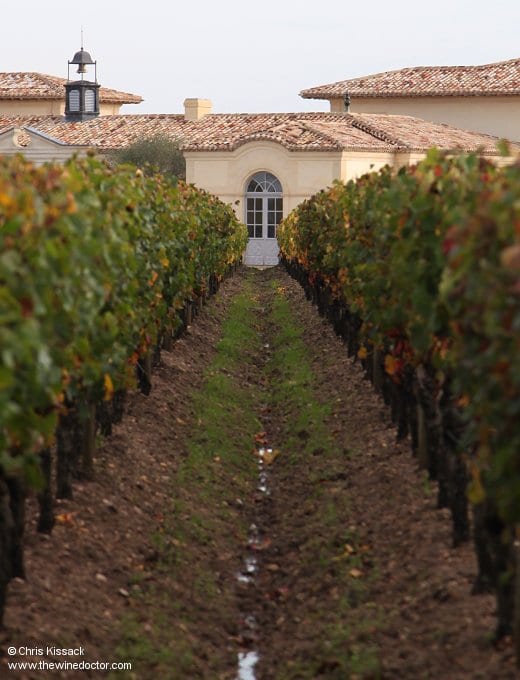
PetrusThe Petrus vineyard is noted for its rich, dark clay soils, less gravelly than that in some neighbouring estates such as La Fleur-Pétrus, Cheval Blanc and Figeac. These soils sit on the Petrus boutonnière (or Petrus button), a mound 40 metres above sea level; rather a modest rise, you might say, but the highest point in the appellation nevertheless. Underneath there is a thick seam of iron-rich subsoil known as crasse de fer which characterises some Pomerol vineyards such as Taillefer, where it even contributes to the name. The vines are 95% Merlot and 5% Cabernet Franc although it is not the norm for the latter to be incorporated into the blend, so today the wine is usually pure Merlot. In much older vintages, however, looking back to the 1960s and beyond, Cabernet Franc may have paid a much greater role, as much as 20%. There are just under 12 hectares all told, of which 5 were added to the estate when purchased from neighbouring Gazin in 1969. Such an acquisition is bound to cause eyebrows to raise; after all, how can the quality be maintained when the vineyard doubles in size overnight? This was a question addressed by David Peppercorn writing in Bordeaux (Faber & Faber, second edition) in 1991. Moueix reported that of the five vats produced each vintage, three come from the original Petrus vineyard, whereas two are from the purchased vines. When ranked one to five in order of merit he claimed that the wine from the purchased vines never came last.

The vines are trained low, and many are very old, with an average age in excess of 45 years. The heritage of the vineyard has been protected by both Loubat and Moueix over the years; after the devastating frost of 1956 Loubat refused to replant, instead grafting new vines onto the surviving rootstocks; some of these half-old, half ancient vines still populate the vineyard today. Since then, whereas it is usual to replace individual deceased vines with new, Moueix has resisted, ensuring the age of the vineyard remains high, and replanting whole blocks when it is ultimately necessary. Otherwise the vineyard work is as you might imagine; yields are limited by pruning, the soils are ploughed and there is crop-thinning and de-leafing to ameliorate quality. The harvest is by hand, and such is the size of the vineyard it may be finished within two afternoons, after the morning dew has evaporated. If the moisture is more than the sun can handle it has been known for the vines to receive a blow-dry from a hovering helicopter. The ultimate yield is typically in the order of 35 hl/ha. In the cellars, which sit unprepossessingly at the side of one of the many minor roads that criss-cross the Pomerol appellation, the process of converting grape into wine follows a fairly standard pattern. There is a sorting before pressing and fermentation in thermoregulated concrete tanks, with maceration of the skins for 18-25 days. There is malolactic fermentation in a mix of oak and vat, and blending takes place in December before the barrel ageing per se begins, using 100% new wood. The wine will rest here for up to two years before bottling.

Rather as is the case with Le Pin my experience of Petrus is limited by the price of the bottles, and access to the wines. No invitations to grand, multi-vintage dinners for me! And so it is only the most recent vintages I have tasted, having taken advantage of the primeur opportunity when Christian and Edouard Moueix open the doors of their quay-side offices in order to show the latest vintage to all and sundry - provided you have an appropriate appointment, of course. I am fortunate, however, that this tiny sample includes the 2008 vintage, a magnificent effort, a wine that slid into my top ten for the vintage with ease; if there was ever an example of the greatness of Petrus, this is it. (7/5/09)

Contact details:
Address: 54, quai du Priourat, 33502 Libourne
Telephone: +33 (0) 5 57 51 78 96
Fax: +33 (0) 5 57 51 79 79
Internet: www.moueix.com

Petrus - Tasting Notes

Click to locate stockists.

2009

Petrus (Pomerol) 2009: Merlot 100% of course, alcohol 14%, pH 3.8. Very well defined and elegant fruit profile here, with a haunting Pomerol spice. A lovely and supple palate, very well defined, fresh and lively fruit profile, with a beautifully pure definition. Red plums and cherry, also slightly floral, with notes of violets, vibrant and lightly crystalline fruit, and light nuances of damson too. Elegant, elegant, elegant. Underneath, however, there is a layer of tannins which is well-controlled, giving backbone and enveloping the wine, but never dominating it. The fruit comes out on top, the harmonious texture too. There is fine acidity at the core, and there is a suppleness of fruit over the top that makes it seem very approachable. But underneath it is a wine of structure and power. It has a fine balance, but when you come to appreciate the structure it is clearly a vin de garde. Great length. From my 2009 Bordeaux primeur assessment. 18.5-19.5+/20 (March 2010)

2008

Petrus (Pomerol) 2008: Really very impressive style on the nose here, with rich, ripe, plump but stylishly fresh fruits dominating. The palate has a silky start to it, and the quality of the tannins clearly sets this wine apart from the rest of the Moueix portfolio in this vintage. They have a very ripe and polished character, providing elegance but also substance. The palate builds in terms of impact, with a firm and fresh acidity throughout. A very admirable wine with fine potential. From my 2008 Bordeaux primeur assessment. 18-19+/20 (April 2009)

2007

Petrus (Pomerol) 2007: A rich, sweet, dark and creamy nose. Real depth here, some purity to it, and a bright fruit character. Rich, plenty of substance, but balanced, firm, grippy and fresh. Deliciously direct style, broad and expressive, with a good style. Pure but deep and characterful with good vigour, this has excellent potential. From my 2007 Bordeaux en primeur assessment. 17-18+/20 (April 2008)

2005

Petrus (Pomerol) 2005: A very solid style on the nose here, dark and concentrated, still showing some primary Merlot character. There is purity to it though, although also a lifted and subtly volatile element, with nuances of balsamic. Intense cherry fruit, cranberry too, with roasted herbs. This all belies a rich, substantial, defined and powerfully tannic palate which has a structure that clearly demands the long haul. Very broad, lightly polished, quite fleshy although nicely styled. There is a prodigious layer of tannin here, which has a massive although velvety feel to it, swimming beneath primary fruit character. Long, tannic, balanced and well defined this is a monumental effort destined to slumber in the cellar for a very long time. From a 2005 Bordeaux tasting at four years of age. 19.5+/20 (November 2009)