Home > Producer Profiles > Bordeaux Profiles > Chateau Nairac
Chateau Nairac
The early history of Chateau Nairac is imprecise, but the origins of the vineyard seem to lie in part of the estate of André Duranceau, a wealthy Bordeaux accountant. His estate included a fine house in Barsac with a not inconsiderable area of vineyard, which he leased out. He bequeathed his estate to a gentleman named Jérome Mercade, who was related by marriage to two other notable families who were proprietors at Climens and Romer-du-Hayot. He expanded the residence, but it was his daughter-in-law, Elizabeth Prost, who inherited the property from Mercade, that expanded the vineyard turning it into a serious concern. She was subsequently joined in her efforts by her own son, but the pair eventually sold the vineyard in 1777, the new owner being Elysée Nairac.
The Nairac family were a
wealthy local dynasty, having made their fortune as merchants, in shipping, and in politics. Their first act was to
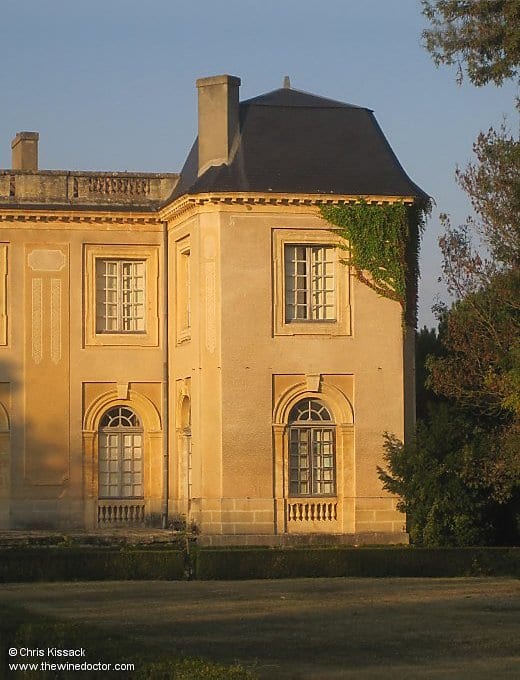
improve the residence, erecting a fine chateau designed by the architect Jean Mollié. Elysée ran the estate until his death in 1791,
at which point it was bequeathed to his five daughters. Two in particular, Henriette and Julie-Emilie,
found themselves in receipt of the vineyard. Together the spinsters lived here
until Henriette's death in 1837, when the family, many of whom had fled France during Robespierre's Terreur, were forced to put the property up for sale. It
was acquired by Bernard Capdeville of Chateau Broustet, who also owned an
enclave in the western part of the Nairac estate which had been sold off as a
bien national following the Revolution. Capdeville united his acquisitions,
creating an estate of an admirable size which produced up to 50 tonneaux
(one tonneau is 900 litres). It was in this state that the property was
classified in 1855.
In 1861 Capdeville died and his estate was divided into its original constituent parts, with the Nairac portion passing to Georgina, one of his daughters. She married Pierre Gustave Brunet, but as the relationship was without issue this part of the vineyard was passed upon her death in 1906 to a cousin named Armichard. Having secured the estate despite legal challenges from other members of the family, she sold it to a négociant named Jean-Charles Perpezat. The vineyard he acquired was small (hence Capdeville's decision to incorporate it into Broustet), reportedly just 10 hectares, and produced a tiny quantity of wine. Nevertheless, Perpezat set to work, replacing red varieties with Semillon, Sauvignon and Muscadelle, and naturally doing what he could to enlarge the vineyard. Much of his work was dashed when the vines were decimated by the frosts of 1956, but he and his family continued on nevertheless, until they eventually sold the estate to Dr Jean Gabriolle Seynat in 1966. Under his aegis the vineyard slipped further into disrepair, the wine sold off in bulk and the chateau gradually slipping into a state of dilapidation. It would not be until the Heeter family acquired the property in 1971 that the fortunes of Nairac would change. Tom Heeter was an American who had taken on work at Giscours and subsequently married Nicole Tari, daughter of Nicolas Tari, the proprietor. Nairac was their own project, a family home as well as a vineyard, and within three years the chateau was habitable and they had moved in. The vineyard management was brought into line, the outbuildings were renovated, the winemaking facilities improved, and consequently the quality of the wines themselves was ameliorated. Under the care of the Heeter family, with advice from Professor Emile Peynaud, Nairac improved immeasurably. In more recent years it has been cared for by Nicole alone, although with help from her children, following her divorce from Tom Heeter. Despite these events, the quality of the wine seems to have remained high.
There are today 17 hectares of vines
in the Barsac
appellation, mostly adjacent to the chateau, planted
on a gravel and limestone soil. Semillon dominates, accounting for 90% of the
vineyard, with 6% Sauvignon Blanc and 4% Muscadelle. The vines have an average
age of 30 years. Under the tenure of Heeter the wines included a significant
proportion of Sauvignon Blanc, as much as 18%, as he appreciated the fresh
aromatics it provided; to ensure he achieved this he would often harvest the
Sauvignon early, without noble rot, which he felt negatively affected these
characteristics. The Semillon has always been harvested in a series of tries,
as is the norm throughout the commune. Once harvested the fruit is pressed and
transferred to oak for fermentation, a practice recommended by Peynaud which
mirrors that undertaken at Yquem. Once finished, the wine may see up to 30
months barrel age before bottling. The resulting grand vin is Chateau Nairac, there is no second wine.
The style of Nairac is undoubtedly a rich one, but it still has the fresh and vibrant acidity that characterises Barsac, but despite this there is also plenty of structure and oak-imbued character, sometimes a little heady, luscious viscosity. Certainly the 1989 showed a lot of this sort of character. More recent vintages have shown a little more raciness, a little more elegance, and are perhaps therefore more readily identifiable as Barsac, but they still have the voluptuous streak added to the mix. If rich, luscious and yet fresh is your style, then Nairac could be the wine for you. (1/8/07)
Contact details:
Address: Chateau Nairac, 33720 Barsac
Telephone: +33 (0) 5 56 27 16 16
Fax +33 (0) 5 56 27 26 50
Internet:
www.chateau-nairac.com
Chateau Nairac - Tasting Notes
Chateau Nairac (Barsac) 2009: Residual
sugar 185 g/l. A pure and
deep style to this wine, intense, with rich fruit swirled with intense honey
sweetness reflecting that high residual figure. The palate
has a little more lift than even the nose suggested, is well textured, with an
elegant, supple fruit style. There is substance to it as well though, also spice
and grip. Lovely wine. From my 2009 Bordeaux
en primeur assessment. 17.5-18.5+/20 (March 2010)
![]()
Chateau Nairac (Barsac) 2007: A very pure nose, sweet golden fruits, with lovely density
on the palate. Very sweet, a rich fruit style, with apricots swirled in in a
dense layer of honey. Structured, even a little grippy, with rich
marmalade-tinged fruit and plenty of depth. It has some length too. This is another wine
showing much more convincingly than during the primeurs. From my tasting
of 2007 Sauternes at
two years of age. 18+/20 (October 2009)
![]()
Chateau
Nairac (Barsac) 2007: An appealing nose of honey, acacia and crystalline fruit. A pure style on the
palate, with delicate citrus and floral flavours. Nicely framed, fresh and
peppery, with lovely acids quite persistent through the midpalate. A good,
creamy-honey finish, bright style and a good length. From my
2007 Bordeaux
en primeur assessment. 16-17+/20 (April 2008)
![]()
Chateau
Nairac (Barsac) 2006: A fresh, attractive, mineral-laden nose. Rather fat on the
palate, very fleshy, with a dense, marmaladey richness, although with a savoury
rather than sweet edge to it. There is a little trace of botrytis here,
something not too common in this vintage. This wine has grip, substance and nice
acidity too. Very good. From my tasting of
2006 Sauternes at
two years of age. 16+/20 (October 2008)
![]()
Chateau Nairac (Barsac) 2005: Honey, vanilla and oak are apparent on the nose here, with
rather discrete fruit at first, although it does reveal a little more with due
time in the glass. Creamy, velvety texture, with honey and beeswax character,
and decent acidity to cap it off. Good flavour and a very typical profile for
Nairac. Good potential. From my tasting of
2005 Bordeaux at two
years of age. 16.5+/20 (October 2007)
![]()
Chateau Nairac (Barsac) 2004: Much more depth on the nose here, with some
peppery oak and honeyed fruit. Creamy, good depth of sweet, honey coated
peachy-apricot fruit. Still a trace of oak, lovely depth, suggestive of
complexity unrevealed as yet. Vibrant, barley sugar finish. Very good style.
From my 2004 Bordeaux
assessment. 16.5+/20 (October 2006)
![]()
Chateau Nairac (Barsac) 2003: Real richness here; the botrytis aromas of honey
and quince just leap from the glass. Full, opulent, creamy palate, combining
richness and great style. White peach with a floral, aromatic quality, and
lovely botrytis character. Delightfully fresh acidity, and a cheekily meaty
finish. This is very good indeed. From my
2003 Bordeaux
assessment. 18/20 (October 2005)
![]()
Chateau Nairac (Barsac) 1989: Deep orange-gold. Fudge, sugar,
marmalade nose, with botrytis, and still showing a little oak. Rich and thickly
textured palate, with decent balance although acidity is a touch low. Lovely
Demerara sugar and fudge flavour. Has an oily voluptuousness that wouldn't
appeal to all, but overall I find it very good. Drink over the next ten to
fifteen years. 17/20 (September 2004)
![]()