Home > Producer Profiles > Bordeaux Profiles > Chateau Haut-Bailly
Chateau Haut-Bailly
The origin of Chateau Haut-Bailly is uncertain, and surprisingly the earliest concrete evidence of its existence is as recent as 1845 when it was included in a classification of the leading Graves chateaux by Wilhelm Franck. Earlier documents concerning the chateaux of Graves make no mention of Haut-Bailly, although there is a Chateau Branon which seems to have since disappeared, so perhaps this estate is the original Haut-Bailly. Alternatively, the vineyard may have been planted on freshly cleared land. It is likely that the true answer will never be known.
The Bailly estate, as it was then referred to, was owned by a Monsieur Ricard,
who subsequently sold it on to the renowned viticulturist Alcide Bellot des Minières.
Bellot de Minières was originally an engineer, and his reasons for turning to
viticulture are not clear. It is possible that his brother, personal secretary
to Cardinal Bonnet, Archbishop of Bordeaux, who probably first spotted that the
estate was for sale, encouraged him. Nevertheless, Bellot de Minières grasped the nettle
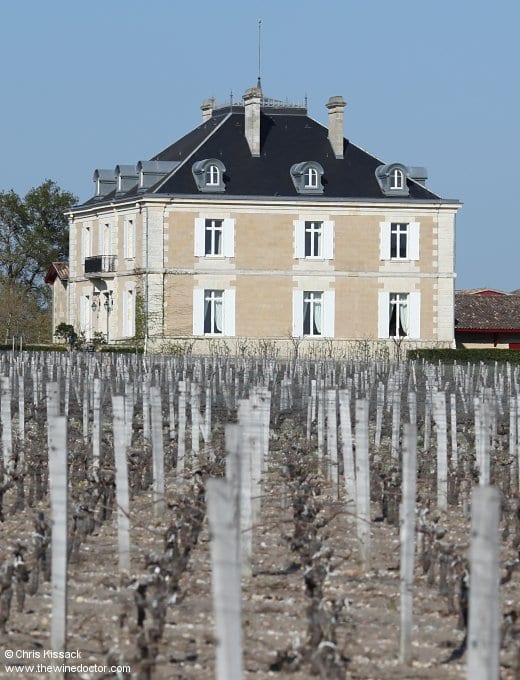
firmly, reorganising and expanding the vineyards first, and then moving on to build the chateau, which
stands to this day. The wine's reputation soared, and prices easily matched
those of a deuxième cru from further north; flushed with success Bellot
de Minières described his wine as a Premier Grand Cru Exceptionnel, and
the term Cru Exceptionnel can still be found on the labels of more recent
vintages of Haut-Bailly. Nevertheless, not all of Bellot de Minières decisions were so astute. As phylloxera advanced across
Bordeaux and the whole of France, he shunned the new solution of planting
grafted vines, rejecting the resulting wines as 'incomplete'. He plodded on,
spraying his vineyards with a copper ammonia solution, and at the turn of the
century Haut-Bailly was still planted up with ungrafted vines.
Bellot de Minières died in 1906, and it was inherited by his daughter, Valentine Heirweg. She and her cousins ran the estate for little more than two decades before selling onto Franz Malvesin. Malvesin continued with his original root vines, instead turning his attention to the cuverie, where he instituted some questionable practices, such as pasteurisation and early bottling. He died in 1923, and practices quickly reverted back to the traditional, but in his absence there was no consistency of leadership. The estate passed to his illegitimate children and thus through the Beaumartin family, who owned the estate in combination with a Parisian banker named Comte Lahens. But then the usual 20th Century rot set in, with war and depression, plus a string of less than adequate vintages, responsible for Haut-Bailly's poor performance. In 1937, by which time some of the vineyard had been pulled up, the Beaumartin family bought out Lahens; subsequent deals saw the estate change hands again, eventually coming to the joint ownership of Monsieurs Boutémy and Tyberghien. Their tenure was not a success, and it was not until 1955 that the seeds of new success were sown.
Sanders & Wilmers
It was in this year that the estate was sold to Daniel Sanders, a war veteran
who had settled in Bordeaux following his convalescence, eventually inheriting a
merchant's business through his marriage to the merchant's daughter in 1919. He
spent some time acquiring a
number of minor properties, but having
experienced the 1945 Haut-Bailly he resolved to purchase the dilapidated property.
Even at this time many of the vines were still ungrafted, testament to Bellot de
Minières reticence regarding this practice. With this change of ownership things began to look up at Haut-Bailly, and quality
certainly improved over the ensuing years. In 1980,
however, Sanders
died, and his son took control; today Daniel's granddaughter, Veronique Sanders
(pictured right), is in
charge. It is notable, however, that Veronique is only part of the team; since 1998 the estate has
been in the ownership of US banker Robert Wilmers (pictured left), whilst remaining under the management of
the Sanders family, with Gabriel Vialard running the cellars. Wilmers
contribution has been important,
however, financing a geological survey and the purchase of new equipment for the
cuverie. Although the wine had already shown much improvement, some
recent vintages have been truly excellent, testament to the continued efforts of
the team.
Haut-Bailly - The Vines and Wines
The Haut-Bailly vineyard is located in a single block, the soils a mixture of sand and Tertiary gravel over Faluns de Léognan, a soil rich in sandstone and fossilised shells. The vines themselves are mainly Cabernet Sauvignon (65%), with 25% Merlot and 10% Cabernet Franc. Remarkably 15% of the vineyard consists of old vines, close to the chateau buildings, that date from the pre-Phylloxera era; these comprise a mix of the above three varieties, together with Petit Verdot and Malbec. Harvesting is by hand, with three tiers of sorting first at harvest, then as the fruit is destemmed in the winery, and finally using a sorting table before vinification. The fermentation is in temperature-controlled concrete vats, which vary in size facilitating the individual processing of separate plots. There is a three week cuvaison, and then up to eighteen months in oak, which is typically 50-60% new each vintage. Following assemblage in stainless steel, the wines are then bottled without fining or filtration, the grand vin being the red (there are no white wines made here) Chateau Haut-Bailly, the second wine being Le Parde de Haut-Bailly.
As suggested in my account of recent appointments and investment, the wines of Haut-Bailly are in my opinion currently on a high. I have certainly purchased recent vintages, such as the 1995 and 1996, with confidence, and the 1997 is one of the better wines of the vintage that I have encountered. Even mature examples such as the 1981, 1983 and 1985, that predate recent investments, are very good. But it is the very recent years that have seen the most improvement. Largely they remain fabulous value also, although prices are beginning to reflect the quality more closely, as evidenced by the stunning 2005, although to be fair prices for 2005 Bordeaux were high across the board. The 2003 was also excellent, sampled on several occasions in recent years. I did wonder if this trend were set to end with the 2006 vintage, however, as I did not like the wine when I assessed a barrel sample in April 2007. A reassessment one year later proved my impression to be wrong, however, and indeed all 2006s I encountered at the primeur tastings that year were showing much better. But back to Haut-Bailly; quite simply, these are, on the whole, lovely wines worthy of any cellar or table. (28/10/04, updated 23/4/08)
Contact details:
Address: Chateau Haut-Bailly, Route de Cadaujac, 33850 Léognan
Telephone: +33 (0) 5 56 64 75 11
Fax +33 (0) 5 56 64 53 60
Internet:
www.chateau-haut-bailly.com
Chateau Haut-Bailly - Tasting Notes
Click
to locate
stockists. Latest notes:
Chateau Haut-Bailly (Pessac-Léognan) 2006: The nutty oak sensed in
April 2007 has fully integrated, leaving an attractive open, fruit-dominated
nose. Plentiful, fresh,
brambly-blackcurrant character which has plenty of life. Gentle acidity on the palate, gently covered tannins, but there is good
substance and structure to it. It has a fine, harmonious composition and my impresssion is much more favourable than last time. 16.5+/20
(April 2008)
![]()
Chateau Haut-Bailly (Pessac-Léognan) 2003: A ripe and exotic character on the nose here, but
thankfully not a baked character. Ripe in terms of structure, with a
firmness to the tannins as has been noted from previous tastings. A nice flesh,
a touch chewy perhaps under the fruit. But overall this has good quality and an attractive style for
the vintage. 17+/20 (April 2008)
![]()
Chateau Haut-Bailly (Pessac-Léognan) 2002: A beautifully evolved nose, with fresh notes of
iron filings alongside the smoky fruit. It has an open and vibrant style. A fine
texture and weight, gently integrated, but with plenty of substance. A lovely,
broad presence, not rich but appealing and well balanced. For the vintage, I
think, this is impressive. 17+/20 (April 2008)
![]()
Older notes:
Chateau Haut-Bailly (Pessac-Léognan) 2007:
A fine presence of sweet fruit and honeyed oak here,
brambly, fine and crunchy. Good substance, and with a nice weight through the
midpalate. It has a fine, textured quality, with a slightly gritty fruit. Nice,
gentle, but with a good substance. Nicely balanced. From my 2007 Bordeaux
primeur assessment. 15.5-16.5+/20 (April 2008)
![]()
Chateau
Haut-Bailly (Pessac-Léognan) 2006: An attractive nose, with deep, nutty fruit. Sweet with
a nice depth. On the palate, though, rather soft, with moderate acidity, but
with a nice, open, relaxed fruit forward style. Gentle, ripe tannins. Like some
other wines it is nicely composed but it has no vigour. I am usually a great fan
of Haut-Bailly so it pains me to say that this isn't what I was hoping for. From
my 2006 Bordeaux
assessment. 14.5-15.5/20 (April 2007)
![]()
Chateau Haut-Bailly (Pessac-Léognan) 2005:
A very pure nose, with dark summer fruits and some nutty oak, but finely melded
together. The palate has a similarly harmonious style, elegant and yet
mouth-filling and broad, but not overly rich or creamy. A firm spine of acid and
tannin beneath, nicely covered, and plenty of substance. A fine, nicely composed
finish. Great potential here. From my tasting of
2005 Bordeaux at
two years of age. 18.5+/20 (October 2007)
![]()
Chateau Haut-Bailly (Pessac-Léognan) 2005: CS 56%, M 38%, CF 6%. A good depth of colour
on inspection, quite concentrated out to the rim. The nose is simply divine,
displaying great refinement, with cashew nut black fruits and a mineral
freshness. And the palate doesn't disappoint; gentle texture, perfectly
balanced, carrying a seam of as yet unintegrated tannins and firm, youthful
acidity. Beautiful purity, rounded, well polished and elegant wine. Wonderful.
From my 2005 Bordeaux en
primeur tasting. 18-19/20 (April 2006)
![]()
Chateau Haut-Bailly (Pessac-Léognan) 2004:
Why is the nose here always so complete? This really reminds me of the 2005, tasted in April this year. It has
refined, perfumed, floral, mineral-edged fruit rather than the less elegant
gravel exhibited by so many of the other wines. A lovely style on the palate,
mineral-edged fruit, showing lovely structure. Beautifully poised, with a fine
presence on the palate. This has fabulous potential. Who couldn't like this?
From my 2004
Bordeaux assessment. 18.5+/20 (October 2006)
![]()
Chateau Haut-Bailly (Pessac-Léognan) 2003: An exotic nose here in keeping with the vintage, showing bright,
vibrant red cherry fruit with, admittedly, and rather confit, cherry pie
style in the background. Rather a low acidity on the palate, unsurprisingly,
with a panoply of evocative flavours as on the nose, and although there is a
big, tannin-dominated finish this has undeniable style. This could progress to a
rather elegant maturity, but predicting over what length of time this will
proceed is difficult. 16.5-17+/20 (November 2006)
![]()
Chateau Haut-Bailly (Pessac-Léognan) 2003: A good nose here, showing a
really attractive style; it offers very ripe fruit with a certain freshness, the
profile not quite entering into the prune-like or stewed end of the spectrum.
Similar appeal on the palate; although it has a rather brawny presence at the
moment, with some firm but ripe tannins quite prominent, there really is classic
style hiding in the wings. Good, gravelly, minerally typicity. Showing more
style, and better overall, than when tasted at the UGC tasting last year. Well
done! 17+/20 (April 2006)
![]()
Chateau Haut-Bailly (Pessac-Léognan) 2003: A
rather muted nose. A little perfume, but otherwise not showing much at all.
There is a full, nicely textured character on the palate, with ripe and supple,
although still rather firm, tannins through the midpalate and finish. There is a
creaminess to the style, and the palate is nicely knitted together, and the wine
has a presence right through to the finish. This is potentially the best wine
here I think, and is merely closed down today. Really nicely composed albeit rather muted,
and I hope this may be more expressive with time. From my
2003 Bordeaux
assessment. 17+/20 (October 2005)
![]()
Chateau Haut-Bailly (Pessac-Léognan) 1999: A beautiful nose, seductive yet classic, stony and
perfumed. A very evolved, open style. Gentle, moderately concentrated, rather
firm and intense tannins, but still a fine composition. Good acidity, overall a
very good style. Attractive, slightly pretty, but excellent for the vintage.
From a Bordeaux tasting
with Bibendum. 17+/20 (April 2007)
![]()
Chateau Haut-Bailly (Pessac-Léognan) 1999: A rather floral nose, with
some meaty elements alongside some attractively perfumed red fruit. A
middle-weight palate, underpinned by a good structure of tannins and just
moderate acidity. This is very nicely composed, finely poised, with fresh
flavour and good potential for the cellar. Very nice. 16.5+/20 (November 2006)
![]()
Chateau Haut-Bailly (Pessac-Léognan) 1997: Quite a dark but clearly
maturing wine. Classic bouquet on the nose, mature slightly meaty-gravelly fruit
with a little perfumed edge. The palate is certainly ready, with a rather
middle-of-the-road approach, with mature fruit presented in a nicely rounded,
gentle texture. I've found another in only a handful of decent wines from the
1997 vintage, yet I'm afraid it remains overpriced for the quality offered.
16/20 (April 2006)
![]()
Chateau Haut-Bailly (Pessac-Léognan) 1994: From a half-bottle. This
wine has a dark, maturing hue, although it still has plenty of pigment. There
are notes of classic, maturing, claretty fruit on the nose, with a rather solid,
violet-tinged perfume. It is firm rather than delicate, on the nose as well as
the palate, where it demonstrates a full, spicy, peppery grip. Ageing nicely,
with a nice broad flavour, but overall a little stolid, with little of the
delicate perfume that makes Graves so appealing. But I think this wine has
plenty to offer yet. From a 1994
Bordeaux tasting. 17+/20 (April 2007)
![]()
Chateau Haut-Bailly (Pessac-Léognan) 1986: Little sign of any
age from this very dark purple wine. A delicious nose of
sweet, smoky cassis fruit, with layers of liquorice and
cream. Quite big and luscious on the forepalate, with less tannins than
the other wines in this flight. Good fruit, with spice and creamy oak. Some
notes of soot and tar, but otherwise a soft, generous, layered palate.
Good length too. From a 1986 Bordeaux
tasting. 17.5/20 (February 2001)
![]()
Chateau Haut-Bailly (Pessac-Léognan) 1985: A vibrant, surprisingly
youthful, glossy and homogenous colour. A wonderful treacle toffee nose on a
background of maturing dark fruits. Splendid! Pure, glossy, deep and rich on the
palate. Burnt fruit, smoke and minerals. Great texture. Rounded, firm, still
with a tannic backbone, but very approachable now. Fabulous, interesting, expressive
and yet elegant wine. From a Graves
tasting. 18.5+/20 (October 2004)
![]()
Chateau Haut-Bailly (Pessac-Léognan) 1983: Opened for 1-2 hours. No
sediment of note. Good deep mature colour. Brief, fleeting notes of watermelon
at first (unusual!), before more usual aromas of meaty fruit, animal fur and
earthy tobacco come to dominate. Very clean, medium bodied palate. Still showing
a trace of welcome grip, buoying up the meaty, iron-edged fruit. Firm, full
finish, with a savoury character. Showing rather prominent acidity throughout,
but not sufficient to distract from the experience. In need of drinking up to
see it at its best I think. Very good. 17/20 (July 2005)
![]()
Chateau Haut-Bailly (Pessac-Léognan) 1981: Served blind. A lovely,
dark yet vibrant, deep red hue with fleeting nuances of orange and gold. On the
nose there is quite a bit of beefy character, with a mineral edge. Full,
textured, quite softly elegant though, really good style. Lovely weight and
really very flavoursome. Just another example of the superb wines this property
has been putting out over the last two or three decades. It surpasses the 1983,
though, although I think the 1985 is the greater of the trio. 18.5/20 (October 2006)
![]()
Home - Site index - Site updated May 16, 2008 - © The Winedoctor 2000 - 2008 - Wine Scores - RSS