Home > Producer Profiles > Bordeaux Profiles > Chateau Faugères

Chateau Faugères

The history of Chateau Faugères can be traced back at least until 1823, when the property came into the ownership of the Guisez family. And, until very recently, the estate remained in the hands of the same family, having been inherited by Pierre-Bernard Guisez, otherwise known as Péby, and his wife Corinne in 1987. Together they produced wine from their vines which encompassed both the St Emilion and Côtes de Castillon appellations, in later years with consultation from Michel Rolland. In 1998 Péby died at the too youthful age of 52, but nevertheless his widow, aided by their daughters continued, even creating a super-cuvée, Péby-Faugères, in his honour. This was the situation until 1995, when the family sold the estate to a Swiss businessman named Silvio Denz, a friend of Comte Stephan von Neipperg who had already established a history of investment in vineyards. Together he, Rolland and Neipperg will continue the work of the Guisez family.

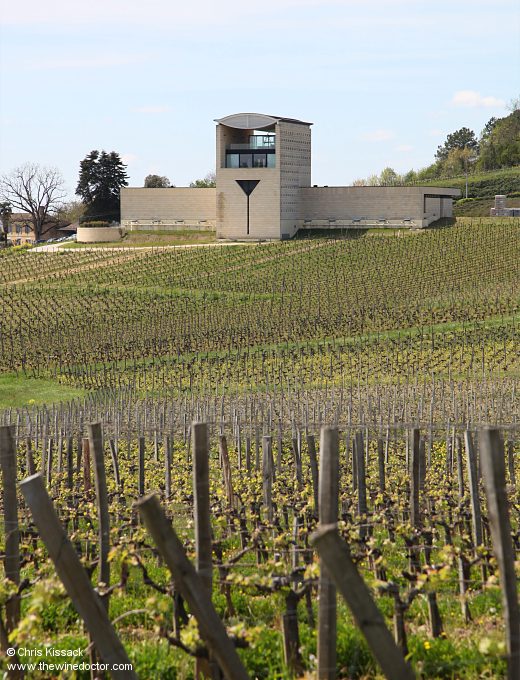
Chateau FaugeresThe estate is located 6 kilometres east of St Emilion close to St Etienne de Lisse, near the slopes of the eastern St Christophe plateau; the soils are thus a mix of clay and limestone. The vines cover 80 hectares surrounding an 18th Century Carthusian monastery and are graced by a chateau (left) from the same era built in a rather understated, chartreuse style. There are 49 hectares entitled to the St Emilion appellation and 31 hectares of Côtes de Castillon. Since the change of hands in 2005, however, there have already been major changes, starting with the acquisition of more vineyards, and the construction of a new winery, designed by Swiss architect Mario Botta, to complement the barrel cellar built in 1992. Péby-Faugères has seen a change in name, albeit slight, to Cuvée Spéciale Péby, and there has a been a second wine introduced.

The vineyards appear immaculate and are carefully managed, with some leaf stripping and green harvesting during the summer months. The harvest is performed by hand and the fruit transported in small trays to the winery, where the grapes undergo two sortings before fermentation. The accepted grapes are moved by conveyor to the vats, which are stainless steel - ranging from 80 to 152 hectolitres - for the majority, but 50 hectolitre oak casks for the Péby cuvée.

Three wines originate from the St Emilion terroir, one of clay and limestone, starting with what would usually be thought of as the grand vin, Chateau Faugères, although with the existence of a super-cuvée above this - not a common practice in Bordeaux - this designation is perhaps open to question. The wine is typically 85% Merlot, 10% Cabernet Franc and 5% Cabernet Sauvignon, sourced from vines that are 35 years old. After temperature controlled fermentation, the norm at the estate, the wine goes into oak, 50% new, for 14 months followed by bottling, with a production of up to 5000 cases. The second wine, Haut Faugères, introduced with the 2004 vintage, receives a very similar treatment although has a slightly smaller production, perhaps a little over 3000 cases. A step up from the grand vin, however, is the aforementioned Péby-Faugères or Cuvée Spéciale Péby, also a St Emilion but this time 100% Merlot sourced from a 9 hectare plot of 40-year-old vines. Rich in style, the product of low yields (25 hl/ha for the 2005 vintage), this will see 18 months in 100% new oak, with malolactic encouraged in barrel on the lees; there are about 100 cases produced per annum. Finally, the fourth wine, the Côtes de Castillon Cap de Faugères, has a similar constitution to the Chateau Faugères, but sees only 12 months in oak; production levels are considerable, up to 8500 cases.

What has perhaps really put Faugères on the map is high accolades from Robert Parker, with the Péby cuvée the wine that has received the most attention - and the highest scores. Having tasted a couple of vintages, I can see the appeal. These are rich, impressive wines. Whether they appeal will depend on your own palate, your bias for or against this style of wine, but they are certainly brimming with quality. (7/8/08)

Contact details:
Address: St Etienne de Lisse, 3330 St Emilion
Telephone: +33 (0) 5 57 40 34 99
Fax: +33 (0) 5 57 40 36 14
Internet: www.chateau-faugeres.com

Chateau Faugères - Tasting Notes

Click to locate stockists.

2004

Chateau Cap de Faugères (Côtes de Castillon) 2004: This is 85% Merlot, 10% Cabernet Franc, 5% Cabernet Sauvignon, from vines that average 30 years of age. It spends 12 months in used oak. It has a very characteristic, meaty, fruit rich nose, with a very ripe, slightly feral character. The texture on the palate is lovely, it has an immediately apparent creaminess, but beneath this there is a deeply set structure, good grip and firm acidity. A big, rich style showing a wealth of sweet, dark fruit, but not overdone and nicely structured. Very good potential. From a Bordeaux 2004 assessment. 16.5-17+/20 (November 2007)

Chateau Faugères (St Emilion) 2004: Again this is 85% Merlot, 10% Cabernet Franc, 5% Cabernet Sauvignon, from vines that average 35 years of age. It spends 14 months in a mix of 50% used oak and 50% new. Lovely, pure, deep fruit on the nose, with a dark, roasted, meaty style. This is very attractive. It has texture and a fresh and admirable depth. The tannins are ripe and well balanced and overall this is very nicely composed. It is stylish, concentrated, and it has a dense finish. This has great potential. From a Bordeaux 2004 assessment. 17.5+/20 (November 2007)

Péby-Faugères (St Emilion) 2004: This is 100% Merlot, a selection of the best parcels. Oak fermented and matured, there are typically only 100 cases per annum. It has a fine and concentrated nose, with deep fruit, particularly notes of blackberries swirled in cream. There is a fine delineation and a good, vigorous nature, overall a firm and yet creamy style. With good acidity and a lovely backbone of well balanced tannins, this is in fact delicious. Wonderful clarity on the finish. And not over-extracted. Excellent wine. From a Bordeaux 2004 assessment. 18+/20 (November 2007)

2000

Chateau Cap de Faugères (Côtes de Castillon) 2000: There is a nice density to this wine which shows some lovely exotic fruit on the nose, in a very attractive and open style. Like other wines in the portfolio it starts off soft on the palate, fleshy in style, but then with more backbone through the midpalate. There is good grip over a dried fruit character, and good acidity. An attractive wine which needs time in the cellar yet. 17+/20 (February 2008)

Chateau Faugères (St Emilion) 2000: A very open and expressive nose here, quite exotic, and rich with spiced, plummy fruit. It has a very attractive palate also, soft at the entry and then showing more structure towards the end. Good acidity, overall this has an appealing composition. A lot of substance here. This needs time, between two and five years at least. 17.5+/20 (February 2008)

Péby-Faugères (St Emilion) 2000: A very intense and dense hue here. This has a big, characterful, richly spiced palate. It is softly structured, with a lot of tannin and substance. It has a moderate level of acidity. An impressive showing here, but the soft and modern composition is not one for traditionalists. It needs plenty of time to integrate though. Very good indeed, with excellent potential. 18+/20 (February 2008)