Home > Producer Profiles > Bordeaux Profiles > Chateau de Fargues

Chateau de Fargues

In many classified appellations - perhaps in every such appellation - there are properties which, for a variety of valid and sometimes not so valid reasons, seem to have slipped the net and avoided joining the list with their peers. If we are to search the classification of Sauternes and Barsac, which was drawn up in 1855 alongside that which pertains to the properties of the Médoc, it is perhaps to Chateau de Fargues - that we should first turn.

As is the case with a number of Sauternes estates de Fargues possesses some ancient history, and an inspection of the property today is testament to this. It has a dilapidated air, the thick walls and the rough stone material decorated only by the vegetation sprouting from the nooks and crannies, and along the tops of the walls where once a roof sat. If you were expecting a Renaissance chateau you will de disappointed; this ancient building bears more resemblance to a ruined castle, as indeed it should. The first foundations were laid in 1306, on the order of Raymond Guilheim de Fargues. Newly ordained as cardinal by his uncle Bertrand de Goth, otherwise known as Pope Clément V (and obviously best associated with Pape-Clément), Raymond wished to erect a fortress in keeping with his new status, and 700 years later it still stands, in part at least, testimony to its solid construction.
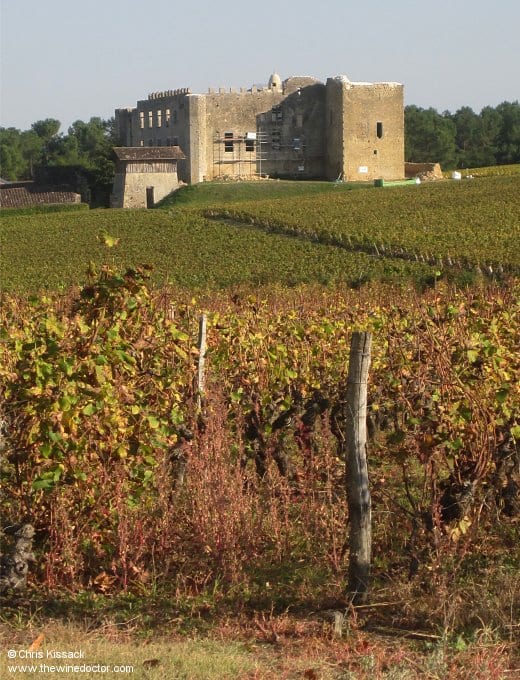
With the passing of time the stronghold changed hands several times, first coming to the la Mothe family and then to Gaston de Foix, a French nobleman who came from a powerful lineage that included cardinals, viceroys and princes. From them it passed to the Monferrands, and was bequeathed to Isabeau de Monferrand by her father following his death at Castillon in 1453. She married Pierre de Lur in 1472, and together they and their issue resided at the property for more than two centuries. In 1586 Jean II de Lur, a descendent of Pierre and Isabeau, married Catherine-Charlotte de Saluces, and it is from these two that the Lur-Saluces family of today originate. Their great-grandson Eutrope Alexandre, however, was in 1672 the last of the line to be born at de Fargues, for in May 1687 the property was irrevocably damaged by fire, and it has stood as little more than a ruin for three centuries. Nevertheless, today the property remains - uninhabited - in the ownership of the modern day descendents of this Lur-Saluces union.

The Lur-Saluces dynasty was a strong and noble one, as was no doubt reinforced in 1785 with the marriage of Louis-Amédée de Lur-Saluces to Francoise-Joséphine de Sauvage d'Yquem, bringing them ownership of Yquem, already then well established as a fine viticultural estate with a detailed and illustrious history. With this acquisition the ruin of Fargues, essentially an agricultural estate which was home to arable crops as well as a few vineyards dedicated to red varieties, perhaps held little interest for them. Indeed, as far as sweet wine production goes the estate was not exploited until the 1930s, many centuries after most Sauternes vineyards were established. It was Marquis Bertrand de Lur-Saluces who was responsible for this new development, converting part of the estate's 25 hectares of vineyard from red to white varieties. Commencing with a 5 hectare plot adjacent to the chateau, 25 years later this had expanded to just 10 hectares. Bertrand's death in 1968 did not stall this process; his work was continued by Alexandre de Lur-Saluces, and by the turn of the century the vineyard covered 15 hectares, with an ongoing system of uprooting and planting in place, as well as plans to plant up 9 hectares of favourable gravelly terroir currently occupied by some of the local pine trees.

Chateau de FarguesToday the estate covers 170 hectares in total, and there are still 25 hectares of fields dedicated to arable crops, principally maize which is used as cattle feed, as well as pasture for grazing Bazas cattle, raised for meat as well as for their manure which is used to sparingly fertilise the vineyards. The aforementioned pine trees dominate the estate, accounting for 100 hectares, and there are also copses of oak, chestnut and acacia, and a system of artificial ponds. But it is of course the vines that interest us most; the 15 hectares mentioned above are situated next to the ruined chateau on sandy soils, over a clay and gravel subsoil complete with ancient field drains. They have an average age of 35 years, are 80% Semillon and 20% Sauvignon Blanc, and are planted at a density of 7000 vines/ha. The vineyard work is fairly traditional, with no fertilisation other than the aforementioned manure and no herbicides. The fruit is harvested by hand in tries, sometimes five or more, picking through until November, and the average yield over twenty years is just 8 hl/ha. The target is 20º potential alcohol although there is no intention to Chaptalise should this target be missed. In a dismal vintage where there is no hope, it is probably more likely that no wine would be made, as was the case in 1964, 1972, 1974 and 1992.

The wine is fermented in new oak barrels under the supervision of estate manager François Amirault, once of Nairac. The barrels are replaced on an annual basis; when the two properties were under the same ownership these were sourced from Yquem, although I imagine that relationship has now fallen by the wayside. Once fermentation is complete the wine remains in the barrel for ageing, for up to 36 months. It is racked every three months, with regular topping up as required. At the end of this process there may be a light fining but there is no filtration. What is deemed sufficiently good for the grand vin is blended and bottled as Chateau de Fargues as it has been since the first ever vintage, which was 1943. The remainder is presumably sold off as there is no second wine although there is a dry white Guilheim de Fargues, barrel-fermented and aged in oak for one year, before bottling under the generic Bordeaux appellation.

Before meeting de Fargues for the first time I must confess I knew nothing of the property at all. Unlike other illustrious properties such as Yquem, I imagine most who have the good fortune to taste or drink the wine know something of the estate before the liquid ever nears their lips. But de Fargues was very much off my radar, an omission perhaps compounded by its absence from the classification drawn up in 1855, decades before the Sauternes vineyard was even established on the property. But looking back over my notes for recent vintages, this is a mistake I would not like others to make. The wines, each time tasted in a line up of their peers, seem to perform consistently well. They are rich, well flavoured and characterful. Being in the ownership of the Lur-Saluces family no doubt invites comparisons with Yquem, although this initially seems unfair; after all, surely no estate can truly shine against such a neighbour? Nevertheless, the prices of these wines perhaps demand such a comparison; these are not inexpensive bottles. And some authors, such as Stephen Brook writing in Sauternes, report that on occasion de Fargues can seem superior to its illustrious one-time stablemate. But looking beyond this, taking the wines in the context of the other leading estates of the region, these wines do indeed stand up very well against their peers. And for a vineyard that didn't even exist before the 1930s, and is planted on less than favourable sandy soils, that is surely the most remarkable achievement. (12/11/08)

Contact details:
Address: Chateau de Fargues, 33210 Fargues de Langon
Telephone: +33 (0) 5 57 98 04 20
Fax +33 (0) 5 57 98 04 21
Internet: www.chateau-de-fargues.com

Chateau de Fargues - Tasting Notes

Click to locate stockists.

2009

Chateau de Fargues (Sauternes) 2009: Sweet honey with crystalline fruits and notes of white flower petals here - this has a wonderful nose. Fresh and pithy, quite pure fruit character, with notes of yellow plum. Lovely substance on the palate, with a seam of nascent botrytis underneath the fresh fruit. Great depth on the finish which is very long. An impressive wine, forceful and yet defined. Will age beautifully. From my 2009 Bordeaux en primeur assessment. 17.5-18.5+/20 (March 2010)

2007

Chateau de Fargues (Sauternes) 2007: A very polished style here, a fine honeyed style, bright and crystalline, with floral elements. The palate mirrors the nose exactly, backed up by a chalky substance. Sweet honeyed fruits, mango and tangerine and peach, with beautiful acidity, this is just stunning. Better than I thought en primeur. From my tasting of 2007 Sauternes at two years of age. 18+/20 (October 2009)

Chateau de Fargues (Sauternes) 2007: This has a tighter nose than the Bastor, although there is an undercurrent of rich, attractive honey aromas. The palate is rich, creamy and peppery, broad and weighty, although with a minerally flourish and a fine acid backbone. Nice grip too. Not a very vigorous style, but rich and very good. From my 2007 Bordeaux en primeur assessment. 16-17+/20 (April 2008)

2006

Chateau de Fargues (Sauternes) 2006: A fairly rich nose here, showing a melange of honey, toffee and oak. Perhaps a little more botrytis here than in many of the other wines. The palate is showing a lot of fat, plenty of richness and sweetness, and a nice seam of acidity. This is a very rich, opulent, rather heady style, with a full, characterful finish. It certainly has appeal. From my tasting of 2006 Sauternes at two years of age. 16+/20 (October 2008)

2005

Chateau de Fargues (Sauternes) 2005: This has a good a characterful nose, with quite dense honey and pineapple character, and also some botrytis. Rich, deep, concentrated on the palate, appealing, with meaty substance and great texture. The acidity is a touch on the low side, but it has plenty of delicious appeal. From my tasting of 2005 Bordeaux at two years of age. 17-17.5+/20 (October 2007)

2004

Chateau de Fargues (Sauternes) 2004: There is a lovely depth on the nose here, showing some rather subtle botrytis, in a very fat style. Some deep, quince and botrytis notes on the palate with considerable quality of flavour. Rich and meaty, vibrant with fresh acidity too. A very fat style. This is very good. From my 2004 Bordeaux assessment. 17+/20 (October 2006)

2003

Chateau de Fargues (Sauternes) 2003: A more restrained style on the nose here, but showing an appealing barley sugar aroma and some persistent oak. Full, meaty style on the palate, showing plenty of honeyed oak, but with plenty of character to compensate; orange peel and blossom flavours, a little grippy structure, and good acidity. This is very good indeed. From my 2003 Bordeaux assessment. 17.5+/20 (October 2005)