Home > Producer Profiles > Bordeaux Profiles > Chateau Desmirail

Chateau Desmirail

Chateau DesmirailIt is not immediately apparent why Chateau Desmirail, a property which lies near Cantenac in the Margaux appellation, should be chosen to host the 2007 Sauternes en primeur tasting, but it was. Cantenac is not quite the beating heart of this Bordeaux commune, as this is surely Margaux itself, which lies just to the northwest and boasts a greater concentration of classed growth properties, including of course the eponymous Margaux. Neither, however, is it anywhere near Sauternes, which lies some distance upriver, beyond much of the Graves appellation and of course the city of Bordeaux itself.

One possible explanation for this apparent anomaly is in the ownership of Desmirail; the current incumbent is Denis Lurton, one of the Lurton dynasty, having taken over the running of the property from his father, Lucien. The Lurtons certainly have a presence in Sauternes, as another of Lucien's estates, Climens, passed to his daughter Bérénice, the tiny property Doisy-Dubroca is run by Louis Lurton, another of Lucien's children, and the general manager of Yquem, Pierre Lurton, is a cousin. Perhaps Denis had his arm twisted a little?

The Lurtons took ownership of Desmirail during the 20th century, only gaining full control in 1981 when Lucien Lurton acquired a final portion of the vineyard from Chateau Palmer. Before the Lurtons, however, there was of course a string of other proprietors. The story begins with the vast Rauzan estate, of which I have already written, most pertinently in my Rauzan-Gassies and Rauzan-Ségla profiles. This expansive landholding was created by Pierre des Mesures de Rauzan, who in 1661 purchased a large portion of the Médoc around Cantenac, the newly established estate incorporating many vineyards that are today classed growths in their own right. Indeed, his purchases, which he augmented with vineyards acquired from neighbours over two decades, were the origin not only of the two Rauzan estates and Desmirail, but also of Marquis d'Alesme Becker, Pichon-Baron and Pichon-Lalande, and following an exchange of vineyards, some ended up as part of Latour.

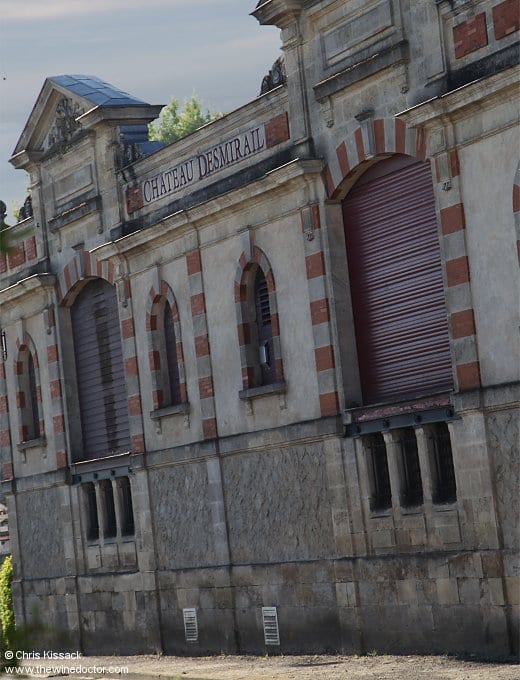
Perhaps the most significant of the early proprietors of this estate was Jean Desmirail, who acquired the land at the end of the 17th century as part of a dowry, brought by one of the Rauzan daughters. He gave his name to the property, and his descendants maintained ownership until the 19th century, although by the time of the 1855 classification the property was in the ownership of M. Sipière, who was also manager at Chateau Margaux. In 1860 this gentleman added an attractive chateau to the estate, although he was only to enjoy it for a few decades; in 1905 the property passed to Robert Mendelssohn, a banker from Berlin and nephew of the great composer. In 1914 German ownership resulted in the seizure of the property, and by this route it came into the hands of Martial Michel, a glove manufacturer, who remained the proprietor until 1938 when he sold the chateau itself to Paul Zuger of Chateau Marquis d'Alesme Becker, and the vineyards and Desmirail 'brand' to Chateau Palmer. The property was thus broken up, and indeed the original Desmirail chateau remains part of the Alesme-Becker estate today; the smart buildings that serve as Chateau Desmirail today (pictured above and below), in the village of Cantenac, were acquired by Lucien Lurton after buying the vineyards in 1981. In the interval between 1938 and 1981 the vineyards were harvested alongside those of Palmer, and Desmirail as an independent wine ceased to exist, which explains the forty-plus year hiatus that one finds when searching for older vintages. It was Lucien Lurton that recreated the estate, beginning with the 1981 vintage. By 1992, however, he had passed control to his son Denis, in the same manner that he passed control of his other estates to the rest of his ten children. Denis remains in charge at Desmirail today.

Chateau Desmirail

The vineyards feature the gravelly soils that characterise the better vineyards of the left bank of the Gironde, although there are also areas of sand and clay. There are approximately 30 hectares to the estate, and the vineyards are dedicated to Cabernet Sauvignon, which accounts for 80%, with 15% Merlot and 5% Cabernet Franc. The fruit is hand-harvested before going to a sorting table positioned in the vineyard, from where the harvest travels to the grape reception area where the grapes are destemmed, lightly crushed and then fermented according to plot of origin. During the fermentation the must is pumped over to submerge the cap, and the temperature regulated to around 30ºC, with subsequent maceration of the solids at about two degrees below this figure. Following this the wine is run off into fresh vats for malolactic, tasting and assigning the wines to either the grand vin, Chateau Desmirail, or the second wine which goes by the name of Chateau Fontarney for the French market and Initial de Desmirail for export and for the French on-trade (restaurants). The grand vin would go into oak for 12-18 months, with one-third of the barrels new each year; racking is performed every three months, and the fining is achieved with egg whites prior to bottling.

Overall my experience with Desmirail takes in less than a handful of vintages, including the 1982, a wine from the very early part of the Lurton era, which was very good indeed. Later vintages, specifically the 2005 and 2006, also have good points. This is certainly an estate worth watching. (30/1/09)

Contact details:
Address: 33460 Margaux
Telephone: +33 (0) 5 57 88 34 33
Fax: +33 (0) 5 57 88 96 27
Internet: www.desmirail.com

Chateau Desmirail - Tasting Notes

Click to locate stockists.

2009

Chateau Desmirail (Margaux) 2009: Here we have 70% Cabernet Sauvignon 70% and 30% Merlot, and 13% alcohol. Attractive dark fruit on the nose, with an appealing freshness here. A rather direct cream-fruit quality, but it is very aromatic and harmonious. Good structure, supple firm fruit on the palate, quite fresh with nice acidity and ripe, slightly velvety tannins. Good grip in the finish. It has a hint of Margaux about it. This is nicely done. From my 2009 Bordeaux primeur assessment. 17-18+/20 (March 2010)

2008

Chateau Desmirail (Margaux) 2008: Dark and brawny fruit on the nose here, with a confit raspberry edge. Cleaner on the palate though, rather showy, although there is a leaner, middleweight midpalate. Appropriate tannins and certainly fresh, this has a nice style, but it lacks precision. From my 2008 Bordeaux primeur assessment. 15-16+/20 (April 2009)

2007

Chateau Desmirail (Margaux) 2007: Good, deep, spicy fruit here, and this is a really appealing character on the nose in this vintage. The palate is supple, perhaps slightly chalky, with notes of violet perfume, with a light but appropriate texture and a stylish composition. Overall really quite attractive. From a tasting of 2007 Bordeaux at two years of age. 15.5+/20 (October 2009)

2006

Chateau Desmirail (Margaux) 2006: Rather meaty fruit here, nutty new oak, but it does have a fresh character overall. An appealing texture on the palate, supple and fleshy, with ripe tannins nicely covered. Not so vigorous and the Dauzac, although it has a good ripe grip. Spicy-peppery acidity. This has some appeal. From a tasting of 2006 Bordeaux at two years of age. 16+/20 (October 2008)

2005

Chateau Desmirail (Margaux) 2005: This has appealing fruit, and is another wine still tinged by vanilla aromas. Dark, appealing, dry fruit. The palate is also quite attractive, although with a dry tannic backbone which seems a little bare, but with good acids. It is a touch hard on the finish too. It is not quite as flattering as its peers, and not so harmonious as some, but nevertheless there are good points here. From my tasting of 2005 Bordeaux at two years of age. 15.5+/20 (October 2007)

1982

Chateau Desmirail (Margaux) 1982: A moderate depth of colour, a red-tawny hue with a pale rim. Great nose - full of roasted, meaty aromas, and packed full of similar flavours on the palate. Still firm, almost austere in fact, although the meaty fruit and lovely balance make it quite approachable now. From a 1982 Bordeaux horizontal tasting. 17+/20 (May 2004)