Home > Producer Profiles > Bordeaux Profiles > Chateau Cos Labory

Chateau Cos Labory

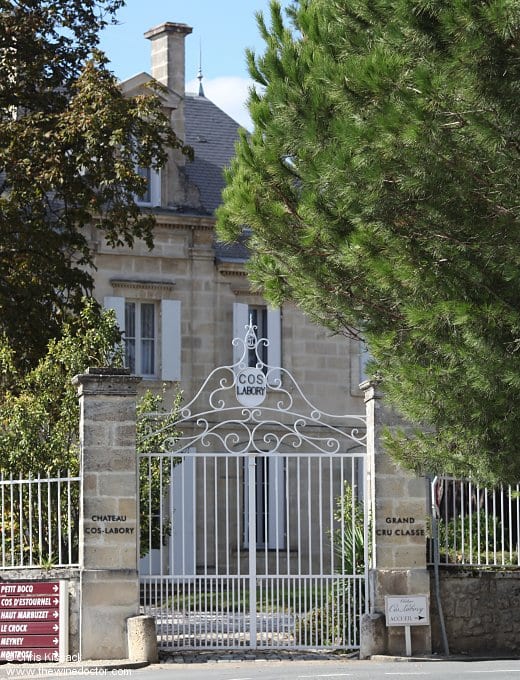
From the heights of winemaking in St Estèphe at Cos d'Estournel we move to the lowest rung of the 1855 classification and to Cos Labory. Although ranked at opposite ends of this small spectrum the two estates do have some common features, the most obvious being the name. As I have already explained in my profile of its more illustrious neighbour, Cos is most likely a derivative of caux, itself derived from colline de cailloux, meaning ‘stony slope’. In the Gascon tongue the end consonant is vocalised, accounting for how caux may mutate into Cos over the years. One particularly important Gascon in this story was Louis Gaspard d'Estournel, who forms another link between these two properties. Following a period of financial difficulties he returned to Cos d'Estournel in 1821, and flush with new funds he acquired numerous nearby plots of land, including Cos Labory in 1847. But this point in Cos Labory's history - which saw it stripped of its better vineyards when they were amalgamated into the d'Estournel estate - was by no means its beginning. For that we must look back at least to the preceding century.
Gaston, Labory, d'Estournel, Weber, Audoy

The domaine first appears as Cos-Gaston, named for the Gaston family who resided here. The patriarch Pierre Gaston ran a successful estate complete with vineyard, and there was commercial production of wine. On his death in August 1777 the property passed to his son Hyacinthe, one of three Gaston offspring, who went on to marry Anne Pauty. They resided at the estate for many years, subsequently bequeathing it to their only child, Marie-Sany. This was the route by which the estate eventually came to the Labory family, following the marriage of Marie-Sany to François-Armand Labory. It was a significant estate, with an annual production as high as 90 tonneaux (1 tonneau is 900 litres) of wine, matching many of the larger estates of the Médoc of the era.

Cos LaboryOne can speculate that Marie-Sany wished to give her children something different from her own solitary childhood, as the couple had eight offspring. Unfortunately this did not make the matter of inheritance straightforward, and a family power struggle led to a series of court cases that were ultimately disastrous for the Laborys. In 1845 four of the children secured ownership, but within a month control switched to three others following a new hearing and, importantly, the offer of a higher bid. This deal fell through, however, opening the door to the aforementioned Louis Gaspard in 1847, who purchased the property for 200000 Francs, a bid considerably lower than the two linked to the family's offers. The Labory and d'Estournel estates were under the same ownership, although for only a brief period; in 1852, subsumed by debt and probably in ill-health he was forced to sell both his estates, and just a year later he died. At least his final months were spent in some comfort, as the new owner of his properties, a London banker Charles Cecil Martyn, allowed d'Estournel to stay on in his house at Pommies until his demise.

Martyn took control of a somewhat emaciated estate, thanks principally to the 'donation' of its best vineyards to Cos d'Estournel; there were just 15 hectares of vines. Nevertheless the quality must have been good, as the prices fetched were sufficient to see the estate ranked as a fifth growth in the 1855 classification. Martyn held onto the estate for eight years, selling it in 1860 (he kept Cos d'Estournel until 1869) to François Marie Peychaud. The estate then passed through a number of hands, first coming to Jean-Alfred Pon in 1911 and then Ernestine Lasseverie in 1921. Her tenure was short, however, and against a backdrop of economic depression and war, and with the vineyards recently ravaged by phylloxera and oidium, the property was seized by the bank Compagnie Algérienne, who sold it to Edmond Charriat. Like a hot potato it then landed in the lap of Ambrosio and Augusto Weber who took on the running of the property. It remains with the descendents of the Weber family today.

The Weber family, who were of American heritage although they lived in Argentina, installed a cousin named George Weber at the estate. He settled there and married Marie-Alberte Loysel, a native of Brittany, and the union produced a daughter named Cecile. She regarded Cos Labory as her home, although being the offspring of an American citizen she was forced to flee France during World War II, and she spent much of her childhood in New York with her father, whilst Cos Labory was managed on their behalf by Pierre Ginestet, who ran nearby Cos d'Estournel. Following the war she returned to the property, and she eventually bought it from the Weber cousins in 1959. She married François Audoy, the son of a local doctor, and together they had four children, one of whom is of particular interest to this brief history. This is Bernard Audoy, who studied oenology at Bordeaux under Emile Peynaud, graduating in 1977 and taking up the reins at Cos Labory in 1978. His three siblings work close by and they and Cecile maintain ownership of the property, but it is most certainly Bernard that runs the show, overseeing the construction of new fermentation facilities in the 1990s, and a new barrel cellar since then.

The Cos Labory Vineyards: Hand and Machine

The Cos Labory vineyards today account for 18 hectares of the St Estèphe appellation and the vines, with an average age of 35 years and planted at 8700 vines/ha, are 55% Cabernet Sauvignon, 33% Merlot, 10% Cabernet Franc and 2% Petit Verdot. A large number of vines exceed 50 years, and very elderly examples are replaced on a vine-by-vine basis rather than through systemic uprooting and replanting. The soils are a mix of gravel and clay over limestone, with gravel predominating on the hill where the Cabernets Sauvignon and Franc has their home, the cooler clays playing host to Merlot. In the vineyard Audoy follows the philosophy of lutte raisonnée, perhaps best described as reasoned viticulture, which allows for the considerate use of chemical treatments where necessary. There are no insecticides in use, and weed control is achieved partly though ploughing, partly with herbicides. Where the estate does differ from the majority of its neighbours, however, is in the matter of harvesting and other vineyard labour; much of this is achieved using machines. Trimming the canopy in summer is a mechanical process, although leaf-plucking is manual, and the harvest of the ripe grapes is a blend of the two. A mechanical harvest puts the estate into a very small minority on the Médoc, as hand-harvesting is certainly the norm. Nevertheless, just like the Quié family of Croizet-Bages and Rauzan-Gassies, Bernard Audoy is a staunch advocate of the process.

Whether picked by hand or machine, the fruit is sorted on tables (in the vineyard for the hand-picked fruit, in the cellar if machine-picked) and then destemmed, crushed and delivered to the fermentation vats. These are stainless steel with temperature control, installed in 1999. In recent years there is a short cold maceration prior to fermentation with cultured yeasts and remuage, and a maximum temperature of 28ºC. Once finished further maceration may take the time in vat up to four weeks, and the wine is then run off into secondary vats for the malolactic fermentation. Some of the wine then goes into barrel, around 40%, a mix of American and French oak from a selection of coopers. The remaining 60% remains in vat before an assemblage of the totality the following spring, when the entire blended wine then goes into barrel for another year, racked as necessary along the way. Before bottling, which is contracted out to a mobile bottling unit, there is the option of fining and a light filtration. The grand vin is Chateau Cos Labory (up to 7500 cases per annum) and the second wine (up to 3300 cases per annum) is Le Charme Labory.

The Wines

Cos Labory has been, for many years, an infrequently sighted wine that many would regard as an under-achiever. In recent vintages, however, there have certainly been some successes, and viewing the reactions from critics and merchant to this has been entertainment in itself, as positive reports almost always come couched with an expression of surprise or sometimes even disbelief. Farr Vintners wrote of the 2003 vintage "one of Bordeaux's perennial under-achievers but this year we couldn’t believe how good it was" and Jancis Robinson described the same wine as an "attention-grabber". Admittedly the vintage in question was one that seemed to favour St Estèphe over some other communes, but nevertheless it does seems as though this was the year that Cos Labory shifted from mere potential to performance. With another favourable vintage Parker wrote "The 2005 is the finest effort I have tasted from this estate in many years". Certainly my own opinion formed from tasting recent vintages is that this is not an estate which should be summarily disregarded; the wines stack up well against the likes of Lafon-Rochet, Les Ormes de Pez and Phélan-Ségur, three peers regularly spotted at the annual UGC tasting of the vintage at two years of age. If the price is right, these wines can today be good value. With further investment I would hope that we see consistent improvement from Cos Labory in the future, building on the successes of recent years. Unfortunately I think to maximise the full potential of the vineyard it would be necessary to radically alter the practices in the vineyard, but I sense that such a change will be a long time coming. (5/11/08)

Contact details:
Address: 33180 St Estèphe
Telephone: +33 (0) 5 56 59 30 22
Fax +33 (0) 5 56 59 73 52

Chateau Cos Labory - Tasting Notes

Click to locate stockists.

2009

Chateau Cos Labory (St Estèphe) 2009: This wine has a fading rim around a crimson-black core. Lots of sweet, grainy fruit on the nose, a wine showing its alcohol quite plainly here. The palate has some supple if rather volatile fruit, a rather soft style, a touch juicy, but with the alcoholic heat again. Grippy, grippy tannins which dominate the finish. This is overdone for my palate. From my 2009 Bordeaux primeur assessment. 13-14/20 (March 2010)

2008

Chateau Cos Labory (St Estèphe) 2008: Dark fruit on the nose here, ripe, a little roasted even. The palate is dense, slightly oily even, a little vegetal, with rather leafy fruit. Although it is all backed up by lots of acidity and dense tannin, the latter with a huge, chewy character. Very extracted. From my 2008 Bordeaux primeur assessment. 14.5-15.5+/20 (April 2009)

2007

Chateau Cos Labory (St Estèphe) 2007: Dense and gravelly fruit on the nose here, slightly hot, seems almost baked, strange considering the nature of the vintage. Lean on entry, soft and plump fruit, a slightly hard structure underneath. Grippy, a touch overly tannic, with disconnected fruit. Fair. From a tasting of 2007 Bordeaux at two years of age. 14/20 (October 2009)

2006

Chateau Cos Labory (St Estèphe) 2006: Lots of sweet oak here, a honey-tinged, blackberry crumble nose with plenty of similarly sweet fruit. Nicely textured on the palate, a dry and structured midpalate, with grainy tannins. Quite a firm grip, with a good, savoury finish. Overall this is well put together although there is a lot of oak and structure for the fruit. From a tasting of 2006 Bordeaux at two years of age. 15.5+/20 (October 2008)

2005

Chateau Cos Labory (St Estèphe) 2005: This wine is not immediately expressive on the nose, but has a dark, attractive profile of fruit with an edge of nutty oak. On the palate this is also true, there is little here in terms of aromatics or flavour, and the wine is just a little ungiving at present. Nevertheless it clearly has an attractive texture and a good grip, and a nicely composed character. It is difficult to judge in this state, and I will have to hedge my opinion. The structure, however, certainly holds promise. From my tasting of 2005 Bordeaux at two years of age. 15.5-16.5+/20 (October 2007)

2004

Chateau Cos Labory (St Estèphe) 2004: Rather plump fruit on the nose here, with traces of smoky blackberry. The palate follows on in a very modern style, showing a firm, extracted structure of ripe tannins which roll across the palate with a dominating flourish at the finish. Moderately low acidity, overall firm, perhaps a little overdone, but nevertheless it is good. From my 2004 Bordeaux assessment. 15.5+/20 (October 2006)