Home > Producer Profiles > Bordeaux Profiles > Clos Fourtet
Clos Fourtet
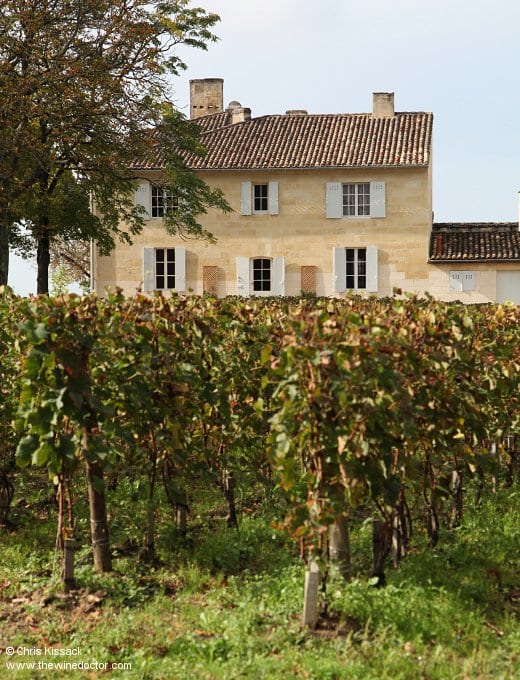
The history of Clos Fourtet extends back as far as the Middle Ages, when there was a defensive fort built here for the protection of the nearby town of St Emilion. This is the reason for the encircling walls which still exist today, making this one of St Emilion's handful of walled vineyards or clos. The importance of the estate as a vineyard, however, really begins with Léon Rulleau, who then passed the property onto his son, Elie. They were a well connected family, Léon's sister Catherine having married Vital de Carle, of the same family that owned Chateau Figeac. It was Elie Rulleau who was responsible for the construction of the fine chateau, of a pale and creamy hue, which is built over the limestone quarries that furnished the town with its stone and for which he too was responsible. Today, although somewhat more damp than the typical chai of the Médoc, these quarries and caves have found a new purpose, serving as extensive cellars for barrels and bottles which hold the slowly maturing wine. At this time the estate was known as Camfourtet (or Camp Fourtet), reflecting its military origins, and this remained the case until 1868 when the Rulleau family softened the estate's image with a change to the more familiar moniker of Clos Fourtet.
In 1919 Fernand Ginestet acquired the estate, the same year that he purchased Petit-Village in Pomerol. His son, Pierre, subsequently sold the property in order to finance the purchase of shares in Chateau Margaux, thus acquiring control of the first growth estate in 1949. He achieved this in a deal with Lucien Lurton of Brane-Cantenac, exchanging the estate in St Emilion for a 40% stake in Margaux which Lurton had inherited from his father-in-law. Without doubt the new proprietors did much to bring Clos Fourtet up to the quality level we see today. They reduced the quantity of Cabernet Sauvignon in the vineyard, opting for the eminently more suitable Merlot which fares much better on the damp clay and limestone soils, and the chai was equipped anew, with stainless steel fermentation tanks. Despite their grand efforts and undoubted success, however, the Lurton family subsequently sold the property, it is said to avoid inheritance taxes, although why the family didn't follow the option of forming a limited company to run the estate, another very valid solution to the problem of French inheritance laws, is unclear. Pierre Lurton went on to manage both Cheval-Blanc and Yquem on behalf of LVMH, so perhaps he felt a calling elsewhere.
The new owner, who parted with an undisclosed sum thought to be about €45 million, was Philippe Cuvelier, a Parisian businessman who made his fortune running Papeterie Gilbert, a paper and office supplies company. Today he remains proprietor of this estate, and he has continued the efforts of the Lurtons, with the help of manager Tony Ballu and Lurton's replacement Daniel Alard as winemaker, both of whom stayed on after the change in ownership, with oenological consultation from Stéphane Derenoncourt.
The vineyards are located just outside the town of St Emilion, to the west,
and just to the north of those of Chateau Canon; of the 20 hectare estate, 19
hectares are devoted to vines. They begin on the limestone plateau on which the
town is situated, running away towards the first valleys which mark the descent
down to the plain, to the west, where the soils are much less favourable. The
Clos Fourtet vines average 30 years of age, and undergo leaf thinning in June
and August, and later a green harvest in order to maximise quality and reduce yields.
Between the rows there is grass in order to increase competition for water in
the superficial soil layers, thus forcing the vine roots deeper, and improving
their capability to cope with hydric stress. Merlot dominates, at 85% of the
vineyard, with Cabernet Sauvignon accounting for 10% and Cabernet Franc just 5%,
all planted at a density of 6000 vines/ha. The fruit is harvested by hand into
small crates to minimise damage, before fermentation on a
plot-by-plot basis in temperature-controlled stainless steel equipment. The must
is then macerated for thirty days before racking into barrels, where it
undergoes malolactic fermentation, resting here for up to eighteen
months, in 80-100% new oak, the balance (if not 100%) being second-year barrels.
The grand vin that results, bottled unfiltered and lightly fined, is
Clos Fourtet (about 5000 cases per annum), and since 1999 there has been a
second wine Closerie de Fourtet (typically 2500 cases per annum).
My tasting experience of Clos Fourtet takes in a number of recent vintages which straddle the Lurton-Cuvelier changeover. The 1998, tasted in a line-up of Premier Grand Cru Classé estates, showed very well indeed and I have bid on the wine in auction several times since that tasting has passed. More recently the 2004 and 2005 were both lovely, with good fruit definition and a pure, elegant, balanced style which spoke nicely of St Emilion and which I also associate with the hand of Derenoncourt. The 2003 I found less convincing, but good nevertheless, and I relish the chance to taste this vintage again in the future to see if the wine should be rated any higher; some other critics certainly seem to think so. With that in mind I have a few bottles waiting in the cellar for a rainy day. (12/10/07, last updated 8/2/08)
Contact details:
Address: 33330 St Emilion
Telephone: +33 (0) 5 57 24 70 90
Fax +33 (0) 5 57 74 46 52
Internet:
www.closfourtet.com
Clos Fourtet - Tasting Notes
Clos Fourtet (St Emilion) 2007: Tasted
twice during the primeurs week, I liked the aromas
of roasted meat on the nose here, alongside a wealth of complex, spicy, creamy
blue-black fruit. Huge and quite flattering on the palate, but with a bright
character and good flesh covering the firm tannic and acidic structure. This is
really nicely put together, but it does have a big, forceful style, albeit
balanced, that might not appeal to all. I like it though. From my
2007 Bordeaux
en primeur assessment. 16.5-17.5+/20 (April 2008)
![]()
Clos Fourtet (St Emilion) 2006: Good fresh fruit here, sweet, a touch smoky. Full
and concentrated on the palate, quite broad, good typicité. Nicely appealing
texture, lovely grip, firm, not a lot of flesh. This is attractive and has
potential. A good wine for this vintage. From my
2006 Bordeaux
assessment. 16-17/20 (April 2007)
![]()
Clos Fourtet (St Emilion) 2005: This
has smoky sweet fruit on the nose, with a very dense character, and little notes
of rich, roasted herbs. Creamily textured palate, seamless composed, with a nice
bitter-edged grip rather like very fine dark chocolate. Rich yet balanced, with
good acidity, but showing a firmer grip towards the finish. Excellent potential
here. From my tasting of 2005 Bordeaux
at two years of age. 18+/20 (October 2007)
![]()
Clos Fourtet (St Emilion) 2005: Lots of ripe, creamy fruit on the nose
here. Tasted alongside a number of other wines from the vintage, here again the
wine has a wonderful presence on the palate, creamy yet precise and well
defined. Dark fruits, ripe and approachable tannic structure beneath, well
coated with fruit. Very robust wine, full of potential, could be truly excellent
with time. 17.5+/20 (December 2006)
![]()
Clos Fourtet (St Emilion) 2004: An exotic, cashew nut, evolving spice nose. Very
attractive. Full, lithe, perhaps a touch lean here too. A fine fruit profile
though. It is quite open, firm and grippy. There is a lot of structure here.
This is rather good and certainly has potential. From a tasting of
2004 Bordeaux. 17+/20 (April 2007)
![]()
Clos Fourtet (St Emilion) 2004: A very expressive nose, with dark, plummy fruit and
fine, nut oil oak. The palate is very soft, warm and welcoming, with a plump,
bosomy style. Then, through the midpalate, some grippy tannins slowly build. It
all fits together very well, rounding off in a fine, grippy finish. Good acids.
From my Bordeaux 2004
assessment. 17.5+/20 (October 2006)
![]()
Clos Fourtet (St Emilion) 2003: A super ripe nose here, of exotic dark fruits. Full on
fruit on the palate, although only moderate weight, a little creamy on entry,
but then loses it through the midpalate. Seems attenuated. Over-extracted again?
Piles of tannin here also. From my
Bordeaux 2003
assessment. 15/20 (October 2005)
![]()
Clos Fourtet (St Emilion) 1998: Estate owner Philippe Cuvelier talked
us through the wine. The vineyards are planted with Merlot 85%, Cabernet Franc
5%, Cabernet Sauvignon 10%. The blend this year included no Cabernet Franc.
Macerated for 28 days, fermented in stainless steel, malolactic in barrel. A dense, very opaque wine. A fabulous,
open nose, packed with intense fruit. The palate is wonderful - balanced, yet
with velvety texture, good concentration and a full flavour, of brambly fruit
and smoke. Textured, with a tannic backbone, and a good length. Very impressive.
From a tasting of
1998 St Emilion. 17.5+/20 (May 2004)
![]()
Home - Site index - Site updated August 08, 2008 - © The Winedoctor 2000 - 2008 - Wine Scores - RSS