Home > Producer Profiles > Bordeaux Profiles > Clos de l'Oratoire

Clos de l'Oratoire

The origins of Clos de l'Oratoire lie in the Peyraud estate, which was established by the Beylot family, a firm of négociants based in Libourne, in the middle years of the 19th century. This was a substantial estate which required extensive planting by the proprietors, who were also responsible for the construction of the chateau which still graces the vineyards today. Its division, in which some of the best parcels were cleaved off to create Clos de l'Oratoire, occurred following the first classification of the St Emilion vineyards in 1955. The Beylot family made the split in good time for the 1969 reclassification, seeing the smaller of the two classed as Grand Cru Classé. The larger part, by then know as Chateau Peyreau, remained unclassified, and both parts stayed under the tenure of the family.

Just a few years later, however, came a significant change in ownership with the arrival of the Neipperg dynasty. Today the property is owned by Stephan von Neipperg, although it was in fact his father, Joseph-Hubert, Graf von Neipperg, a descendant of Franconian nobility, who acquired the property. Joseph-Hubert was one in a long line of successful winemakers in his homeland, Württemberg, which is now part of Baden-Württemberg, a southwest German state. He had made his first investment in Bordeaux in 1971, with the purchase of Canon-la-Gaffelière, and it was only the following year that he added Clos de l'Oratoire to his portfolio. Nevertheless it is Stephan, his son, who is today the driving force behind Clos de l'Oratoire, as well as Chateau Peyreau, which also came under the direction of the Neipperg family.

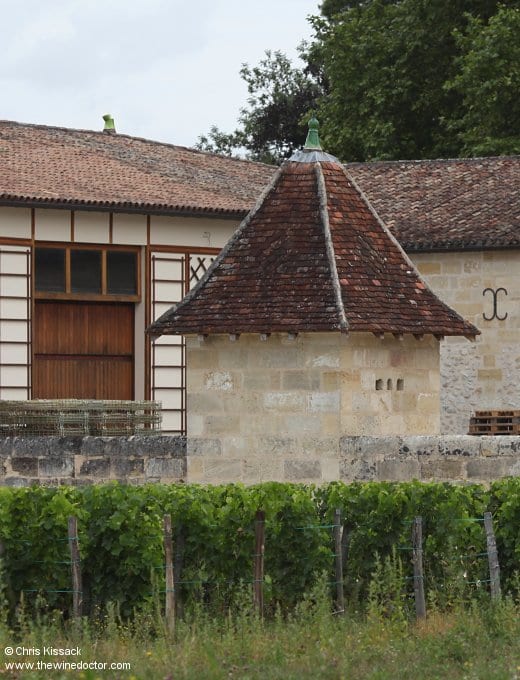
Clos de l'OratoireThe Clos de l'Oratoire vineyards amount to 10.3 hectares all told, and are located on the slopes to the northeast of St Emilion itself, the soils having an upper layer of sand that is typical as you move away from the limestone plateau on which the town rests. Deeper underfoot there is clay which is well suited to the Merlot which dominates the vineyard, accounting for 90% of the vines, with 5% each of Cabernet Franc and Cabernet Sauvignon making up the balance. Overall the vines have an average of 30 years. Quality is ameliorated and yields controlled with grass interplanting, the use of only organic fertiliser, bud pruning, leaf thinning and bunch thinning too, should conditions demand it. The fruit is harvested entirely by hand and then transported back to the chai at Chateau Peyreau in small plastic crates to avoid damaging the berries. The grapes are sorted and then destemmed before a second sorting and fermentation, which is undertaken in temperature-controlled wooden vats with a maceration of up to 28 days, all overseen by von Neipperg and of course Stephane Derenoncourt, who started out working with von Neipperg at Canon-la-Gaffelière, but is now widely recognised as one of Bordeaux's leading consultants. The fermenting wine is pumped over or the cap punched to submerge it, decisions obviously taken on a vat-by-vat basis. Once finished, the wines go into oak of which 80-100% is new with each vintage. Here it rests on its lees for between 18 and 20 months before bottling, the production amounting to about 4000 cases of the grand vin, Clos de l'Oratoire, per annum.

Although produced in the Derenoncourt style I have found the wines of Clos de l'Oratoire to have less elegance and appeal than those of Canon-la-Gaffelière, but perhaps this reflects terroir in the same way that the ranking of these two properties does. Putting this comparison aside, the wines certainly give pleasure and if discovered at a favourable price then placing an order can be worthwhile. I have enjoyed the 1995 although it is by no means a stellar wine, but it is very good indeed, bordering on excellent. More recent vintages tasted have been less convincing, but 1995 was undoubtedly superior to 2006 on the right bank. I suppose the same conclusion may be drawn from a comparison of the 1995 and 2004 vintages, although in the latter I found many right bank properties to perform well, and in that context I found the Clos de l'Oratoire a little disappointing, although still a good wine in its own right. (21/11/07)

Contact details:
Address: 33330 St Emilion
Telephone: +33 (0) 5 57 24 71 33
Fax +33 (0) 5 57 24 67 95
Internet: www.neipperg.com

Clos de l'Oratoire - Tasting Notes

Click to locate stockists.

2006

Clos de l'Oratoire (St Emilion) 2006: A very deep, plush fruit nose with some oak apparent. Pure black fruits, rather lifted, a touch green and leafy, slightly minty despite minimal Cabernet Franc this year. Slightly confected, but it is young. A middleweight palate, firm grippy tannic base, good acidity but like some other wines not a lot of flesh over it. A touch lean and stretched out. Not a great effort. From my 2006 Bordeaux assessment. 14.5-15.5/20 (April 2007)

2004

Clos de l'Oratoire (St Emilion) 2004: Another dark-fruited wine, with little meaty notes on top of blueberry and bramble fruit. Soft, fleshy, rounded and showing good substance, with a ripe, meaty character, but beneath this there is a ripe tannic grip, and there are some firm acids too. This has developed into an overtly showy wine, with plenty of meaty grip, and this has potential for providing some good drinking in the future. From a 2004 Bordeaux tasting at four years of age. 16+/20 (November 2008)

Clos de l'Oratoire (St Emilion) 2004: Nuts and oak in abundance here, lots of complex, spicy fruit, and a depth of character, But on the palate rather a middleweight, well defined, but with some flesh. A firm tannic base, very firm acidity, with an unremarkable finish. This has some good potential. From a tasting of 2004 Bordeaux. 16+/20 (April 2007)

1995

Clos de l'Oratoire (St Emilion) 1995: A good and rich colour, although with some tinges of oxblood maturity, and showing plenty of fruit on the nose after a short while in the decanter. It is only with 2-3 hours of aeration that this wine really begins to open up and show its true potential though. Simple fruit aromas give way to a remarkable panoply of beef, blood, tea leaves, cranberry and leafy autumnal undergrowth. This is glorious and so delicious. The palate shows good flesh, but underpinned by a dry and well formed structure, and overall there is plenty of rich, mouth-filling, appealingly bitter substance. A lovely savoury character on the finish too. A great wine that is very ready for drinking now. Open one if you have one! From a 1995 Bordeaux tasting. 18+/20 (March 2010)

Clos de l’Oratoire (St Emilion) 1995: A dark, opaque hue, showing a tiny bit of pink age at the rim. Wonderful nose; Dundee cake, with cashew nuts, dark chocolate, plums and black cherry, sweet tobacco, animal fur and liquorice. This is truly captivating. Lovely weight on the palate, creamy with a grippy layer beneath, then beneath that a smoky bitterness. Fine, savoury, black cherry fruit, with a medium body and well balanced acidity. A flourish of tannin at the finish. Lovely extract still shows. This is elegant yet quite substantial wine. Delicious. Approachable now, but really needs 2-3 more years, then should drink well for eight years. 17.5+/20 (December 2004)