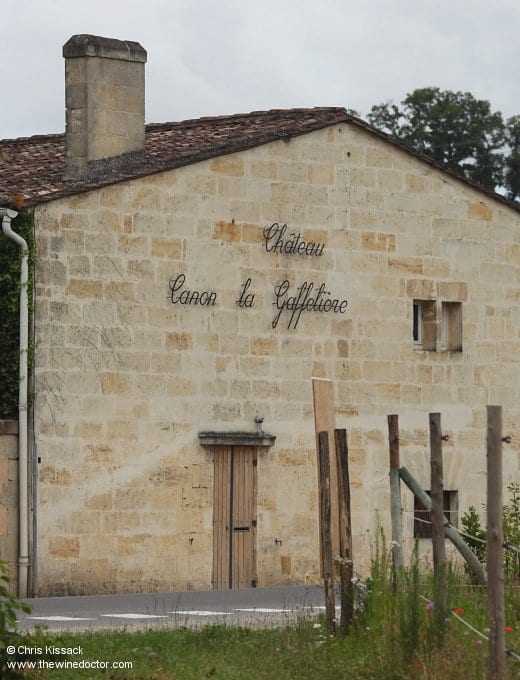
Home > Producer Profiles > Bordeaux Profiles > Chateau Canon-la-Gaffelière
Chateau Canon-la-Gaffelière
The majority of the leading St Emilion estates are located on the limestone plateau around the town, or on the slopes, known collectively as the Côtes, or alternatively on the Graves (not to be confused with the vineyards around Pessac and Léognan, alongside the Garonne), which leads on to the vineyards of Pomerol. The vineyards of Chateau Canon-la-Gaffelière lie on the Pieds de Côtes, on the celebrated limestone escarpment, although with a more sandy character towards the foot of the slope. Further south the plain stretches down to the Dordogne, here the soils are increasingly sandy, and there are few chateaux of note here, save for maybe Chateau Monbousquet.
The land around St Emilion is no stranger to viticulture, archaeological excavation at the nearby Chateau La Gaffelière having unearthed Roman mosaics depicting the planting of vines. The origin of the name Gaffelière is not, however, quite so ancient; it is a derivative of gaffet, which translates as leper. The land around Canon-la-Gaffelière was the location for a leper colony, which was still in existence in the 17th century, when a huge swathe of real estate, including the colony, was purchased by the Comte de Malets-Roqueforts. The new owners rented out much of what they owned on to share-croppers, a system whereby the tenants worked the land, which they paid for by handing over a proportion of the harvest to their landlords each year. With the passage of time this huge estate was divided up, with a portion owned by a gentleman named Boitard destined to become Chateau Canon-la-Gaffelière, whilst the descendants of Comte de Malets-Roqueforts held on to Chateau La Gaffelière itself.

The
current owner, Comte Stephan von Neipperg, doesn't come onto the scene until
the late 20th century. It is in fact his father who enters first; Joseph-Hubert,
Graf von Neipperg, a descendant of Franconian nobility. Joseph-Hubert was
the most recent generation in a long line of successful winemakers in his homeland,
Württemberg, which is now part of Baden-Württemberg, a southwest German
state. He bought Canon-la-Gaffelière in 1971, but it is his son, Stephan, that
has been credited with the transformation of this St Emilion estate after taking control in 1985. His influence is considerable, and his great success,
in more recent vintages working with oenologist Stéphane Derenoncourt, has
allowed him to expand his portfolio of properties, which now includes
Clos de
l'Oratoire, the celebrated 4.5 ha garagiste estate La Mondotte and
Chateau d'Aiguilhe in the Côtes de Castillon, among others. Andrew Jefford, in
The New France (2002), describes von Neipperg as one of the two most influential
of Bordeaux's present-day proprietors. High praise indeed, which I think
reflects von Neipperg's unending push for quality, based on not only good cellar
management but also attention to the finest detail in the vineyard.
As mentioned above, the vineyards of Canon-la-Gaffelière lie on the slopes of St Emilion's limestone plateau, with limestone, clay and sandy soils. It is a single block of vines, 19.5 hectares in size; von Neipperg would have included disparate plots in the blend of Canon-la-Gaffelière, but was informed by local authorities that his chateau faced demotion from its ranking as Grand Cru Classé if he did so. And so the disparate plot continued to fly solo, von Neipperg and Derenoncourt moulding the wines it produced into what we now know as La Mondotte. Keeping our focus on Canon-la-Gaffelière, however, it is in the vineyard the serious work starts. It is planted with a slight predominance of Merlot (55%), with 40% Cabernet Franc, this variety said to be a strong determining factor in the character of the final wine, and 5% Cabernet Sauvignon, all planted at a density of 5500 vines/ha, and with an average age of 45 years. Stephan von Neipperg sees himself very much as a grower of grapes first, winemaker second, and to this effect many practices in the vineyard approach biodynamic methods, certainly organic, as von Neipperg breathes life back into his soil. Only low-nitrogen fertiliser is used, all the vineyard processes are manual, and there is some use of homeopathic biodynamic preparations. Yields are severely restricted.
At harvest time the fruit passes over a sorting table before fermentation in
temperature-controlled wooden tanks, which replaced the pre-existing steel
ones from the 1997 vintage. There is pigeage of the cap and, notably, micro-oxygenation. The wine goes
into oak barrels for up to 19 months, of which up to 100% are replaced
each vintage, all under the watchful eyes of estate secretary Cécile Gardaix and
winemaker Paul Pétrou, guided by Stéphane Derenoncourt, obviously. There is restrained use of sulphur, and in barrel the wines rest
on their lees for much of the time. They may be racked just once, and interaction
with the solids is encouraged with regular bâtonnage, another notable although
not unique approach; there are one or two other high-flying, high-scoring St
Emilion properties that have also adopted this rather Burgundian practice. The
wines may see a very light fining and filtration. The grand vin that
results is Chateau Canon-la-Gaffelière (7500 cases per annum), and there
is a second wine, the rather enticingly named Côte Mignon La Gaffelière.
I have tasted a few vintages of the former, and found them on the whole to be
brilliant. Recent vintages are said to have shown vast improvements, and my experience with the 2004, 2005 and 2006 would seem to support this assertion.
Starting with the 2005, this wine is simply superb, unsurprisingly perhaps, as such a perfect vintage is bound to
suit von Neipperg's approach in the vineyard to a tee. But what of the other
vintages? The 1999 which I tasted in April 2006 was very unusual, and so far has
been the only mote in this estate's eye. It was so unusual, however, that I can
only imagine it was a problem with an individual bottle, of the wine simply
wasn't showing well on the day. I have reserved
judgement; I would love to hear from anyone with similar experience of this
vintage. The 2004 on first tasting I thought tended towards the modern St Emilion disease, over-extraction,
and again at that time I reserved judgement. I have reviewed it three times
since then, giving it similar high scores each time; this is lovely wine, and I
am sure the score will creep higher yet. The 2001 is similarly fine. And the
2006? It is a fine effort for the vintage. Overall, these are wines well worth
buying and drinking, and this is something I could say of many other properties
where Derenoncourt has a hand, as I have come to realise I rather admire the
style he works towards. (3/8/06, updated 4/10/07)
Contact details:
Address: 33330 St Emilion
Telephone: +33 (0) 5 57 24 71 33
Fax +33 (0) 5 57 24 67 95
Internet: www.canon-la-gaffeliere.com
Chateau Canon-la-Gaffelière - Tasting Notes
Chateau Canon-la-Gaffelière (St Emilion) 2009:
A very dark wine here, totally in
keeping for this estate. The palate is initially withdrawn, but opens
out into a style that has a slightly gamey, oak -tinged character. There is a lot
of good substance on the palate, with broad and dark fruits, underpinned
by lots of tannic grip. The fruit has a very lush, soft, rich style, but
also good acidity. No overtly expressed alcohol. Rather it is warm, huge, but
balanced. A very good wine and perhaps an example of how the style of the vintage can help those
estates where extraction is traditionally high. Or is the extraction itself
reined in? Very good. From my
2009 Bordeaux primeur
assessment. 17-18+/20 (March 2010)
![]()
Chateau Canon-la-Gaffelière (St Emilion) 2008:
Dense fruit on the nose here, roasted meat and baked blackberry fruit; this is
rich and intense, and rather less bright and lifted than many other wines tasted
here. On the palate, though, it has a smoothly polished texture. The ripe
tannins are well covered, so although it has a firm and a slightly chewy
extraction it all sits quite well together. Good but not forceful acidity. This
has great potential.
From my
2008 Bordeaux primeur
assessment. 17.5-18.5+/20 (April 2009)
![]()
Chateau Canon-la-Gaffelière (St Emilion) 2007:
Smoky black fruits on the nose here, with a slightly hot edge. Soft and a little
unfocused on the palate, fresh though, with lots of substance. Grippy, rich in
dark character, with a wealth of tannins. As usual it teeters on the edge of
ever-extraction, but I suspect it will come good with time. From a tasting of
2007 Bordeaux at
two years of age. 15.5+/20 (October 2009)
![]()
Chateau Canon-la-Gaffelière (St Emilion) 2007:
A sweet and creamy nose, showing attractive plum and spice aromas, at the outset
this sample has an appealing style. There is a textured, fleshy and yet firmly
composed palate, which maintains a stylish demeanour rather than anything more
flashy through the midpalate. Underneath there is a good grip, ripe tannins and
good acidity too. It captures the vintage nicely. From my
2007 Bordeaux
en primeur assessment. 15.5-16.5+/20 (April 2008)
![]()
Chateau Canon-la-Gaffelière (St Emilion) 2006:
Dark and almost minty fruit here, with a little touch of dark chocolate. It
shows more depth and substance than Canon, with a huge presence of soft, ripe
fruit. It has a little edge of jamminess, and underneath a huge amount of
tannin, but it is well covered by all that fruit and texture. It culminates in a
creamy finish. This has excellent potential. From a tasting of
2006 St Emilion &
Pomerol. 17.5+/20 (October 2008)
![]()
Chateau Canon-la-Gaffelière (St Emilion) 2006: An appealing nose, sweet, primary
black fruits, not a hint of greenness here! Nice flesh on the palate, well
poised, good acidic structure, full, a touch plump, quite vibrant, firm, with
good potential. Yes, this is very good indeed. From my
2006 Bordeaux
assessment. 16-17+/20 (April 2007)
![]()
Chateau Canon-la-Gaffelière (St Emilion) 2005: This has a very flashy, plummy nose.
Exuberant style. There is a core of ripe tannins on the palate, which are
prominent and firm, but they are well matched by a firm backbone of acidity
and a lovely, dense fruit profile. Textured. A big and impressive style, with an
awful lot going on here. A little on the edge but overall really excellent with
fine potential. From my tasting of
2005 Bordeaux at two
years of age. 18-18.5+/20 (October 2007)
![]()
Chateau Canon-la-Gaffelière (St Emilion) 2005: M 55%, CF 35%, CS 10%. Lots of
colour again here. Good fruit on the nose, with quite charismatic spicy Dundee
cake Merlot character. Very full and creamy on entry, impressive, yet quite fine
and balanced. The palate has a silky-supple presence, around a core of ripe,
polished tannin. This round and complete wine has undeniable style. Excellent; a
real and commendable success. From my
2005 Bordeaux en
primeur tasting. 17.5-18.5/20 (April 2006)
![]()
Chateau Canon-la-Gaffelière (St Emilion) 2004:
Here is an interesting wine, showing notes of high-toned fruit on the nose,
perhaps with a slightly jammy character, but certainly with some dense, meaty
undertones. A fat style on the palate, just a touch inky, with piles of dense,
ripe, meaty-beefy fruits. It has a very rich style with a soft, fleshy and
flattering texture, but there is nice if rather subdued acidity. There is plenty
of appeal for me; it is just on the edge for me in terms of ripeness and
extraction, but I don't think it has gone too far. Really very good indeed. From
a 2004 Bordeaux
tasting at four years of age. 17.5+/20 (November 2008)
![]()
Chateau Canon-la-Gaffelière (St Emilion) 2004: Expressive, exuberant, still showing some
oak, but alongside lots of fruit, full and spicy and a little complex too. Well
rounded, broad, nicely textured, with a good backbone of ripe tannin. Very firm
still, full and grippy finish. There is lots of potential here. And it is
showing much better than the disorganised effort I tasted this time last year. From a
tasting of 2004 Bordeaux.
17+/20 (April 2007)
![]()
Chateau Canon-la-Gaffelière (St Emilion) 2004: The first time I tasted
this vintage, in 2006, it didn't seem right at all. This is my second taste
since then and I am now sure that this is another great wine from Derenoncourt
and Neipperg. A deep colour, and still very primary on the nose, still a little
nutty. This has grip and structure, and a full, creamy texture on top, but it is
the gritty, grippy core that is most apparent at the moment. There are little
complex nuances of pickling spices too. Very good indeed, with great
potential. 17.5+/20 (February 2007)
![]()
Chateau Canon-la-Gaffelière (St Emilion) 2004:
Even deeper, even plusher in style. Dark plum fruit, with some nutty oak in
harmony, but with a lifted vibrancy, an almost perfumed character. Very
attractive. There is elegance on the palate, a reserved style, not
over-extracted, just a firm, youthful grip, but with appropriate fruit and
texture. Red fruits on the finish, and a good length. Very good. From my
2004 Bordeaux
assessment. 17.5+/20 (October 2006)
![]()
Chateau Canon-la-Gaffelière (St Emilion) 2004: A densely coloured wine. Quite
an unusual nose here; plummy, herbal, sweet, rather peppery. This is well
rounded, soft, with rather low acidity on the palate. There are some slightly
hard, charcoaly, peppery tannins. Seems a bit hot, unbalanced, and disjointed.
It seems rather over-ripe and perhaps over-extracted as well, and is the worse
for it. I don't like this. A real disappointment compared with the 2005. Is it
showing right today? Not scored. (April 2006)
![]()
Chateau Canon-la-Gaffelière (St Emilion) 2001: This has a lovely nose,
full of pure and expressive fruit. It is very rich and forward. The palate is
simply delicious, rich, concentrated and creamy. Underneath this voluptuous
texture there is a bright, grippy, tannic backbone, and some very decent
acidity. This wine has a great presence. Purity and definition, a Derenoncourt
hallmark? Superb wine. 17.5+/20 (February 2007)
![]()
Chateau Canon-la-Gaffelière (St Emilion) 1999: Quite a rich hue, with
a dense colour extending right out to the rim. Good, meaty, Dundee cake notes of
maturing Merlot on the nose. The palate is very strange though. It is lean,
nicely textured, but has a slightly fishy character to it. More cod than odd!
Surely this can not be typical? I can only hope, for those with this in their
cellar, that this was an off-bottle. Not scored. (April 2006)
![]()