Home > Producer Profiles > Bordeaux Profiles > Chateau Branaire-Ducru
Chateau Branaire-Ducru
The origin of the Branaire-Ducru vineyards may be traced back to the 17th Century, when they were once part of the estate at Chateau Beychevelle. The owner of Beychevelle, Bernard de Valette, the Duc d'Epernon, left behind a string of unpaid bills when he died in 1642. In order to meet the demands of his creditors, Beychevelle was sold off, leading to the parcellation of the estate. The chateau and some of the vineyards were regrouped by subsequent owners, but part of the estate, purchased by Jean-Baptiste Braneyre in 1680, was destined to become what we know today as Branaire-Ducru. Incidentally another part became what we known today as Ducru-Beaucaillou.
Braneyre's
descendants held tenure here for well over a century although his daughter,
Marie Braneyre, married Pierre de Luc, and it is the de Luc name that is
associated with the early history of this estate. Pierre and Marie had a son,
Laurent de Luc, born in 1730, who subsequently married Marie de Chillaud of
Fieux de Larenchère in 1779. They survived the Revolution, despite having been
arrested, and went on to have a total of four children, including two sons,
Louis and Justin Duluc, the persecution of the aristocracy having fostered a
discretionary contraction of the family name. Laurent died in 1814, followed by
Marie in 1818, but not before she had purchased a small house in Bourdieu, a
hamlet very close to Chateau Beychevelle. Subsequently, Louis and Justin
expanded and improved their inherited property, naming their chateau Braneyre (Branaire),
for their grandmother and her father, Jean-Baptiste.
The Duluc family remain at Branaire during the creation of the 1855 classification, when the property was ranked as a fourth growth. A year later, however, Louis Duluc died without a direct heir, and the property was managed by other family members, including his widow, brother, sister and nephews. By 1875 his descendant Gustave Ducru and his sister, Zélie Ravez, were in charge; Gustave purchased his sister's share, becoming sole owner, but when he died in 1879 the estate passed back to her again. In 1899 she bequeathed the estate to a clutch of nephews, the Marquis de Carbonnier de Marzac, Comte de Ravez and Comte du Périer de Larsan. These three live on today on the Branaire-Ducru label, each one represented by a crown, and yet the whole estate was subsequently sold off in 1919 to Jean-Michel Tapie. Tapie's tenure was not distinguished, the wines being a paler imitation of many other wines produced in the St Julien commune. This was still the situation in 1988, when Branaire-Ducru was purchased by Patrick Maroteaux.
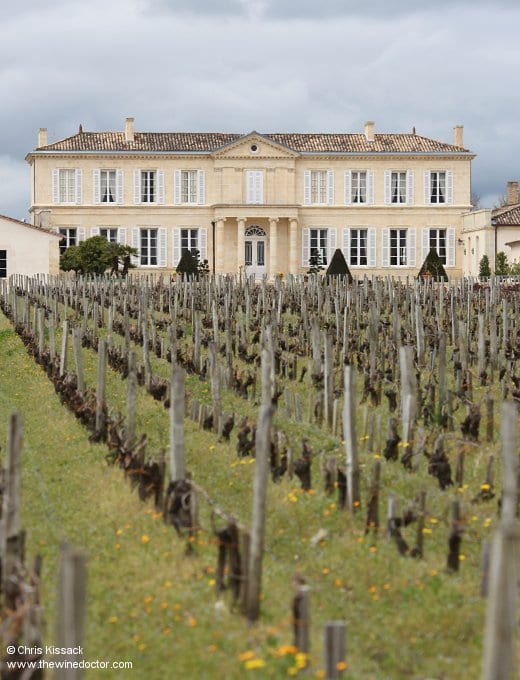
Chateau Branaire-Ducru is tucked away in the south-eastern most part of the St Julien appellation, close neighbours being Beychevelle, which lies between Branaire-Ducru and the Gironde, and Chateau St Pierre. The vineyards run west-east in several plots close to the chateau, over typical Médoc terroir of Quaternary alluvial gravels. There are 50 hectares in all, planted with 74% Cabernet Sauvignon, 22% Merlot and just 4% Petit Verdot, with an average age approaching 40 years, although there are many vines approaching a century. The harvest is manual, and fermentation takes place in a modern, well-equipped cellar, funded by the Maroteaux administration and now run by managing director Philippe Dhalluin. The must and embryonic wine is fed through the cellar by gravity rather than pump, to ferment in stainless steel, temperature-controlled, before up to two years in oak, 50% new each vintage. The wine undergoes an egg-white fining prior to being bottled unfiltered. The grand vin is Chateau Branaire-Ducru, 15000 cases, and there is a second wine, Chateau Duluc, named for the Duluc family, of which there are 7000 cases per annum.
My most illuminating Branaire-Ducru experience was the 1989 vintage, tasted in a horizontal St Julien line-up. I remember the tasting quite well. There was one wine that was streets ahead of all the others, and this was revealed as Léoville-Barton; with no Gruaud or Las-Cases in the fray, what remained included the likes of Beychevelle, St Pierre, Talbot and so on. So what was this other wine, a close match to the Leoville-Barton in terms of quality, structure, perfume and pleasure? The great joy of blind tasting is that it removes preconceptions; the label was revealed as Branaire-Ducru, to some surprise. Under the direction of Maroteaux, a marked improvement in the quality of the wines, from the previously underperforming Branaire-Ducru, was already apparent by the 1989. In recent years, this trend has continued, and they have become solid buys; the 2005 vintage, tasted in early 2006, is a fitting testament to the investment made by the new owners. (18/7/06)
Contact details:
Address: 33250 St Julien
Telephone: +33 (0) 5 56 59 25 86
Fax: +33 (0) 5 56 59 16 26
Internet: www.branaire.com
Chateau Branaire-Ducru - Tasting Notes
Chateau Branaire-Ducru (St Julien) 2007: This has some very sweet fruit on the nose, with a bright bramble and blackberry
character, painted with a little oak. On the palate it has a very cool style
which is stony, but ripe and clean. It is attractive, but shows leanness through
the midpalate and reveals a firm structure here. Quite nicely styled, with some
potential. From my
2007 Bordeaux
en primeur assessment. 15-16+/20 (April 2008)
![]()
Chateau Branaire-Ducru (St Julien) 2006: On the nose this has a chalky, stony,
mineral edged fruit style which I think I have noticed from Branaire in a
small handful of recent vintages now. Full, rather perfumed, nice ripe tannins,
and a chalky, stony edge rather like that on the nose. Decent texture and
weight. Branaire seems to be ranking among the better wines St Julien more and
more these days. Not a patch on the 2005 - but no surprises there. From my
2006 Bordeaux
assessment. 15.5-16.5/20 (April 2007)
![]()
Chateau Branaire-Ducru (St Julien) 2005:
The nose here shows attractive fruit aromatics, with plenty of very open cherry
and raspberry characteristics. When I tasted this en primeur I noted that it
needed to flesh out a little, and indeed the palate shows it has done just that.
It has a fairly dense structure with a full, creamy, rather seamless
composition. There is a firm core of tannin hidden beneath. This seems much less
paradoxical in its nature than when I last tasted it, but the likely outcome is
no different. This should be just fine. From my tasting of
2005 Bordeaux at two
years of age. 17+/20 (October 2007)
![]()
Chateau Branaire-Ducru (St Julien) 2005: This doesn't quite have the depth of
intensity of colour that many other wines of this vintage demonstrate, although
it is quite vibrant in the glass. Certainly it has plenty of appeal on the nose,
with an aromatic, peppery, nutty, violet-tinged raspberry and blackberry fruit
profile. This leads onto a palate that is elegant and balanced, infused with
minerals and full of character. Behind it there is a very firm tannic backbone -
which I missed on first tasting, the aromatics and fruit are so startling -
pervading through to the finish. Needs to put on a little weight en barrique.
Good length. This has an unusual character, paradoxically light and yet
powerful, but should be fine, and is certainly a top effort from proprietor
Patrick Maroteaux. From my
2005 Bordeaux en
primeur tasting. 17-18/20 (April 2006)
![]()
Chateau Branaire-Ducru (St Julien) 2004:
This has a highly perfumed, minerally nose, and on the palate it has a very nice
composition. Fine grained tannins, elegant, balanced with fine fruit and rather
crisp. light-footed acidity. There is freshness in abundance. This has a
distinctive style which can also be found in the more impressive 2005 vintage
and is distinctively Branaire-Ducru. Very good potential here. From my 2004 Bordeaux
assessment. 17+/20 (October 2006)
![]()
Chateau Branaire-Ducru (St Julien) 2004: A vibrant, dark hue to this wine,
which shows some sweet, slightly herbal. berry fruit on the nose, with elements
of tar, violets and blackberry leaf. Rather lean, reserved style on the palate,
with firm tannins beneath. And firm acidity too. This presents a very classic
style, with a rather subtle texture. This needs years but it will be good.
16.5+/20 (April 2006)
![]()
Chateau Branaire-Ducru 2003: Not very expressive, but with sweet,
blackcurranty fruit on the nose. Attractive palate. Restrained, elegant, with
appealing texture. The acidity is a little low, and there is quite a show of
tannins. Again this should show some improvement in the cellar. From my Bordeaux 2005
en primeur tasting. 15.5+/20 (October 2005)
![]()
Chateau Branaire-Ducru (St Julien) 1999: This wine is showing early maturity,
with meaty, macerated fruit on the nose, although it is presented in a very
fresh, classic, lifted style. Again, like the 2004, this has a lean palate; the
tannin is more integrated here, although it still needs to soften up before this
reaches approachability. Classically moulded, appealing style, but needs 4-5
years in the cellar yet. The 2004 has the edge, I think. 16+/20 (April 2006)
![]()
Chateau Branaire-Ducru (St Julien) 1989: A firm nose here, with
great fruit, but also classic aromas of cedar and pencil
lead. This leads to an equally impressive palate, which
again has great balance and structure. A lovely,
unobtrusive tannic backbone supports some powerful fruit,
with harmonious balanced acidity. This is superb stuff. From a
Bordeaux 1989 tasting.
18.5/20 (January 2002)
![]()
Chateau Branaire-Ducru (St Julien) 1982: A good depth of colour. Powerful nose
of mature fruit. A full, sweet, powerful palate, still with some spicy tannins.
It has balance too. Firmly put together but rounded and approachable. Clean
finish. From a Bordeaux 1982
tasting. 17/20 (May 2004)
![]()
Chateau Branaire-Ducru (St Julien) 1982:
There is more age apparent here, this wine bearing a tawny rim. Still
plenty of life in it yet, though. A floral,
elegant nose, with a hint of toffee. Delightful texture on the palate,
which is packed with fruit and has a nicely integrated tannic
structure. Wonderfully balanced acidity. This is a superb wine,
although the components need more time to come together in a more
harmonious fashion. It is a wine still on the way up. From a
1982 Vintage Twenty
Years On tasting. 18/20 (April 2002)
![]()
![]()
Home - Site index - Site updated October 12, 2008 - © The Winedoctor 2000 - 2008 - Wine Scores - RSS