Home > Producer Profiles > Bordeaux Profiles > Chateau Beau-Séjour Bécot

Chateau Beau-Séjour Bécot

The estate today known as Beau-Séjour Bécot was once part of a much grander (and larger) Beauséjour estate, long since divided, which had a history that spanned many centuries. Its origins lay in the Middle Ages, when the land was in the ownership of the monks of the St Martin Abbey, monks who also tended vines at what would one day become Chateau Canon. During the 17th Century, however, the ascetics relinquished control of their vineyards, and one particular lieu-dit named Peycoucou, a name rather romantically thought to be derived from the singing of the cuckoos (coucou) on the hill (puy), was acquired by the aristocratic Gerès family. These were seigneurs from Camarsac who settled in St Emilion, naturally marrying within their class, as Jeanne de Gerès was wedded to François de Carle de Figeac, a local nobleman. The estate thus came to the de Carles family of Figeac and it was their son, General Jacques de Carle, who renamed the property Beauséjour in 1787.

Jacques de Carles died in 1803, passing the estate to his cousin André de Carle-Trajet who sold it on after two decades to a local pharmacist, who in turn passed on the 14 hectare estate to Pierre-Paulin Ducarpe, and it is he that took the carving knife to Beauséjour in 1869. Dividing it between his two children, the chateau and associated buildings, with half the vineyard, was gifted to his daughter who, through marriage, had taken the name Duffau-Lagarosse, thus creating Beauséjour-Duffau-Lagarosse. His son took the remaining half, and it is this vineyard that piques our interest here; this was the nascent Beau-Séjour Bécot. The property again changed hands in 1924, this time coming to Dr Jean Fagouet, who was responsible for an expansion of the vineyard to 10.5 hectares. It remained with this family until 1969, when it was acquired by Michel Bécot, who thus appended his name to that of the chateau. The Bécot family still own the domaine today, Michel having subsequently relinquished control to his two sons, Gerard and Dominique, and today they are ably assisted by Juliette Bécot, the third generation to help run the estate.

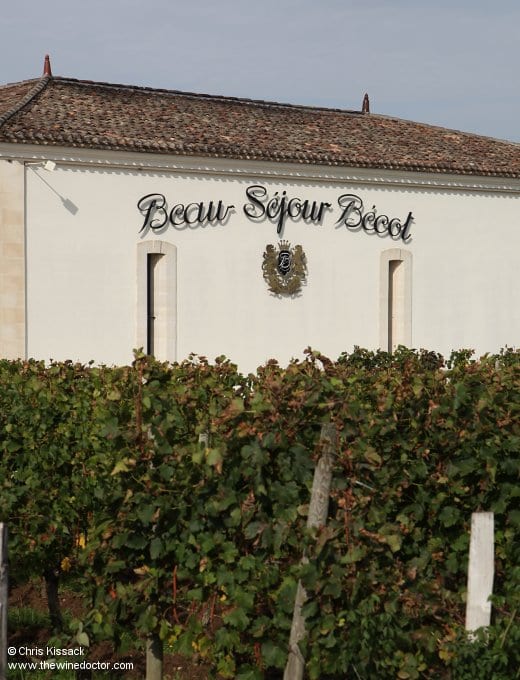
Beau-Sejour BecotThe Beau-Séjour Bécot vineyards lie to the west of St Emilion, on the edge of the St Martin de Mazerat plateau. Here the rock underfoot is limestone and chalk peppered with fossilised starfish as is typical of the slopes of the commune. The vines themselves dig their roots into this, supported by a meagre topsoil, a thin coating of organic matter, mixed with clay and limestone. All told there are 16.5 hectares, the vines predominantly Merlot which covers 70% of the vineyard, with 24% Cabernet Franc and 6% Cabernet Sauvignon, and the vines have an average age in excess of 35 years. The planting density is 6200 vines/ha, and the rows are interplanted with grass to increase competition at superficial levels. Vineyard practices at Beau-Séjour Bécot are intensive, with leaf-thinning twice a year, and a green harvest in the summer months to help control yields. There is aggressive sorting and selection of the fruit, at the time of picking and in the chai. Once there the fruit is fermented in 80 hectolitre temperature-controlled stainless-steel vats which were installed in 1971. The wine is subsequently bled off into oak barrels, with between 80% and 100% new oak in each vintage, where it rests for a period of 16 to 18 months. Before bottling it is neither fined nor filtered. The grand vin is Beau-Séjour Bécot, and there is a second wine Tournelle de Beau-Séjour Bécot, and total production amounts to 5000 cases.

The increase from 10.5 hectares under Fagouet to the 16.5 hectares that comprise Beau-Séjour Bécot today was largely achieved by the incorporation of two other vineyards into the whole; La Carte, which had been owned by the Bécot family since 1929, and Trois Moulins. Unfortunately for the Bécots, however, these additions did not meet with the approval of the INAO committee in charge of the 1985 revision of the St Emilion classification. These vineyards brought an incompatible terroir to the mix, it seemed, and Beau-Séjour Bécot was demoted from its status as Premier Grand Cru Classé, the top ranking alongside illustrious names such as Angélus and Figeac, to mere Grand Cru Classé. Beauséjour-Duffau-Lagarosse, meanwhile, carried on in its exalted and superior status. It was not until the next revision in 1996, by which time Michel Bécot had long retired, did the wines have a chance to show they were worthy of reinstatement, and that is indeed the reward the Bécots received; since then, Beau-Séjour Bécot has remained a Premier Grand Cru Classé. Nevertheless the family do not seem to have stopped acquiring new vineyards, although perhaps unsurprisingly it seems they no longer attempt to incorporate them into Beau-Séjour Bécot. Perhaps the most significant addition to the Bécot portfolio is La Gomerie, a tiny estate planted exclusively with Merlot which neighbours Beau-Séjour Bécot. This they manage quite separately, very much in the garagiste mould. They have also invested in Castillon with the purchase of Chateau Joanin, now renamed Joanin-Bécot, in a project spearheaded by Juliette.

With limited experience of the wines I won't make a drawn-out statement on their quality, but in a good vintage such as 1998 the Beau-Séjour Bécot stood up well against its peers. In 2003 the wine was also good, in a vintage when I found many other wines to be over-extracted, overly tannic and to have in some cases a vice-like grip. I have included these notes below, as well as my solitary experience of the Côtes de Castillon, Chateau Joanin-Becot, which I tasted on a trip to Bordeaux in 2006. (3/10/07)

Contact details:
Address: 33330 St Emilion
Telephone: +33 (0) 5 57 74 46 87
Fax +33 (0) 5 57 24 66 88
Internet: www.beausejour-becot.com

Chateau Beau-Séjour Bécot - Tasting Notes

Click to locate stockists:

2005

Chateau Joanin-Bécot (Côtes de Castillon) 2005: Tasted with dinner at Chateau Thieuley. This has an obvious presence of sweet, ripe fruit on the nose, with a slightly hot feel to it, smoky and also a touch jammy I think. On the palate it seems simply huge; there is a wealth of rich fruit, with firm and ripe tannins which is all a little in-your-face. But there is good style here too; it has acidity which gives it an attractive lift, and it is all firmly cemented together. This is no loose and blowsy wine. This will appeal to many. 16+/20 (December 2006)

2003

Chateau Beau-Séjour Bécot (St Emilion) 2003: Exotic nose of sweet black plums with a little chocolate. Full, ripe, quite creamy. Well balanced and supple, with a firm but not obvious backbone of grippy tannins. Roast nut, plum and black berry fruit finish. Ripe, well structured wine. Very good. From my Bordeaux 2003 assessment. 16+/20 (October 2005)

1998

Chateau Beau-Séjour Bécot (St Emilion) 1998: Juliette Bécot talked us through the wine. The vineyards are planted with Merlot 70%, Cabernet Franc 24%, Cabernet Sauvignon 6%. There were some roasted grapes due to inappropriate leaf-thinning in July. Macerated for thirty days, malolactic in barrel. A very dark, opaque wine. The nose has elegant, very pure, fresh fruit. The palate is rich, velvety and very textured. Beneath this lies structure and acidity. The fruit on the palate shows a slightly bitter, confected edge, although I doubt this will persist. There is good potential here, but it needs five years at least in the cellar. From a tasting of 1998 St Emilion. 17+/20 (May 2004)

Home - Site index - Site updated September 07, 2008 - © The Winedoctor 2000 - 2008 - Wine Scores - RSS